
2000 (P) Sacagawea Dollar on Susan B. Anthony Planchet - WPL 001
Error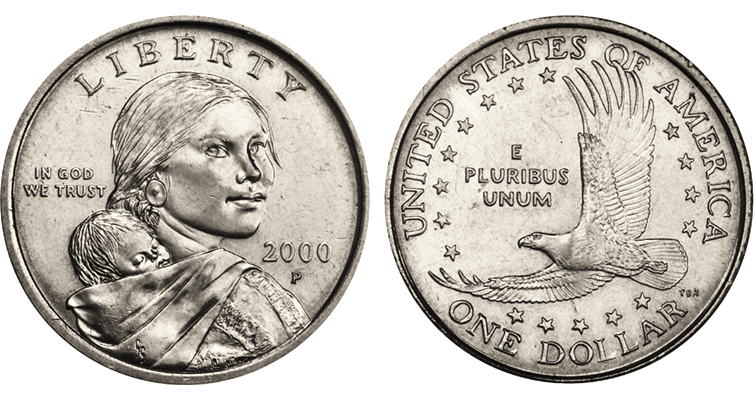
Community Voting
This listing needs 10.0 weighted votes to advance to community review.
Description
The 2000-P Sacagawea Dollar struck on a Susan B. Anthony dollar planchet is an extraordinary transitional wrong planchet error that sits at the intersection of two dollar coin programs. This coin was produced when a leftover copper-nickel clad Susan B. Anthony planchet — the same composition used for SBA dollars from 1979 through 1999 — was fed into a press striking the new Sacagawea dollar design that debuted in 2000. The resulting coin carries Glenna Goodacre's Sacagawea portrait on the obverse and Thomas D. Rogers Sr.'s soaring eagle reverse, but struck on the silver-colored clad planchet of the previous dollar coin rather than the distinctive manganese brass "golden dollar" planchet. This error occupies a unique category in numismatic terminology: a transitional error. Unlike a standard wrong planchet error where planchets from two simultaneously produced denominations become mixed, a transitional error occurs when planchets from a discontinued coin type remain in the Mint's supply and are struck with the dies of its replacement. The Susan B. Anthony dollar was last produced in 1999 (after a gap from 1981 to 1998), and the Sacagawea dollar began production in early 2000. During the changeover, leftover SBA planchets present in the Philadelphia Mint's supply system had the opportunity to enter Sacagawea presses. The Mint was actively clearing SBA inventory while ramping up Sacagawea production, creating a window where both planchet types coexisted in the facility. The physical characteristics make this error immediately identifiable. The standard Sacagawea dollar was struck on a manganese brass planchet with a distinctive golden color, a plain edge, and a weight of 8.1 grams. The Susan B. Anthony planchet is a copper-nickel clad composition with a silver-white appearance, a reeded edge, and a weight of 8.1 grams. While the weight is identical and the diameter is the same (26.5mm for both), the visual difference is stark — this coin looks like a silver-colored Sacagawea dollar rather than a golden one. The edge treatment also differs: a genuine Sacagawea dollar has a smooth, plain edge, while this error retains the reeded edge of the SBA planchet, providing a secondary authentication point that cannot be replicated through post-mint alteration. The reeded edge is particularly significant because edge reeding is applied to the planchet during the upsetting process before striking, making it a feature of the planchet itself rather than the dies. The year 2000 transition from the SBA to the Sacagawea dollar was one of the most significant denomination changeovers in modern U.S. Mint history. The SBA dollar, introduced in 1979, had been widely criticized for its similarity in size and color to the quarter, leading to public confusion and resistance to the coin. Production was suspended after 1981, resumed briefly in 1999 to address a coin shortage, and then permanently replaced by the Sacagawea design. The Sacagawea dollar was designed specifically to address the SBA's shortcomings with its golden color and smooth edge, making it easily distinguishable from all other circulating denominations. The irony of this error is that it recreates exactly the problem the Sacagawea design was created to solve — a dollar coin that looks like it could be confused with a different denomination. Transitional errors from the SBA-to-Sacagawea changeover are among the most famous modern U.S. error coins. The first examples were discovered in circulation in early 2000 and generated significant media coverage, which in turn prompted collectors to search through rolls of new Sacagawea dollars looking for silver-colored examples. Several varieties exist within this transitional type, including coins struck on planchets with varying degrees of edge reeding and coins showing different levels of die pressure, suggesting they were produced across multiple press setups during the transition period. Some examples show particularly sharp detail, indicating they were among the first strikes from fresh dies on the wrong planchet. Authentication of this error type requires careful examination of three features: composition (the silver-white clad color versus golden manganese brass), edge treatment (reeded versus plain), and weight consistency with the SBA planchet specifications. The identical diameter of both dollar types means the full design is present on the coin — unlike wrong planchet errors between different denominations where the design is truncated — which makes the composition and edge differences the primary diagnostic features. Collectors should be aware that some altered coins exist where standard Sacagawea dollars have been chemically stripped of their golden color to simulate this error; the reeded edge is the definitive diagnostic that separates genuine transitional errors from alterations. For error coin collectors, the 2000-P Sacagawea on SBA planchet represents one of the most historically significant transitional errors of the modern era. It documents a specific moment in U.S. Mint operations when two programs overlapped, and the physical evidence of that overlap survived quality control to reach collectors. Examples in higher grades command significant premiums due to the combination of historical importance, visual distinctiveness, and relative scarcity. The coin tells the story of an industrial transition — the end of one dollar program and the beginning of another — preserved in metal. This variety is cataloged as WPL 001 in the NumisDex wrong planchet registry.
Community & Reference
Related Errors
More Wrong Planchet Errors
Collector Essentials
Tools for examining and preserving error coins and die varieties.
10x-20x Jeweler's Loupe
Essential for examining die varieties, doubled dies, and RPMs
Cherry Picker's Guide
The definitive reference for U.S. error coins and die varieties
2x2 Coin Flips & Holders
Protect and organize your finds with archival-quality holders
USB Digital Microscope
Capture detailed images for documentation and community submissions
As an Amazon Associate, NumisDex earns from qualifying purchases.