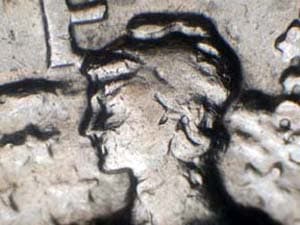
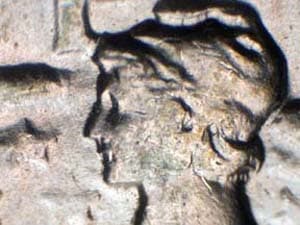
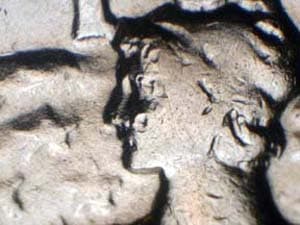
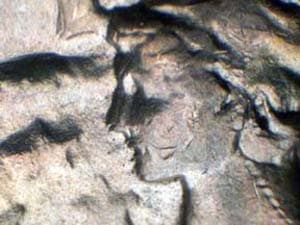
Doubled Working Hub Obverse (WHO)
A Doubled Working Hub Obverse is a hub-level doubling error that occurs one step earlier in the die production chain than a standard Doubled Die Obverse. Instead of a single working die receiving a doubled impression, the working hub itself was doubled during its creation from the master die. Because every working die made from that hub inherits the doubling, WHO varieties appear on coins struck by multiple different die pairs — a key diagnostic that separates them from ordinary doubled dies.
What Is a Doubled Working Hub?
In the U.S. Mint's die production hierarchy, a master hub creates a master die, the master die creates working hubs, and working hubs create the working dies that strike coins. A Doubled Working Hub Obverse occurs when a working hub receives two slightly misaligned impressions from the master die. That working hub — now carrying doubled design elements — transfers the doubling to every working die it produces.
The critical distinction is scope. A Doubled Die Obverse affects only the coins struck by one specific working die. A WHO variety affects all coins struck by every die made from the affected working hub. This means WHO varieties are distributed across multiple die pairs, and the same doubling pattern appears on coins with different reverse die characteristics.
How Does It Happen?
The working hub is created by pressing the master die into a steel blank under tremendous hydraulic pressure. Prior to the Mint's adoption of single-squeeze hubbing technology in 1996-97, this process required multiple impressions to fully transfer the design. If the master die or working hub blank shifted between impressions, the design was imparted in two slightly different positions.
Because the misalignment occurs at the hub level rather than the die level, the resulting doubling tends to be more uniform and spread across the design than a typical DDO. The doubling is present in the hub itself, so it transfers consistently to every working die — there is no variation between dies as there would be with individual die-level doubling events.
The Mint's transition to single-squeeze hubbing reduced the frequency of all hub-doubling varieties, but it did not eliminate them entirely. Modern WHO varieties still occur when the hub or blank shifts under pressure during the single-impression process.
How to Identify a Doubled Working Hub Obverse
WHO varieties share visual characteristics with DDOs but have distinct diagnostic features:
- Spread or shelf-like doubling: WHO doubling typically presents as a spread or shelf-like displacement rather than the dramatic separation seen in strong Class I DDOs. The doubling is real and consistent, but the offset between the two impressions tends to be smaller.
- Uniform distribution: The doubling affects design elements across the entire obverse in a consistent manner. Every letter, digit, and design feature shows the same direction and degree of displacement.
- Multiple die pairs: The definitive diagnostic for a WHO is finding the identical doubling pattern on coins from different die pairs. If two coins show the same obverse doubling but have different reverse dies, the doubling originated at the hub level rather than the die level.
- Less dramatic than strong DDOs: While some WHO varieties show clearly visible doubling, they are generally more subtle than the most famous DDOs like the 1955 or 1969-S Lincoln cents. The doubling is consistent and real, but collectors should use 5x-10x magnification for examination.
Distinguishing WHO from DDO
| Feature | Doubled Working Hub (WHO) | Doubled Die (DDO) |
|---|---|---|
| Origin | Working hub creation | Working die creation |
| Dies affected | All dies from that hub | One specific die only |
| Die pair test | Same doubling across different die pairs | Unique to one die pair |
| Typical strength | Moderate, spread-like | Ranges from subtle to extreme |
| Relative scarcity per die | More coins exist overall | Fewer total coins |
Distinguishing WHO from Machine Doubling
Machine doubling (strike doubling) produces flat, shelf-like displacement during the striking process. Unlike WHO varieties, machine doubling shows no consistent directionality across all design elements, the displaced image lacks full serifs on letters, and the effect varies from coin to coin because it is a striking phenomenon rather than a die or hub characteristic.
Notable Examples
1972 Lincoln Cent WHO Varieties
Several 1972 Lincoln cent die pairs share a common obverse doubling pattern that originated at the working hub level. These are distinct from the famous 1972 DDO (FS-101), which shows much stronger doubling from a single die. The WHO varieties display a subtle but consistent spread on LIBERTY and IN GOD WE TRUST across multiple die pairs.
1999 Lincoln Cent WHO
The 1999 Lincoln cent produced several WHO varieties that show consistent doubling on the date and LIBERTY. These were among the first WHO varieties widely recognized after the Mint's transition to single-squeeze hubbing, demonstrating that the new technology did not fully prevent hub-level doubling.
Washington Quarter WHO Varieties
Multiple dates in the Washington quarter series from the 1970s through 1990s show WHO characteristics. The doubling on these coins is visible on IN GOD WE TRUST and the date, and the same pattern appears across multiple die pairs for each affected year.
Jefferson Nickel WHO Varieties
Several Jefferson nickel dates display WHO doubling, particularly visible on MONTICELLO lettering and the building's architectural details. These varieties are documented by CONECA and provide affordable examples of hub-level doubling for collectors.
Collecting Tips
- Affordability: WHO varieties are generally more affordable than strong DDOs of the same denomination and date. This makes them excellent additions to a doubled die type set without requiring a large budget.
- Authentication: Because WHO doubling is typically more subtle than major DDOs, accurate attribution is important. Purchase coins certified by PCGS or NGC with the WHO designation, or study the diagnostics published by CONECA and other attribution services.
- Multiple die pairs add interest: Building a set showing the same WHO doubling from different die pairs demonstrates the hub-level origin of the variety and makes for a compelling educational display.
- Die state still matters: Even though the doubling originates at the hub, individual die wear affects how clearly the doubling presents on struck coins. Early die state examples with sharp detail are preferred.
- Check for DDOs too: A coin showing WHO doubling could also have additional die-level doubling (DDO) from its specific working die. Coins exhibiting both hub-level and die-level doubling are particularly noteworthy.
- Market recognition is growing: WHO varieties have gained increased collector recognition in recent years as attribution services have refined the distinction between hub-level and die-level doubling. Early acquisitions of well-attributed WHO varieties offer solid collecting value.
Related Error Types
- Doubled Die Obverse (DDO) -- Doubling at the working die level, affecting only one specific die
- Doubled Working Hub Reverse (WHR) -- The same hub-level doubling phenomenon on the reverse
- Master Die Doubling Obverse (MDO) -- Doubling one step earlier, at the master die, affecting all working hubs and dies
- Doubled Die Reverse (DDR) -- Die-level doubling on the reverse
- Repunched Mint Mark (RPM) -- A related doubling concept specific to the mint mark punch