Master Die Doubling Obverse (MDO)
A Master Die Doubling Obverse is the most pervasive form of doubled die variety in the U.S. Mint's production hierarchy. It occurs at the very first transfer stage — when the master hub impresses the master die — and propagates through the entire downstream chain: every working hub, every working die, and every coin struck for that design year and mint facility carries the same doubling.
What Is Master Die Doubling?
The die-making process begins with a single master hub — the original positive-image tool bearing the approved coin design. The master hub creates the master die (a negative image), which in turn creates all working hubs, which create all working dies used to strike coins. A Master Die Doubling Obverse occurs when the master die receives two misaligned impressions from the master hub. Because the master die sits at the top of the production tree, its doubling is inherited by every downstream component.
This means MDO is the most widespread doubling variety by coin count. Every coin of that design — regardless of which working hub or working die struck it — shows the same subtle doubling. It is also, paradoxically, the least dramatic form of doubled die. The master hub-to-master die transfer is performed with the highest precision the Mint can achieve, so any misalignment tends to be extremely small.
How Does It Happen?
The master die is created by pressing the master hub into a specially prepared die blank under controlled hydraulic pressure. Before the Mint's transition to single-squeeze hubbing in 1996-97, this required multiple impressions. Even a microscopic shift between impressions transferred the design in two slightly offset positions.
Several factors make MDO doubling characteristically subtle:
- Precision equipment: The master hub-to-master die transfer uses the Mint's most carefully calibrated presses and alignment fixtures, since any error at this stage affects the entire production run.
- Soft die blanks: Master die blanks are annealed to a softer state than working die blanks, allowing the design to transfer more completely with less pressure and fewer impressions.
- Quality control: The Mint inspects master dies more rigorously than working dies, because a flawed master die has cascading consequences. Master dies with obvious doubling are rejected.
The result is that MDO doubling consists of very small offsets — often just a few thousandths of an inch — that pass inspection but remain detectable under magnification. The Mint's single-squeeze technology further reduced MDO occurrences, but the variety still appears when alignment shifts occur during the single high-pressure impression.
How to Identify a Master Die Doubling Obverse
MDO identification requires careful technique and a specific diagnostic approach:
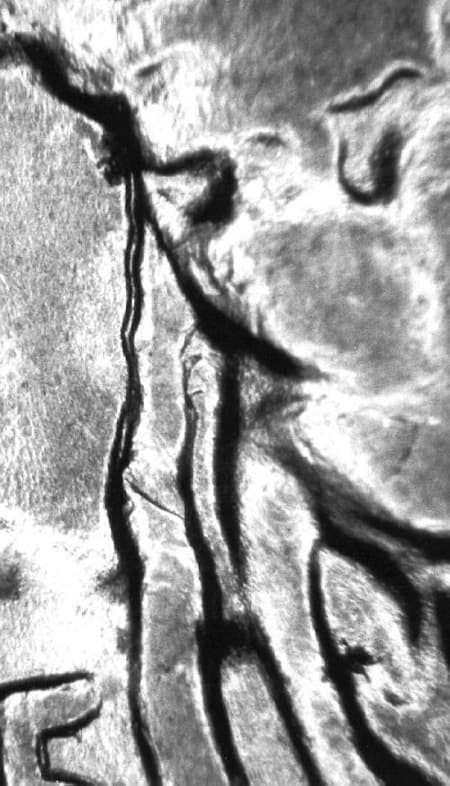
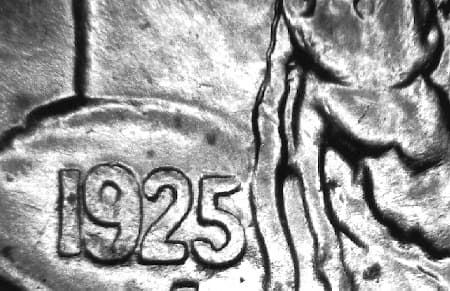
- Subtle, uniform spread: MDO doubling presents as a very slight spread or thickening of design elements. Letters appear fractionally wider, serifs show minor splitting, and fine details have a "fuzzy" quality that differs from die wear. The effect is uniform across the entire obverse.
- Consistent across all die pairs: This is the definitive diagnostic. If the same doubling appears on coins from different die pairs — including coins from different working hubs — the doubling originated at the master die. Coins from different mint facilities sharing the same master die will also show identical doubling.
- Low magnification detection: Most MDO varieties require at least 10x magnification to detect. Some are only apparent at 20x or higher. The use of strong, angled lighting helps reveal the slight displacement.
- Not die deterioration: MDO doubling is consistent and directional. Die deterioration doubling (DDD) is random and worsens with die wear. An MDO variety shows the same doubling on early die state and late die state coins; DDD worsens over the die's service life.
The Die Production Hierarchy and Doubling Diagnosis
Understanding where doubling originates requires examining coins from multiple die pairs:
| Doubling Origin | Diagnostic Test |
|---|---|
| MDO (Master Die) | Same doubling on coins from different working hubs and different die pairs |
| WHO (Working Hub) | Same doubling on coins from different die pairs but same working hub |
| DDO (Working Die) | Doubling unique to coins from one specific die pair only |
This hierarchy means that confirming an MDO requires the broadest sampling — coins from at least two different working hubs (identifiable by minor hub-specific characteristics) must show identical doubling.
Distinguishing MDO from Die Deterioration
Die deterioration is the most common source of false MDO attributions:
| Feature | Master Die Doubling (MDO) | Die Deterioration Doubling (DDD) |
|---|---|---|
| Direction | Consistent across all elements | Random, no consistent direction |
| Progression | Identical on early and late die state | Worsens as die wears |
| Scope | All dies from the master die | One specific working die |
| Character | Crisp offset, however small | Fuzzy, mushy spreading |
Notable Examples
1909 V.D.B. Lincoln Cent MDO
The inaugural year of the Lincoln cent design shows master die doubling that is consistent across all die pairs. The doubling is visible on IN GOD WE TRUST and LIBERTY under magnification. Because every 1909 V.D.B. cent was struck from dies derived from the same master die, the doubling is universal to the issue, which made it challenging to identify as a variety rather than a normal design characteristic.
1943 Steel Lincoln Cent MDO
The wartime steel cent issue shows detectable master die doubling on the date digits. The steel planchet's hard surface preserved strike detail sharply, making the subtle MDO doubling more visible than on softer copper or zinc planchets. Examining multiple die pairs confirms the consistent doubling pattern.
Early Jefferson Nickel MDO Varieties
Several early dates in the Jefferson nickel series (1938-1942) display MDO characteristics on the obverse portrait and IN GOD WE TRUST. These are attributed based on the identical doubling appearing across all known die pairs for those dates.
Washington Quarter MDO Varieties
Certain Washington quarter dates from the 1960s and 1970s exhibit MDO doubling on the date and LIBERTY. The high-volume production of quarters from this era provides abundant die-pair diversity for confirming the master die origin of the doubling.
Collecting Tips
- Specialist territory: MDO varieties appeal primarily to advanced variety collectors who appreciate the technical significance of master die-level errors. Casual collectors rarely notice the subtle doubling, which keeps prices accessible.
- Documentation is everything: Because MDO doubling is subtle, the strength of an MDO attribution depends on die-pair documentation. Collectors who can demonstrate the same doubling across multiple die pairs from different working hubs provide the most convincing evidence.
- Magnification investment: A quality stereo microscope at 10x-30x is far more effective than a loupe for detecting MDO doubling. The binocular view and stable platform allow systematic comparison of design elements.
- Pair with WHO and DDO examples: Building a set that includes MDO, WHO, and DDO varieties for the same denomination illustrates the complete die production hierarchy and the different levels at which doubling occurs. This makes for a compelling educational collection.
- Affordable entry point: MDO varieties are among the most affordable doubled die varieties because their subtlety limits demand. Certified examples with the MDO attribution from PCGS or NGC provide confidence in the attribution.
- Research contribution: The study of MDO varieties is an active area of numismatic research. Collectors who systematically examine coins from multiple die pairs and document their findings contribute directly to the attribution of new MDO varieties.
Related Error Types
- Master Die Doubling Reverse (MDR) -- The same master die-level doubling on the reverse
- Doubled Working Hub Obverse (WHO) -- Doubling one step later, at the working hub, affecting all dies from that hub
- Doubled Die Obverse (DDO) -- Doubling at the working die level, affecting only one specific die
- Doubled Working Hub Reverse (WHR) -- Hub-level doubling on the reverse
- Doubled Die Reverse (DDR) -- Die-level doubling on the reverse