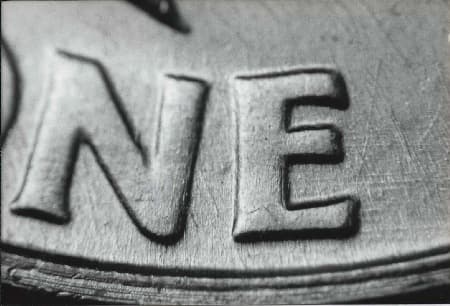
Doubled Working Hub Reverse (WHR)
A Doubled Working Hub Reverse occurs when the working hub for a coin's reverse design receives two misaligned impressions from the master die during the hub creation process. Like its obverse counterpart (WHO), a WHR variety affects every working die produced from the doubled hub, resulting in consistent reverse doubling across multiple die pairs.
What Is a Doubled Working Hub Reverse?
The U.S. Mint's die production process follows a strict hierarchy: master hub to master die to working hub to working die. A WHR variety is created when the reverse working hub — the positive-image tool used to produce working dies — is impressed by the master die in two slightly offset positions. Every working die made from that hub carries the same doubling, and every coin struck by those dies displays it on the reverse.
This hub-level origin is the defining characteristic that separates a WHR from a standard Doubled Die Reverse (DDR). A DDR exists on one working die and produces a limited number of doubled coins. A WHR exists on the working hub and propagates through all dies derived from it, resulting in a larger total population of doubled coins spread across multiple die pairs.
How Does It Happen?
Creating a working hub requires pressing the master die into a hub blank under extreme pressure. Before the Mint adopted single-squeeze hubbing in 1996-97, multiple impressions were standard practice. Each re-entry of the master die into the hub blank created an opportunity for the two components to shift relative to each other. Even a fractional movement produced doubling that was then permanently embedded in the working hub.
The physics of the process favor certain types of displacement. Rotational shifts produce spread doubling that radiates from the center of the design. Lateral shifts produce consistent offset doubling across all elements. Tilting produces doubling that is stronger on one side of the hub than the other. These same directional patterns are inherited by every working die and appear on every struck coin.
After the transition to single-squeeze hubbing, WHR varieties became less common but continued to occur. The single-impression process still involves extraordinary pressure and precise alignment, and any movement during the squeeze produces the same type of hub-level doubling.
How to Identify a Doubled Working Hub Reverse
Identifying a WHR requires both visual examination and die-pair analysis:
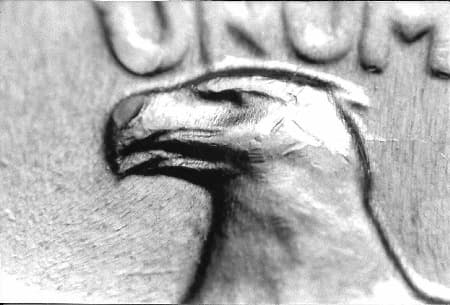
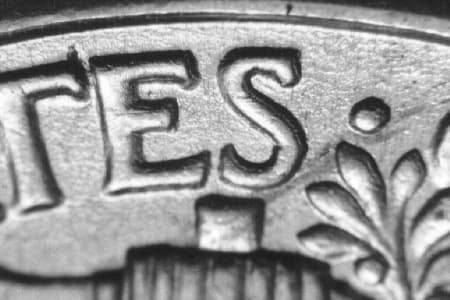
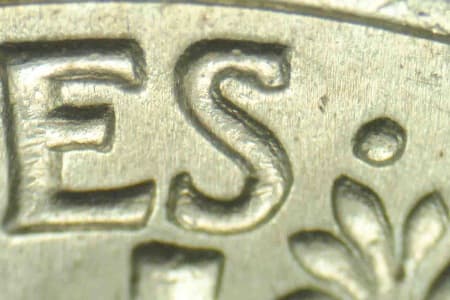
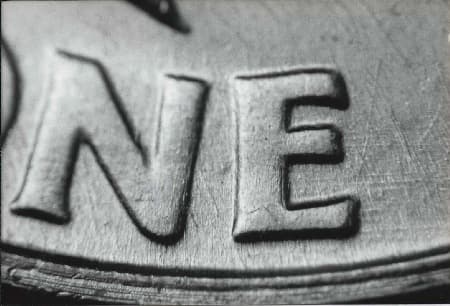
- Consistent reverse doubling: Look for doubling on reverse lettering (UNITED STATES OF AMERICA, E PLURIBUS UNUM, the denomination) and design elements (eagles, buildings, shields, or other motifs). The doubling should be uniform in direction and degree across all affected elements.
- Spread rather than separation: WHR doubling typically manifests as a spread or shelf-like effect rather than the bold, separated images found on strong DDRs. The offset between the two hub impressions is usually small, producing doubling that requires magnification to fully appreciate.
- Multiple die pairs show identical doubling: This is the conclusive diagnostic. If coins with different obverse dies show the same reverse doubling pattern, the doubling originated at the hub level. A single DDR, by contrast, is paired with only one obverse die throughout its service life.
- Notching on letters: Look for consistent notching — small splits at the serifs or crossbars of letters — that repeats identically across all affected design elements. This notching is a hallmark of hub-level doubling at lower magnifications.
Common Misattributions
Several phenomena produce reverse doubling that is not a WHR:
- Machine doubling (strike doubling): Flat, shelf-like displacement caused during striking. It varies from coin to coin, has no consistent directionality, and shows no serifs on the displaced image. Machine doubling has no numismatic value.
- Die deterioration doubling (DDD): As a die wears from striking thousands of coins, the design elements become fuzzy and spread. This produces an appearance similar to doubling but lacks the crisp, consistent offset of a true WHR.
- Die clash transfer: When obverse and reverse dies strike each other without a planchet, design elements from one side can transfer to the other. These clash marks are incuse (recessed) and do not follow the regular design elements.
Notable Examples
1968-S Lincoln Cent WHR Varieties
The late 1960s San Francisco Mint production generated several recognized WHR varieties on Lincoln cents. The reverse doubling is visible on UNITED STATES OF AMERICA and ONE CENT, and die-pair analysis confirms the same pattern across multiple obverse die pairings. These provide an affordable example of hub-level reverse doubling.
State Quarter WHR Varieties (1999-2008)
The 50 State Quarters program, with its annual reverse design changes, produced multiple WHR varieties. The high-volume production and frequent die changes created abundant opportunities for hub-level doubling. Several dates show consistent reverse doubling on state-specific design elements across multiple die pairs, confirmed by variety researchers.
Roosevelt Dime WHR Varieties
The Roosevelt dime series includes several WHR varieties spanning multiple decades. The torch, olive branch, and oak branch on the reverse provide detailed design elements where subtle hub-level doubling is readily visible under magnification. CONECA catalogs list specific die-pair documentation for the most prominent examples.
Lincoln Memorial Cent WHR Varieties (1959-2008)
The Lincoln Memorial reverse, used for nearly 50 years, accumulated numerous WHR varieties. The architectural columns, steps, and lettering of the Memorial design provide multiple points where hub-level doubling is identifiable. The long production run and massive mintages mean WHR examples are available across many dates.
Collecting Tips
- Reverse examination pays off: Collectors overwhelmingly focus on the obverse, meaning reverse varieties — including WHRs — are frequently overlooked in dealer inventories and roll searching. Patient examination of reverse design elements yields discoveries.
- Die-pair documentation adds value: A WHR variety gains attribution strength when the collector can demonstrate the same doubling across coins from different die pairs. Acquiring two or more examples with different obverse die characteristics provides this proof.
- Price advantage over DDRs: WHRs are generally priced below comparable DDRs of the same denomination and date, partly because hub-level doubling tends to be less dramatic and partly because collector awareness is still developing. This creates value opportunities.
- Certification matters: Because WHR doubling is often subtle, third-party certification by PCGS or NGC with the specific WHR attribution gives buyers confidence and supports resale value. Raw coins attributed as WHR varieties require experienced examination to confirm.
- Pair with WHO varieties: Collecting both WHO and WHR varieties for the same date creates a comprehensive hub-doubling set. Some dates produced both obverse and reverse hub doubling from the same production period.
- Study CONECA resources: The Combined Organizations of Numismatic Error Collectors of America maintains detailed WHR listings with die-pair diagnostics, photographs, and attribution guides. These resources are essential for serious variety collectors.
Related Error Types
- Doubled Die Reverse (DDR) -- Die-level reverse doubling, affecting only one specific working die
- Doubled Working Hub Obverse (WHO) -- The same hub-level doubling phenomenon on the obverse
- Master Die Doubling Reverse (MDR) -- Doubling one step earlier, at the master die, affecting all working hubs and dies
- Doubled Die Obverse (DDO) -- Die-level doubling on the obverse
- Repunched Lettering (RPL) -- Doubling specific to individual lettering punches