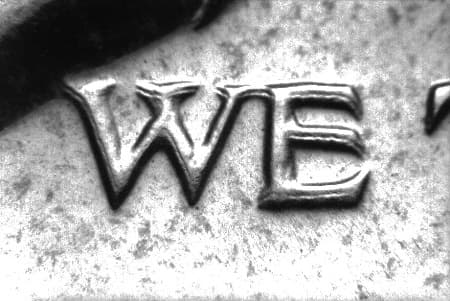
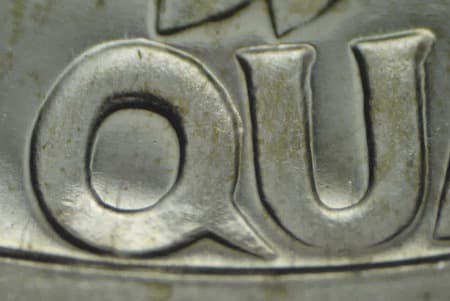
Master Die Doubling Reverse (MDR)
A Master Die Doubling Reverse is the reverse-side counterpart to Master Die Doubling Obverse (MDO). It occurs when the reverse master die receives two misaligned impressions from the reverse master hub, embedding subtle doubling into the very top of the die production chain. Every working hub created from that master die, every working die created from those hubs, and every coin struck by those dies carries the same reverse doubling.
What Is a Master Die Doubling Reverse?
The Mint produces separate die hierarchies for the obverse and reverse of each coin. The reverse master hub impresses the reverse master die, which produces reverse working hubs, which produce reverse working dies. An MDR variety results from misalignment during the very first transfer in this chain — master hub to master die.
Because the reverse master die is the single source from which all reverse production tooling descends, MDR doubling is the most widespread form of reverse doubled die variety. Every coin of that design — across all die pairs, all working hubs, and (when a shared master die serves multiple facilities) all mint marks — shows the same doubling on the reverse.
Like its obverse counterpart, MDR doubling is typically the most subtle form of reverse doubling. The master hub-to-master die transfer is performed with the Mint's highest-precision equipment, and master dies undergo rigorous inspection. Only very small misalignments escape detection and enter production.
How Does It Happen?
The reverse master die is produced by pressing the reverse master hub into a prepared die blank under hydraulic pressure. Before the adoption of single-squeeze hubbing in 1996-97, multiple impressions were required. Any shift between impressions — rotational, lateral, or angular — produced a master die with two slightly offset design impressions.
The subtlety of MDR doubling is a direct consequence of the Mint's quality standards at the master die stage:
- Master-level precision: The presses and fixtures used for master die production are the Mint's most accurate. Tolerances are tighter than for working hub or working die production.
- Inspection scrutiny: Master dies are examined more carefully than any other component in the hierarchy. Dies with noticeable doubling are rejected and destroyed. Only the smallest misalignments pass into service.
- Limited production runs: A single master die produces a relatively small number of working hubs (compared to the thousands of coins a working die strikes), so the Mint invests significant care in each master die.
After the transition to single-squeeze hubbing, MDR varieties became rarer but did not disappear. The single-impression process still involves tremendous force, and microscopic shifts during the squeeze continue to produce detectable master die-level doubling.
How to Identify a Master Die Doubling Reverse
MDR diagnosis requires systematic analysis across multiple die pairs:
- Very subtle doubling: MDR doubling presents as slight thickening, minor splitting of serifs, or a barely perceptible spread on reverse design elements. The denomination, country name (UNITED STATES OF AMERICA), motto (E PLURIBUS UNUM), and fine design details (feathers, columns, torch lines) are the most productive areas to examine.
- Uniform across all design elements: The doubling direction and magnitude are consistent across the entire reverse. If the denomination shows a slight westward spread, the motto and all other elements show the same westward spread.
- Present across all die pairs: The conclusive MDR diagnostic is finding identical doubling on coins from different die pairs and different working hubs. This requires comparing coins that share no common production tooling except the master die.
- Stable across die states: MDR doubling does not change as a working die wears. A coin from the first strikes of a fresh die shows the same doubling as a coin from the final strikes of a worn die. Die deterioration doubling, by contrast, worsens progressively.
- High magnification required: Most MDR varieties are detectable only at 10x-30x magnification under strong, angled lighting. A stereo microscope provides the most reliable examination platform.
Diagnostic Hierarchy for Reverse Doubling
When reverse doubling is found on a coin, determining its origin requires progressive elimination:
| Step | Test | If doubling matches... | Conclusion |
|---|---|---|---|
| 1 | Compare with coins from same die pair | Unique to this die pair | DDR (die level) |
| 2 | Compare with coins from same working hub, different die pair | Same doubling, same hub | WHR (hub level) |
| 3 | Compare with coins from different working hub | Same doubling, different hubs | MDR (master die level) |
Each step requires a broader sampling of coins. MDR confirmation demands the widest range — coins from at least two different working hubs (identifiable by minor hub-specific markers) that show identical reverse doubling.
Distinguishing MDR from Other Reverse Anomalies
Several conditions mimic MDR doubling on the reverse:
- Die deterioration doubling (DDD): Produces fuzzy, spread lettering on heavily used dies. Unlike MDR, DDD has no consistent directional offset, worsens over the die's life, and is confined to one specific die.
- Machine doubling (strike doubling): Flat, shelf-like displacement from the striking process. Varies from coin to coin, shows no serifs on the displaced image, and has no numismatic premium.
- Die polish lines: Polishing marks from die maintenance can create linear marks near design elements that superficially resemble doubling. These follow the polishing direction, not the design geometry.
- Flow lines: Metal flow during striking creates radial lines near high-relief design elements. These radiate outward from the design rather than showing the consistent offset of true doubling.
Notable Examples
Lincoln Memorial Cent MDR Varieties (1959-2008)
The Lincoln Memorial reverse, in production for nearly five decades, generated several documented MDR varieties. The Memorial's architectural detail — columns, steps, and the seated Lincoln statue — provides numerous reference points for detecting subtle master die-level doubling. The long production run and enormous total mintage provide extensive die-pair diversity for diagnostic comparison.
Roosevelt Dime MDR Varieties
The Roosevelt dime reverse, featuring a torch flanked by olive and oak branches, has produced MDR varieties detectable on the torch lines and leaf details. The fine engraving of these elements makes them sensitive indicators of even very small master die-level offsets.
Kennedy Half Dollar MDR Varieties
The presidential seal on the Kennedy half dollar reverse, with its eagle, shield, arrows, and olive branch, provides exceptionally detailed design elements for MDR detection. Several dates from the 1970s and 1980s show documented master die-level doubling confirmed across multiple die pairs.
Washington Quarter MDR Varieties
The heraldic eagle reverse used on Washington quarters from 1932 through 1998 accumulated multiple MDR varieties over its long production life. The eagle's breast feathers, wing tips, and the lettering of E PLURIBUS UNUM are the most commonly affected elements. The State Quarter program (1999-2008), with its annual reverse changes, produced fewer MDR varieties per design because each reverse master die had a shorter service life.
Collecting Tips
- Advanced collector appeal: MDR varieties are specialist items that reward patience and technical skill. The subtlety of the doubling means these coins are overlooked by the general market, keeping prices modest relative to DDR and WHR varieties.
- Invest in equipment: Detecting MDR doubling requires magnification beyond what a standard 10x loupe provides. A quality stereo microscope in the 10x-30x range, combined with a fiber optic or LED light source that allows angled illumination, is the standard tool for serious variety examination.
- Build die-pair evidence: The most valuable MDR attributions are supported by photographic documentation showing identical doubling on coins from multiple die pairs. Collectors who assemble this evidence contribute directly to variety research.
- Compare early and late die states: One effective method for distinguishing MDR from die deterioration is comparing the doubling on coins from different stages of the same die's life. MDR doubling remains constant; deterioration doubling appears and worsens over time.
- Complement with MDO varieties: Collecting both MDO and MDR varieties for the same date creates a complete master die-level doubled die pair. Some production years generated both obverse and reverse master die doubling, making matched sets possible.
- Certification adds credibility: Because MDR doubling is subtle enough to invite debate, third-party certification by PCGS or NGC with a specific MDR attribution provides important independent validation. Certified examples also trade more readily in the marketplace.
- Study published attributions: CONECA (Combined Organizations of Numismatic Error Collectors of America) and other attribution services publish MDR listings with diagnostic photographs and die-pair documentation. These references are indispensable for both identification and confirmation.
Related Error Types
- Master Die Doubling Obverse (MDO) -- The same master die-level doubling on the obverse
- Doubled Working Hub Reverse (WHR) -- Doubling one step later, at the working hub, affecting all dies from that hub
- Doubled Die Reverse (DDR) -- Doubling at the working die level, affecting only one specific die
- Doubled Working Hub Obverse (WHO) -- Hub-level doubling on the obverse
- Doubled Die Obverse (DDO) -- Die-level doubling on the obverse