
Die Clash Overlays for Flying Eagle Cents: Mule Die Clashes (1856–1858)
Die clashes occur when the obverse and reverse dies strike each other without a planchet between them, leaving impressions of the opposing die’s design elements on each die. When coins are subsequently struck from those clashed dies, faint mirror-image traces of the opposite side appear on the coin.
The Flying Eagle cent (1856–1858) holds a unique place in die clash history: it is the only U.S. coin series with documented mule die clashes — instances where a cent die was struck against a die from an entirely different denomination. Three such mule die clashes are known on the 1857 Flying Eagle cent, involving dies from a quarter, a half dollar, and a twenty-dollar gold piece. These are among the most dramatic and sought-after die clash varieties in all of U.S. numismatics.
How to Read These Overlays
The overlay image below shows the obverse and reverse of the Flying Eagle cent stacked on top of each other. The areas where elements from both sides intersect are where standard (same-denomination) clash marks would appear. In practice, clash marks are most visible on the open-field areas of the coin — the flat spaces between design elements where an impression from the opposite die has room to show.
Flying Eagle Cent (1856–1858)
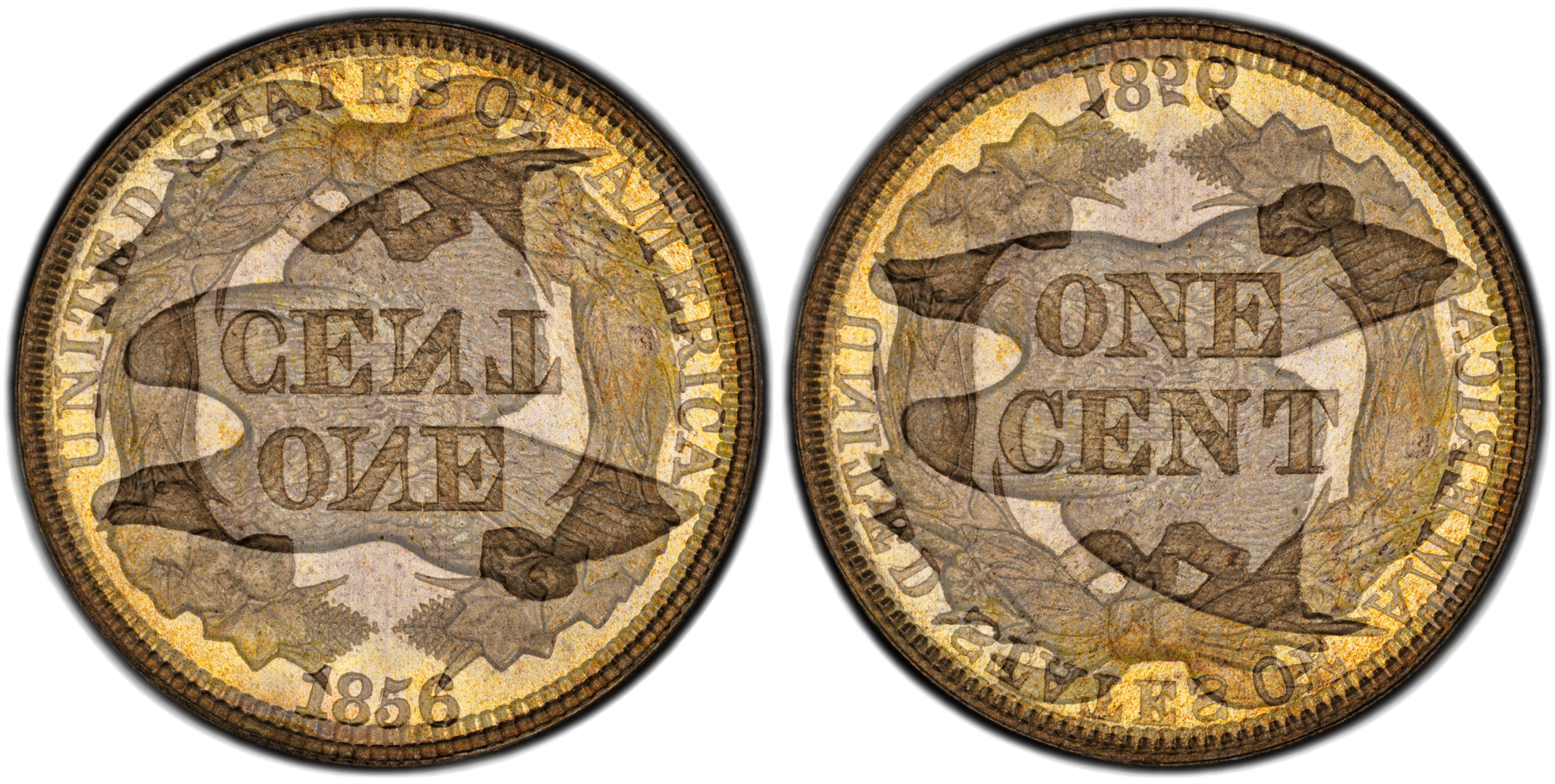
Overlay: Flying Eagle cent — obverse and reverse superimposed.
The Flying Eagle cent was produced from 1856 to 1858. The 1856 is a pattern issue struck in proof for Congress (approximately 2,000 pieces), while 1857 and 1858 are regular-issue coins. The design features an eagle in flight on the obverse and a laurel wreath enclosing “ONE CENT” on the reverse. The copper-nickel composition (88% copper, 12% nickel) was notoriously hard on dies, which contributed to die failures throughout the short-lived series.
On standard die clashes, elements of the wreath would transfer onto the obverse around the flying eagle, and elements of the eagle would transfer onto the reverse within or near the wreath. Due to the small 19mm flan size, these marks can be quite subtle.
However, the Flying Eagle cent is best known not for standard die clashes, but for its extraordinary mule die clashes — documented exclusively on the 1857 date.
The Mule Die Clashes of 1857
Mule die clashes occur when a die from one denomination accidentally strikes against a die from a different denomination. This requires dies from different denominations to be present at the same coining press — an extraordinary circumstance that speaks to the sometimes chaotic realities of mid-19th century Mint operations. In 1857, the Philadelphia Mint was producing coins across multiple denominations, and dies evidently came into accidental contact.
Three mule die clashes are documented on 1857 Flying Eagle cents:
Mule Die Clash with Quarter — FS-901
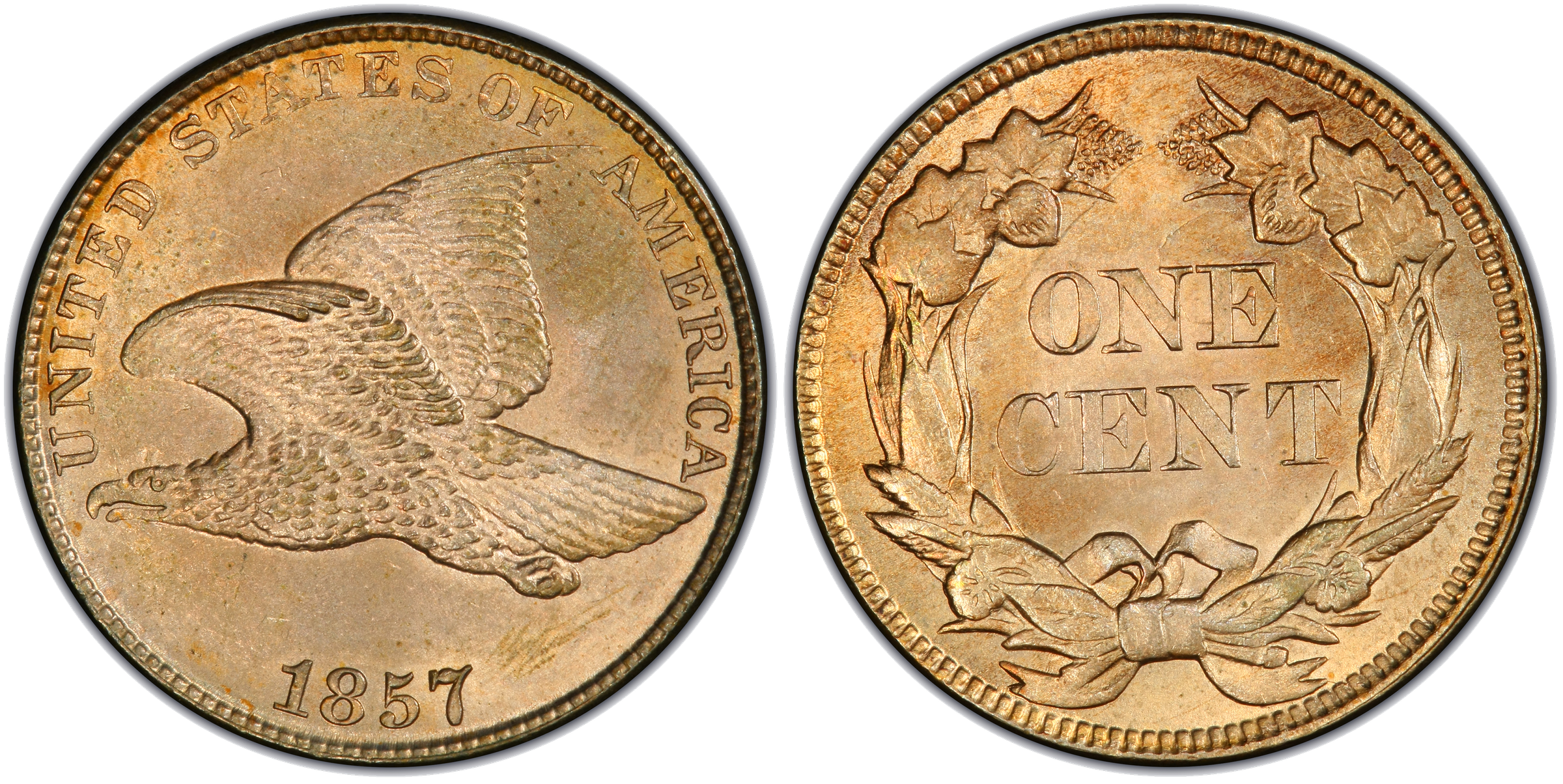
1857 Flying Eagle cent with mule die clash from a Seated Liberty quarter die (Fivaz-Stanton FS-901). Elements from the quarter die are visible clashed onto the reverse of the cent.
Cataloged as FS-901 in the Fivaz-Stanton Cherry Pickers’ Guide, this variety shows clash marks from a Seated Liberty quarter die transferred onto the reverse of the Flying Eagle cent. The quarter die at 24.3mm was significantly larger than the cent die at 19mm, meaning the clashed design elements create a pattern that extends beyond what any same-denomination clash could produce. The foreign design elements from the quarter are unmistakable once identified.
Mule Die Clash with Half Dollar
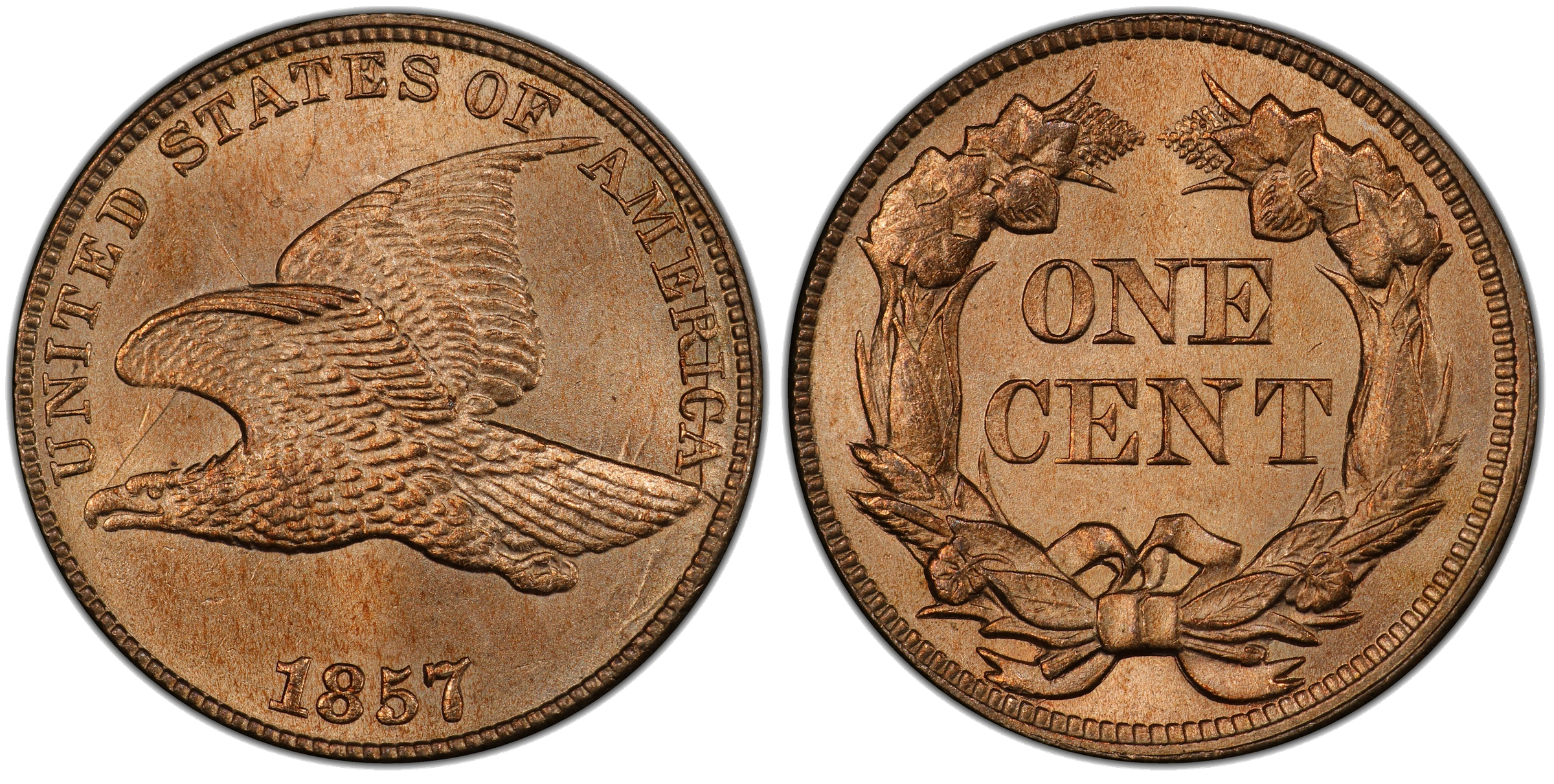
1857 Flying Eagle cent with mule die clash from a Seated Liberty half dollar die. Clash impressions from the larger half dollar die are visible on the obverse.
This variety shows clash marks from a Seated Liberty half dollar die transferred onto the obverse of the cent. At 30.6mm, the half dollar die was more than 60% larger in diameter than the 19mm cent die, creating an extensive clash pattern. The sheer size difference between the dies makes this clash particularly dramatic.
Mule Die Clash with $20 Gold Piece — FS-403
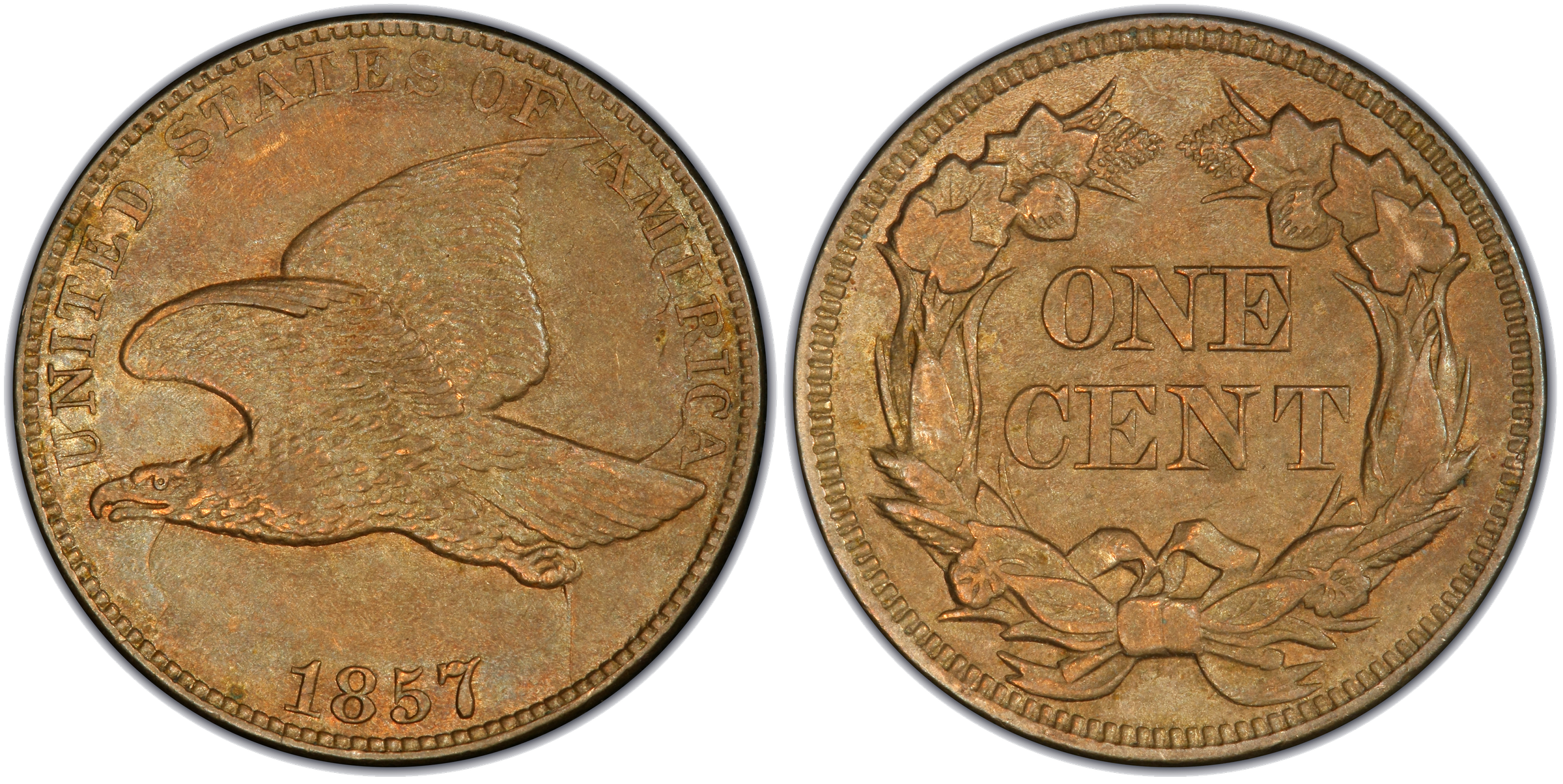
1857 Flying Eagle cent with mule die clash from a Liberty Head double eagle ($20 gold piece) die (Fivaz-Stanton FS-403). Elements from the gold coin die are visible clashed onto the obverse.
Cataloged as FS-403, this is perhaps the most remarkable of the three mule die clashes. A die for the twenty-dollar gold piece — the largest regular-issue U.S. coin denomination of the era, at 34mm — clashed with the much smaller 19mm cent die. The Liberty Head double eagle features a completely different design (Liberty Head with coronet on the obverse, heraldic eagle on the reverse), making the foreign design elements immediately recognizable on the cent. That a die intended for the Mint’s premier gold denomination would come into contact with a humble cent die underscores how extraordinary these varieties are.
Summary: What to Look for on Flying Eagle Cent Die Clashes
When examining Flying Eagle cents for die clashes:
- Standard die clashes: Look for faint traces of the reverse wreath in the open fields around the flying eagle on the obverse, and traces of the eagle within or near the wreath on the reverse. These will be subtle due to the small flan size.
- Mule die clashes: Look for design elements that clearly do not belong to the Flying Eagle cent design — elements from Seated Liberty quarters or half dollars, or Liberty Head double eagles. These are far more dramatic and easier to identify than standard clashes because the foreign design elements are unmistakable.
- Key date: All three documented mule die clashes occur on the 1857 date only.
The copper-nickel composition used for Flying Eagle cents was notoriously hard on dies, contributing to various die failures throughout the series — including die cracks, cuds, and laminations. Combined with the early Mint’s production environment where dies for multiple denominations were in close proximity, these factors created the conditions for the mule die clashes that make the 1857 Flying Eagle cent one of the most fascinating issues in U.S. numismatics.
Explore in the NumisDex Catalog
Related varieties and errors from the NumisDex database:
0 Replies
Related Threads
- Die Clash Overlays for Indian Head Cents: Patterns and Notable Examples (1859–1909)0 replies · 1mo ago
- Die Clash Overlays for Large Cents: All Design Types (1793–1857)0 replies · 1mo ago
- Die Clash Overlays for Half Cents: All Design Types (1793–1857)0 replies · 2mo ago
- Counter Clashes: What Happens When a Die Clash Clashes Back0 replies · 3mo ago
- Die Clashes: Ghost Images From Empty Strikes0 replies · 4mo ago