
By Brandon Norris
Trail Dies: Catalogued as a Doubled Die for Six Years
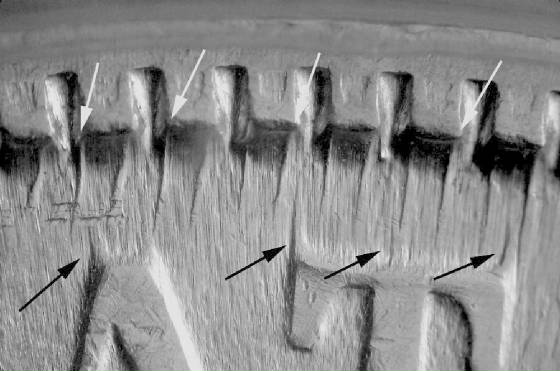
An Attribution That Took Six Years to Correct
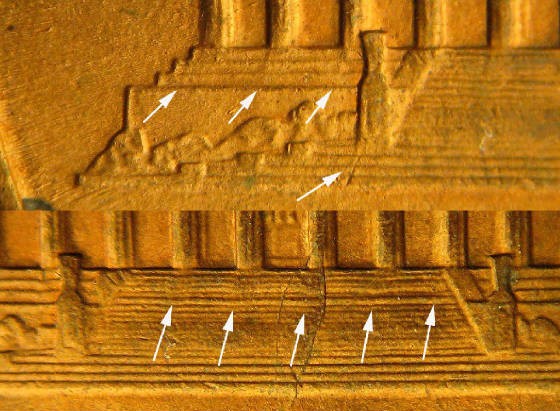
In late 1994 John Wexler received a Lincoln cent from G. J. Lawson showing a strange bending in the steps of the Memorial, beneath the columns. He examined it and concluded that the fluting lines from the columns had been replicated down into the stairs — a doubled die. He catalogued it as 1994P 1c WDDR-004.
It stayed listed as a doubled die for six years.
In June 2000 Kenneth Edgar submitted the same die to Ken Potter. Potter recognised it, and then noticed something nobody had mentioned: thin lines running off the bottom of the designer's initials, FG. That is not how doubling behaves. He named them "trails", for the way they trailed off as they lengthened.
In 2003 Harold Kuykendall sent Potter a 2003 Lincoln cent with the same anomaly, which drew wide attention and brought the phenomenon into print. What separates a trail from a doubled die is morphological: a doubled die duplicates a design element — a full second image — while a trail extends one, a single line that tapers off. (See "What Actually Causes Them" below for the die-polishing mechanism, which was later reproduced in the lab.)
Kuykendall had described the steps as "wavy" in his submission letter. Potter kept the word, and "wavy steps" became the accepted name for trails running from the columns into the Memorial steps. A third date, a 1999 cent, was identified soon after by BJ Neff.
What Actually Causes Them
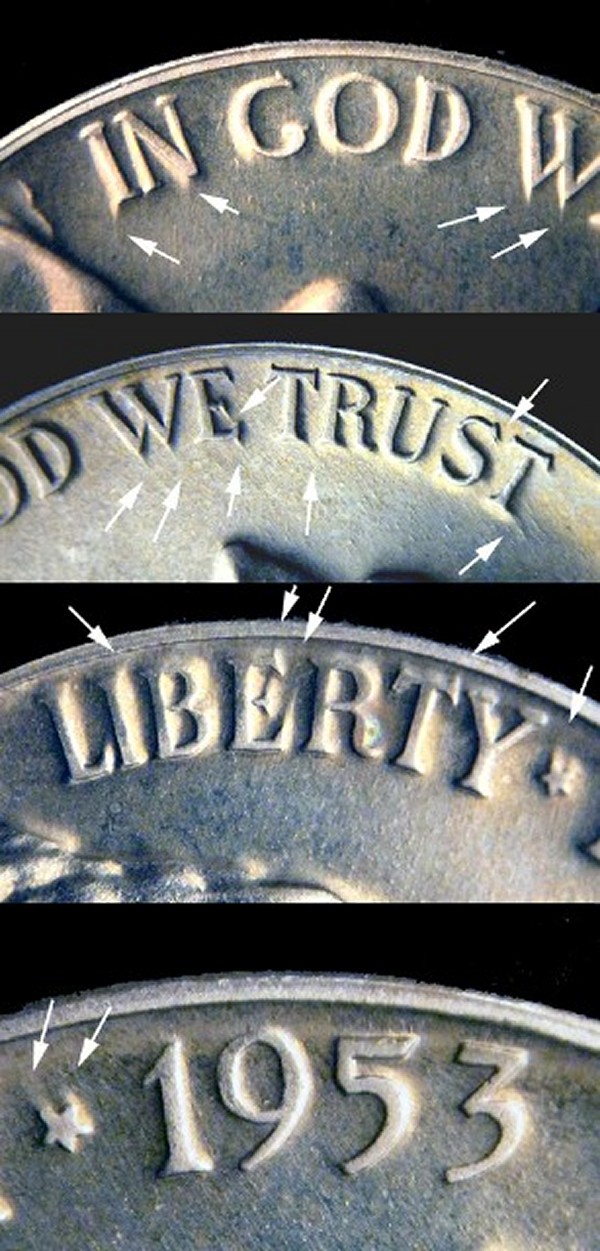
Trails are parallel raised ridges extending from the corners of design elements. They are strongest where the device meets the field and taper as they run outward, and they range from naked-eye obvious to barely perceptible under magnification. A single coin can carry several sets running in different directions.
They come from polishing the die, not from striking the coin.
When the Mint cleans a die with a rotary tool to remove clash marks or cracks, soft bristles or felt fibres penetrate the die's recesses — the incuse letters and numbers. As the spinning tool exits those recesses into the higher relief of the field, the concentrated fibres erode a narrow gully into the die face. That gully is incuse on the die, so it prints as a raised tendril on every coin struck from it afterwards.
Trails also occur on incuse devices, which are raised on the die. There the buff concentrates against the raised wall and gouges a trail into the field where the device terminates. These are weaker, because there is no change in relief at that point to concentrate the fibres.
Sean Moffat reproduced the effect experimentally, applying fine diamond grit to a finished die with a rotating polishing tool for twenty to thirty seconds.
Telling It Apart
| | Trail Die | Doubled Die | Machine Doubling | |---|---|---|---| | Looks like | Raised ridges from element corners, tapering outward | A sharp, fully formed second image | Flat, shelf-like | | Shape | Single lines that narrow and fade | Complete duplicate of the element | Distorted copies | | Cause | Rotary polishing of the die | Hub misalignment | Die bounce during striking | | Same on every coin? | Yes | Yes | No | | Possible under single-squeeze hubbing? | Yes | No | n/a |
That last row is the one that settled it in 2003.
On Dates
Because trails were only recognised in the 1990s, documentation runs backwards as well as forwards. The bulk of the roughly 1,100 known dies fall between 1961 and the present, across cents, nickels, dimes, quarters, half dollars and dollar coins. A small number of earlier examples — including pieces dated 1921 and the early 1950s — have since been attributed retroactively.
An early date therefore reflects when the coin was struck, not how long the variety has been known.
Further reading: Will Brooks, "Unraveling the Mysteries of Trail Dies", Coin World Weekly, 17 July 2017.