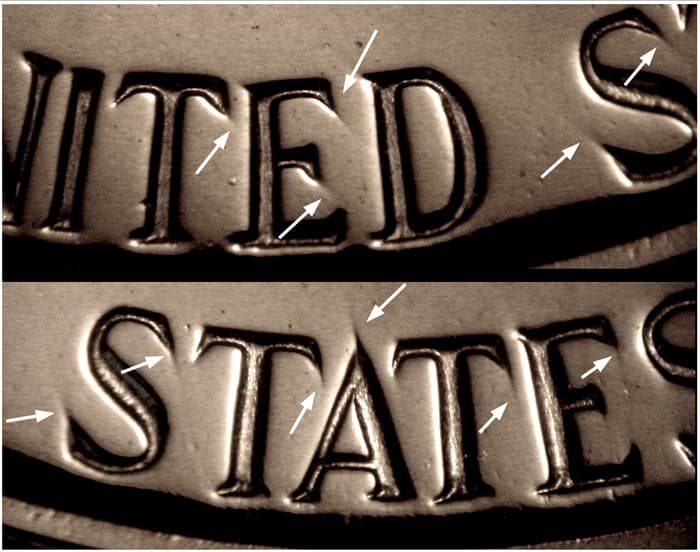
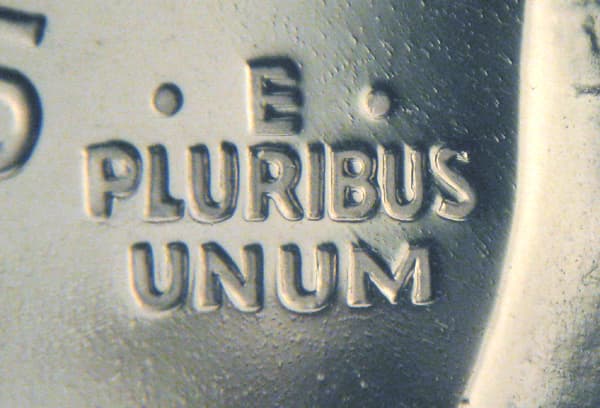
Trail Die Reverse (TDR)
A Trail Die Reverse is a die variety where the reverse of a coin displays raised tendrils extending from design element corners — particularly letters, numbers, and fine devices. These tendrils gradually narrow and fade as they extend into the field. The mechanism is identical to a Trail Die Obverse (TDO), but the affected die is the reverse. Trail dies are produced during die maintenance and affect every coin struck from the affected die.
How Does It Happen?
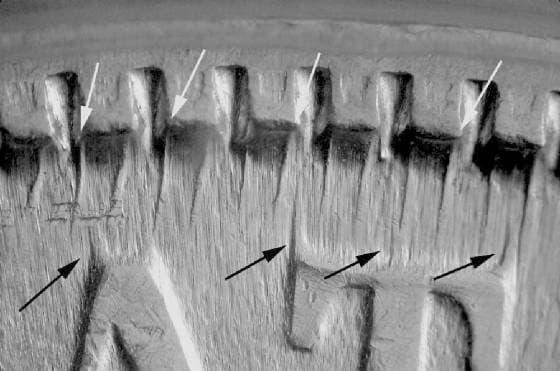
The reverse die undergoes the same maintenance procedures as the obverse die, including periodic polishing to remove clash marks, die cracks, or surface imperfections. Trail dies form when rotary polishing or buffing tools contact the die face and soft bristles or felt fibers gather in the die's incuse recesses — the grooves that form letters, numbers, and design devices on the struck coin.
As the spinning polishing tool rotates, concentrated fibers at design element corners erode narrow gullies into the field portion of the die. These gullies radiate outward from letter corners, number endpoints, and device edges. Because the gullies are incuse on the die, they produce raised tendrils on every coin struck from that die.
The physics of trail formation on reverse dies follows the same principles as on obverse dies:
- Fibers or bristles concentrate at design element corners during rotary polishing
- The spinning action erodes grooves that extend outward into the die's field
- Trails narrow and fade as they extend further from the concentration point
- The resulting tendrils appear raised on the finished coin
Because reverse designs vary dramatically across denominations and eras — from the simple wheat ears of the Lincoln cent to lettering bands like UNITED STATES OF AMERICA and E PLURIBUS UNUM — the visibility and character of trail die features on reverses differ significantly from one series to another. Designs with extensive fine lettering tend to show trail marks most prominently.
How to Identify a Trail Die Reverse
The diagnostic features of a TDR mirror those of a TDO, applied to the reverse:
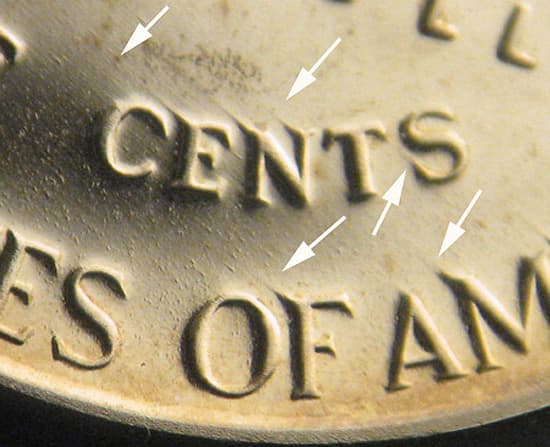
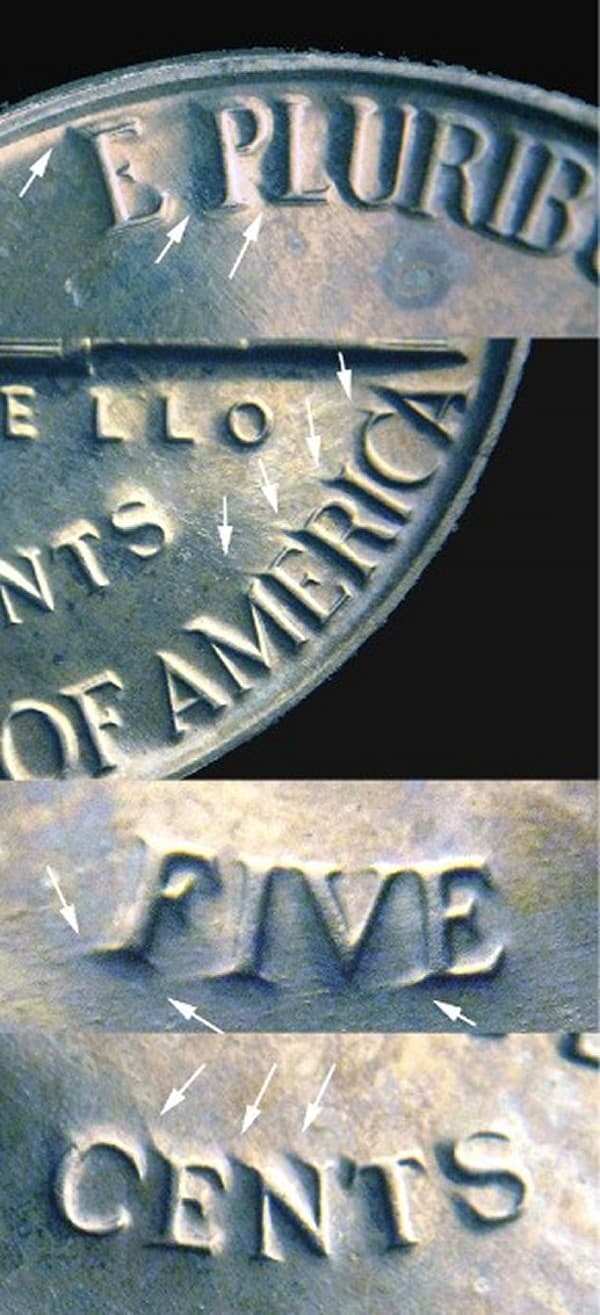
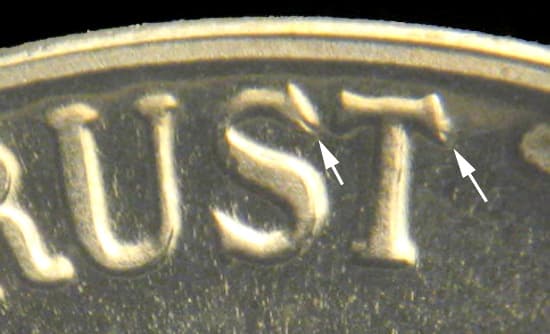
- Raised tendrils from corners: Thin, raised lines extending outward from the corners of letters, numbers, or design devices. These are single lines, not doubled images of the design elements.
- Progressive fade: Each tendril narrows and weakens as distance increases from the originating design element.
- Consistent polishing pattern: All affected elements show trails from the same type of features (letter corners, serif endpoints) because the polishing tool action creates a uniform mechanical pattern.
- Not a second image: Trail marks do not reproduce the shape of the design element — they produce individual lines extending outward. This fundamentally distinguishes them from doubled die reverses.
Reverse-Specific Considerations
Reverse trail dies present identification challenges that differ from obverse trail dies:
- Eagle feathers: On denominations featuring the heraldic eagle (quarters, halves, dollars, gold coins), trail marks on individual feathers can resemble die polish lines. The key distinction is that trails originate specifically from element corners and follow the radial pattern of polishing, while random polish lines are scattered without consistent origin points.
- Lettering bands: Reverse lettering (UNITED STATES OF AMERICA, E PLURIBUS UNUM, denomination text) provides the clearest diagnostic areas. Trail tendrils extending from letter serifs and corners are unmistakable under magnification.
- Wreath and branch details: On designs with wreaths or olive branches (Indian cents, Lincoln wheat cents, Barber coinage), trail marks from leaf tips and berry edges are visible under 10x magnification.
TDR vs. DDR vs. Machine Doubling
| Feature | Trail Die Reverse (TDR) | Doubled Die Reverse (DDR) | Machine Doubling |
|---|---|---|---|
| Cause | Die polishing — fibers erode gullies | Hub misalignment between impressions | Die bounce during striking |
| Appearance | Raised tendrils from element corners | Sharp, fully formed duplicate image | Flat shelf displacement |
| Shape | Single lines narrowing outward | Complete second copy of design | Distorted copies |
| Consistency | Same on all coins from that die | Same on all coins from that die | Varies coin to coin |
| Value | Moderate premium | Significant premium | No added value |
Notable Examples
Lincoln Cent Reverse Trail Dies
The reverse designs of Lincoln cents — both the wheat ears (1909-1958) and the Lincoln Memorial (1959-2008) — are prolific sources of trail die reverse varieties. On wheat cents, trail tendrils extend from ONE CENT lettering and wheat stalk details. On Memorial cents, the columns of the Memorial building and reverse lettering display trail features. The TrailDies.com catalog documents hundreds of TDR varieties on Lincoln cents alone.
Roosevelt Dime Trail Dies
Roosevelt dimes from the 1960s through 1990s produced multiple documented TDR varieties. The torch, olive branch, and oak branch on the reverse provide detailed areas where trail marks are identifiable. The small size of the dime requires higher magnification (10x-20x) for confident attribution.
Washington Quarter Trail Dies
Both the pre-State Quarter heraldic eagle reverse (1932-1998) and the various State Quarter reverses (1999-2008) produced trail die varieties. Trail tendrils extending from UNITED STATES and other reverse lettering are documented, including examples that affect THE EQUALITY STATE and similar state-specific text.
Walking Liberty Half Dollar Trail Dies
The Walking Liberty half dollar (1916-1947) features an intricate reverse eagle design with layered feathers and a detailed perch. Trail die marks on this denomination are scarce and prized by specialists because of the design's complexity and the series' popularity with collectors.
Collecting Tips
- Complementary pairs: Some die pairs produce both a TDO and TDR. A coin exhibiting trail die features on both obverse and reverse is more desirable than one showing a trail on only one side. Check both sides of any trail die coin.
- Design complexity affects visibility: Trail marks are easier to detect on reverses with extensive fine lettering and detailed devices than on reverses with large smooth areas. Series with detailed reverse designs are the best hunting grounds.
- Magnification requirements: Most TDR varieties require 7x-15x magnification to identify confidently. Invest in a quality loupe or stereo microscope with good lighting for reliable attribution.
- Attribution and certification: Both PCGS and NGC recognize and attribute trail die reverse varieties. For varieties documented in the TrailDies.com catalog, the specific TDR number adds provenance and collector interest.
- Price advantage: TDR varieties are consistently more affordable than DDR varieties of comparable visual impact. For collectors who appreciate die varieties but work within a budget, trail dies offer substantial value.
- Die markers for confirmation: Each trail die comes from a specific die, and that die has unique markers (die scratches, polish lines, minor die chips) that confirm attribution. Learning to identify die markers is essential for serious trail die collecting.
- Related defect — wavy steps: Wavy steps represent a specific form of trails and share the same polishing origin.
Related Error Types
- Trail Die Obverse (TDO) -- The same mechanism on the coin's obverse die
- Doubled Die Reverse (DDR) -- A sharp doubled impression on the reverse from hub misalignment
- Doubled Die Obverse (DDO) -- Doubled impression on the obverse
- Die Polishing (DPL) -- Related die maintenance artifact; aggressive polishing creates both trail dies and polish lines
- Die Abrasion (DAB) -- Wear-related die surface changes