Trail Die Obverse (TDO)
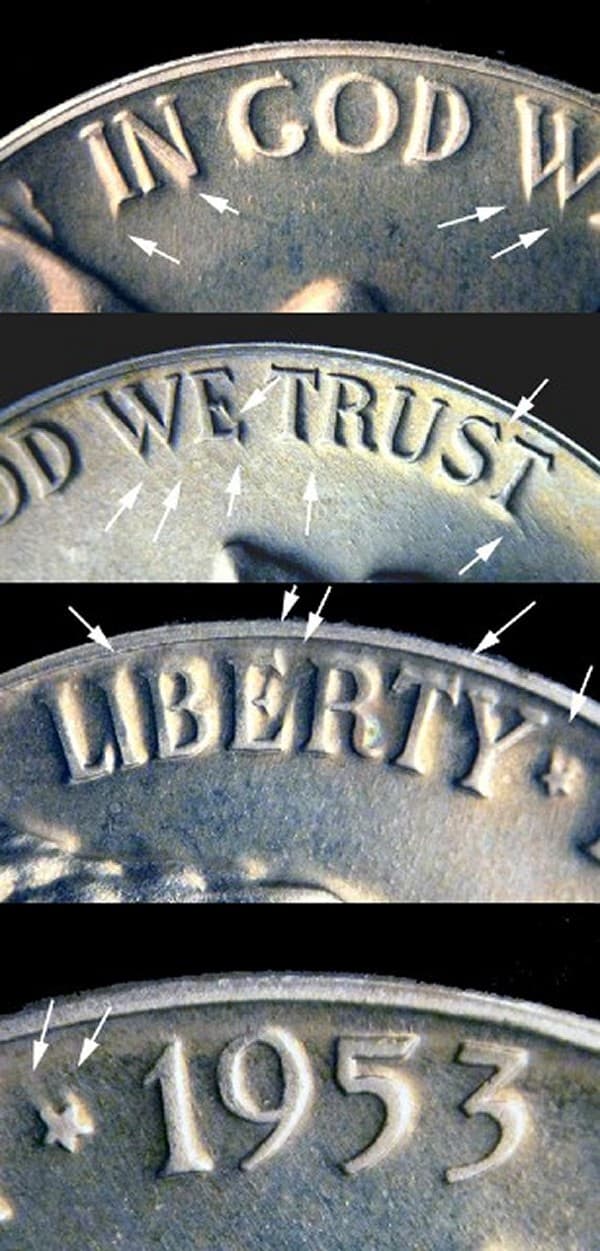
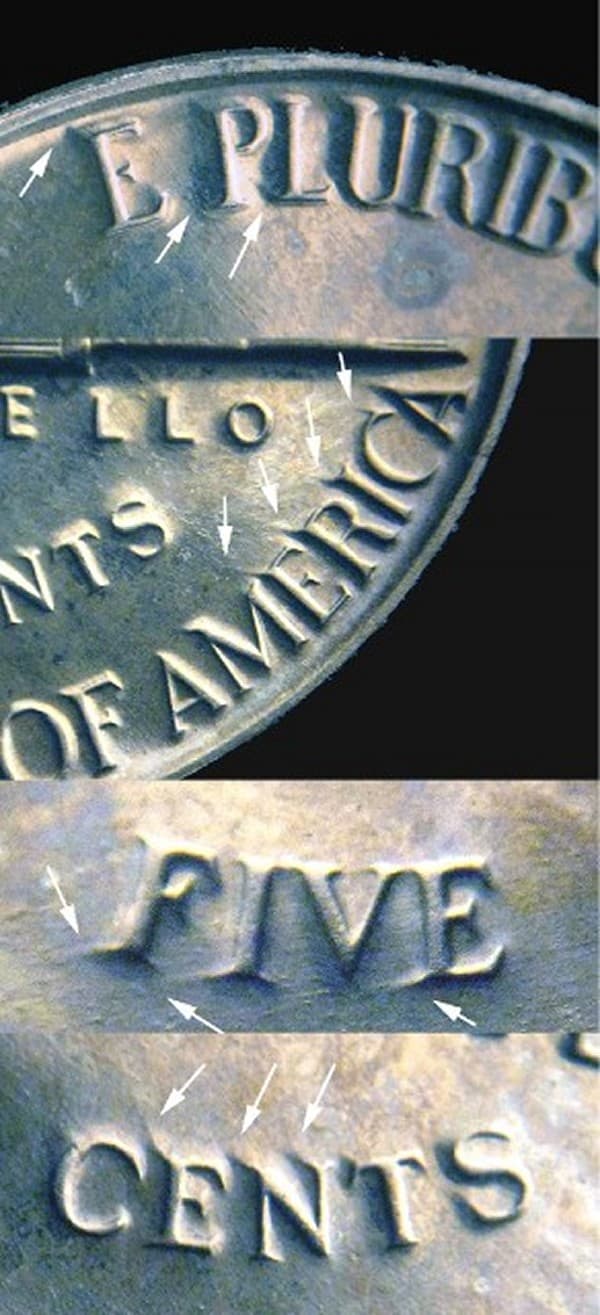
A Trail Die Obverse is a die variety where the obverse shows raised tendrils extending from design elements — typically from the corners of letters and numbers. These tendrils gradually narrow and fade out as they extend into the field. Trail die varieties are produced during the die-making process and affect every coin struck from the affected die. They are sometimes called "trails" or "trail lines."
How Does It Happen?
Trail dies are caused by careless die polishing. During die maintenance, the Mint uses rotary polishing or buffing tools to remove clash marks, die cracks, or other surface imperfections from the die face. When these tools contact the die, soft bristles or felt fibers gather in the die's recesses — the incuse portions that form design elements like letters, numbers, and devices on the finished coin.
As the spinning polishing tool rotates, the concentrated fibers at these recessed edges erode a narrow gully into the field portion of the die face. This gully radiates outward from the corner of the design element where the fibers gathered. Because the gully is incuse on the die, it produces a raised tendril on every coin struck from that die.
Sean Moffat experimentally reproduced trails by applying fine diamond grit to a finished die with a rotating polishing tool for 20-30 seconds, confirming this die polishing mechanism.
The key characteristics of trail formation:
- Polishing origin: Trails are a byproduct of die maintenance, not the hubbing process. They can form at any point in a die's service life when polishing is performed.
- Single tendrils: Unlike doubled dies that produce a second image of the design, trails produce individual raised lines extending outward from design element corners.
- Gradual fade: Each tendril narrows and fades as it extends further from the design element, reflecting the decreasing erosion away from the concentration point.
- Die defect, not striking error: Trails exist on the die itself and reproduce identically on every coin struck from that die.
Trail dies have been documented on modern U.S. coins since 1921, and also appear on foreign coins.
How to Identify a Trail Die Obverse
Trail die varieties have distinctive characteristics that separate them from doubled dies and machine doubling:
- Raised tendrils from corners: The hallmark feature is thin, raised lines extending outward from the corners of letters, numbers, or design elements. These tendrils originate at specific points — not broad doubling across entire design elements.
- Gradual narrowing and fade: Each trail line tapers and weakens as distance increases from the design element. The starting point is strongest; the end is barely perceptible.
- Consistent across the die: All affected areas show trails emanating from the same types of features (letter corners, serifs, number endpoints) because the polishing action follows the same mechanical pattern across the die.
- Not a doubled image: Trail dies do not produce a second copy of a letter or device. They produce thin lines extending outward — fundamentally different in appearance from the full duplicate forms of a doubled die.
- No shelf effect: Unlike machine doubling, trail dies do not produce flat, shelf-like displacement. The tendrils have depth and dimensionality.
Trail Die vs. Doubled Die vs. Machine Doubling
| Feature | Trail Die (TDO) | Doubled Die (DDO) | Machine Doubling |
|---|---|---|---|
| Appearance | Raised tendrils from element corners | Sharp, fully formed second image | Flat, shelf-like |
| Shape | Single lines that narrow and fade | Complete duplicate of design elements | Distorted copies |
| Cause | Die polishing — fibers erode gullies | Hub misalignment between impressions | Die bounce during striking |
| Origin point | Corners of letters/numbers | Entire design element | Varies |
| Die variety? | Yes — consistent across all coins | Yes — consistent across all coins | No — strike-by-strike variation |
Notable Examples
Lincoln Cent Trail Dies
Lincoln cents are the most frequently documented denomination for trail die varieties. The copper composition and fine detail of the Lincoln portrait make trail marks readily visible under magnification. Trails extending from letters in LIBERTY, IN GOD WE TRUST, and the date are commonly observed. The TrailDies.com reference catalogs hundreds of these varieties with die-specific photography.
Jefferson Nickel Trail Dies
Jefferson nickels from the 1960s through 1990s produced numerous trail die obverse varieties. The relatively flat fields of the Jefferson design make even subtle trail tendrils detectable, particularly on the date and motto lettering.
State Quarter Trail Dies
The high-volume State Quarter program (1999-2008) generated trail die varieties across multiple dates and mints. Trails extending from LIBERTY, IN GOD WE TRUST, and the date on the Washington obverse are the most commonly documented.
Kennedy Half Dollar Trail Dies
Kennedy half dollars from the 1970s and 1980s exhibit documented trail die obverse varieties, with trail lines visible extending from lettering serifs and the date. The large format of the half dollar makes trail features easier to photograph and study.
Collecting Tips
- Affordability: Trail die varieties are significantly more affordable than comparable doubled dies. A TDO on a common-date Lincoln cent sells for a fraction of what a DDO on the same coin commands, making trail dies an accessible specialty.
- Strength of trail: The value of a trail die variety is proportional to the boldness and visibility of the trail tendrils. Strong, easily visible trails under 5x magnification are worth more than faint trails requiring 20x to detect.
- Attribution resources: TrailDies.com maintains a comprehensive catalog of trail die varieties with photographs and die markers. Cross-referencing a suspected trail die against this catalog confirms the attribution.
- Certification: PCGS and NGC both recognize trail die varieties and will attribute them on holder labels. Third-party attribution adds credibility and marketability, especially for the stronger examples.
- Photography technique: Trail dies photograph best under low-angle directional lighting that emphasizes the raised tendrils. Lighting perpendicular to the trail direction produces the most dramatic contrast.
- Die state matters: Early die state coins show the crispest trail features. As the die wears through its production run, fine details including trail tendrils become progressively weaker. Conversely, trails can also be introduced during mid-life die polishing.
- Related defect — wavy steps: Wavy steps represent a specific form of trails and are closely related.
Related Error Types
- Trail Die Reverse (TDR) -- The same mechanism on the coin's reverse die
- Doubled Die Obverse (DDO) -- A sharp doubled impression from hub misalignment, distinct from the single-line tendrils of a TDO
- Doubled Die Reverse (DDR) -- Doubled impression on the reverse
- Die Polishing (DPL) -- Related die maintenance artifact; aggressive polishing creates both trail dies and polish lines
- Die Abrasion (DAB) -- Wear-related die surface changes