
The Twenty-Cent Piece: The Coin That Lasted Four Years
The Shortest-Lived Denomination in American Coinage
The twenty-cent piece was authorized in 1875 and dead by 1878. Four years, two of which produced nothing for circulation. And the reason it died is the simplest possible one: nobody could tell it from a quarter.
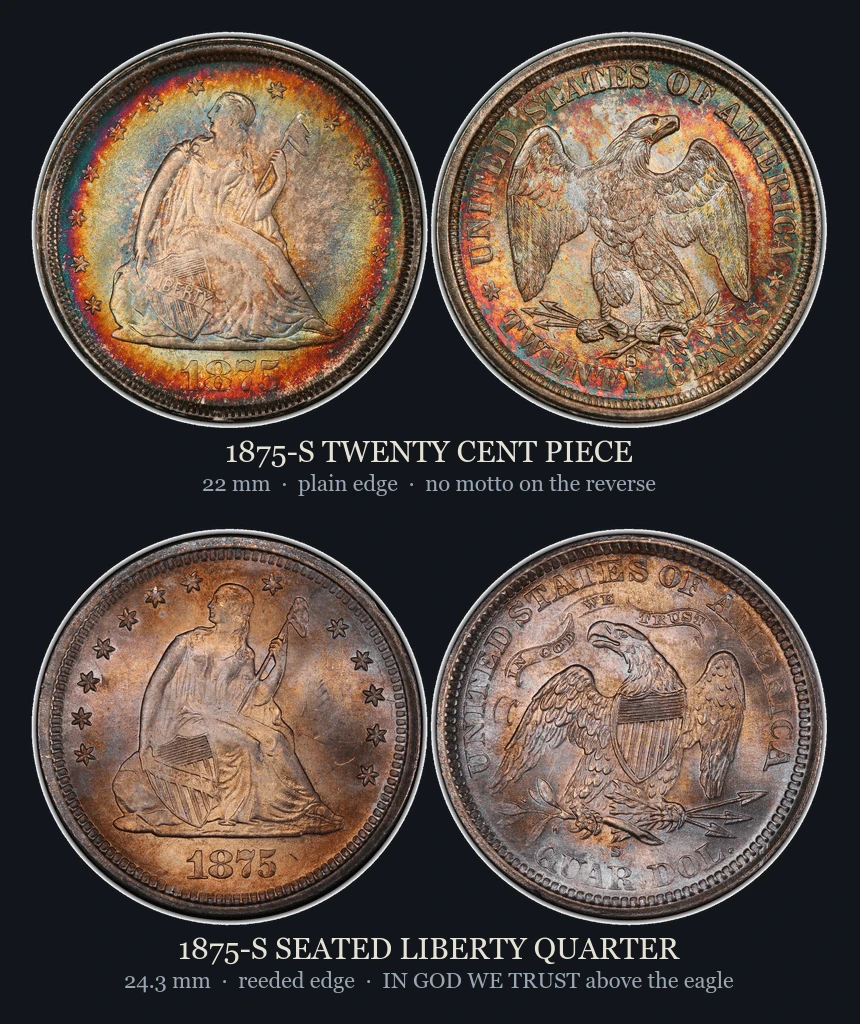
That is the whole story in one image. Top row, an 1875-S twenty-cent piece. Bottom row, an 1875-S quarter. Same Seated Liberty on the obverse. Same silver. The twenty-cent is 22mm across; the quarter is 24.3mm. The Mint tried to differentiate them — the twenty-cent got a plain edge where the quarter's was reeded, and it left IN GOD WE TRUST off the reverse entirely. Look above the eagle on each: the quarter has the motto ribbon, the twenty-cent does not.
In a pocket, in a hurry, in the dark, two millimetres and a smooth edge were not enough.
Why It Existed
The idea was not foolish. Senator John P. Jones of Nevada championed the coin, partly as an outlet for Western silver — the same interests that had produced the Trade dollar two years earlier. And in the West, where the Spanish "bit" of 12½ cents was still a working unit of account, a twenty-cent piece filled a genuine gap: a twenty-cent coin and a nickel made a quarter, and making change for a bit became possible without a half-cent.
William Barber designed it, as he had the Trade dollar. He put a Seated Liberty on the obverse and borrowed the Trade dollar's eagle for the reverse, which is why the two coins look like siblings. Struck in 90% silver at 5 grams.
The Four Years
1875 — the only real year. Philadelphia, San Francisco, and Carson City all struck coins for circulation. San Francisco carried the load with about 1.2 million pieces, roughly 87% of the year's production.
1876 — production collapsed. Public rejection had been immediate: merchants gave the wrong change, customers received the wrong change, and the coin was refused. Philadelphia and Carson City struck small quantities.
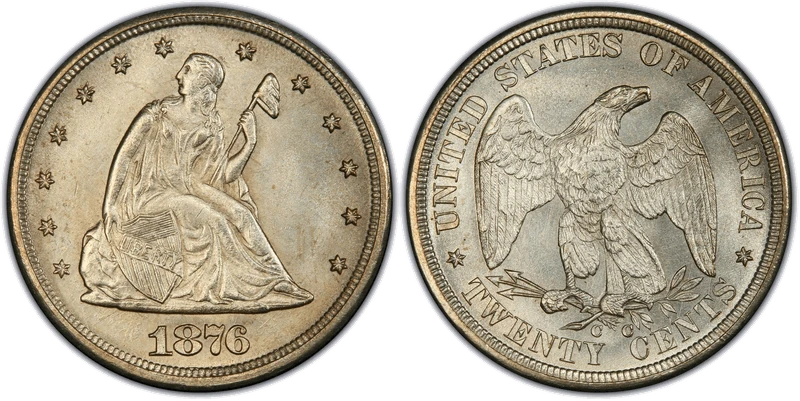
The 1876-CC is the key to the series. Carson City struck 10,000, and most were melted once the denomination was recognized as a failure. Survivors are among the great Carson City rarities.
1877 and 1878 — proof only. No circulation strikes at all. About 600 of the 1878.
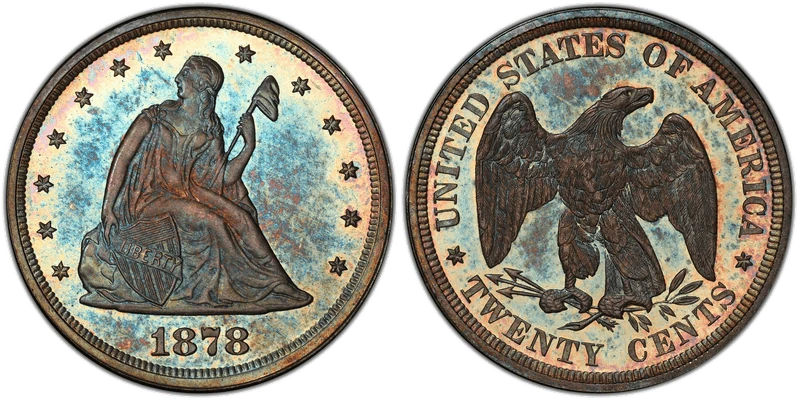
Congress repealed the denomination in 1878.
The Lesson
The twenty-cent piece is one of the cleanest lessons in numismatics. A denomination can be theoretically useful and still fail completely if it is physically confusable with something that already exists. The logic was sound. The execution — a coin two millimetres smaller than a quarter with the same design on it — killed it inside a year.
It is also the last true denomination in this series of posts. After the twenty-cent piece, every everyday circulating denomination the United States has issued has been covered.
What Is in the Catalog
NumisDex catalogues the complete twenty-cent series: all four dates, every mint, every proof year, including the 1876-CC. Behind it sit the 1874–1876 pattern issues — the experimental designs from the two years before and during the coin's short life.
- Browse the complete Twenty-Cent series
- The 1876-CC — the key date
- The 1875 twenty-cent patterns
Discussion
- Do you have a twenty-cent piece in your type set? Which date?
- Was the plain edge a reasonable attempt at differentiation, or was the coin doomed the moment it got the Seated Liberty?
- Carson City twenty-cent pieces sit in the shadow of CC Morgans and Trade dollars. Underrated?
- What other denomination would you have tried instead — and would it have survived the pocket test?
Related Reading
- The Coins America Forgot: Two Cent and Three Cent Pieces — the other odd denominations that share this category
- Trade Dollars: The Only US Coin the Government Disowned — same designer, same silver politics, two years earlier
- The Quarter: America's Most Collected Coin — the coin it could not be told apart from