
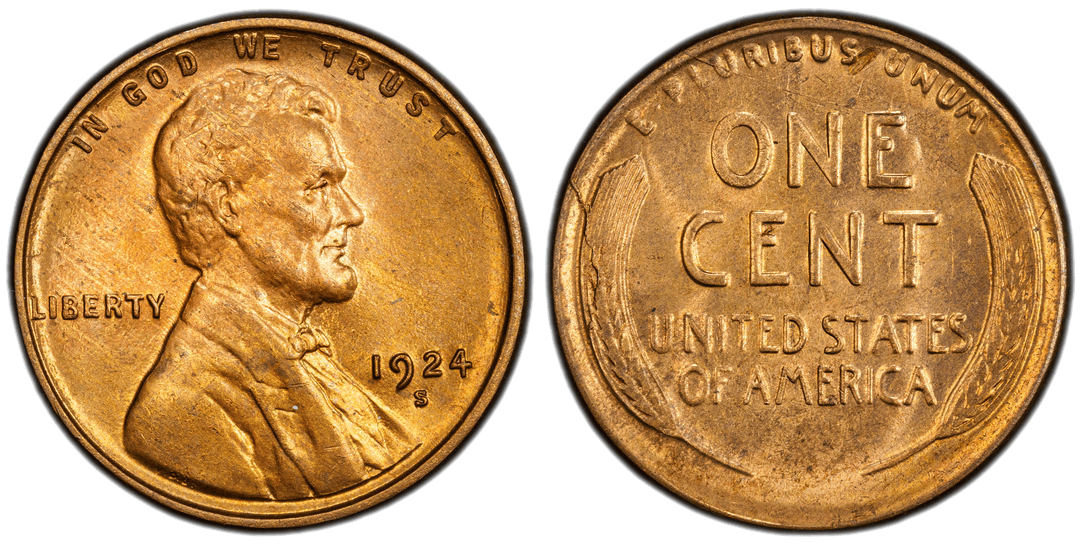
1924 (S) Lincoln Wheat Cent - RCD-1c-1924S-01R Retained Cud
Error
Attribution
Discovered by
Mike Antenucci
Verified by
Cuds on Coins
Original Research
Description
Only retained cud currently cataloged for the 1924-S Lincoln wheat cent, RCD-1c-1924S-01R documents a reverse die rim failure identified by the Cuds on Coins attribution service. The "R" suffix pinpoints the retained cud on the reverse — the wheat ears composition designed by Victor David Brenner in 1909, where twin wheat stalks curve inward above ONE CENT and UNITED STATES OF AMERICA. San Francisco produced approximately 11.70 million cents in 1924, a comparatively low mintage that places this date among the semi-key S-mint wheat cents of the 1920s. Lower production volumes generally mean fewer die pairs consumed, which statistically reduces the total number of die failures observed for a given date — making the documentation of even a single retained cud noteworthy for the 1924-S issue. The retained cud mechanism involves a section of the die rim cracking under the cumulative stress of tens of thousands of strikes, with the fractured portion breaking free and sinking slightly below the adjacent die surface while held in place. The resulting coins display a raised shelf at the corresponding rim position, where the planchet metal was forced into the depression left by the sunken die fragment. This raised area carries its design intact, sitting above the level of the areas struck by the unbroken portion of the die. On Lincoln wheat cent reverses, retained cuds most commonly develop near the tips of the wheat ears or adjacent to peripheral lettering, where the die rim experiences the greatest outward pressure during striking. Collectors searching for this variety should examine the reverse rim methodically under magnification, comparing each segment for the telltale combination of a raised surface with its design still present that distinguishes a retained cud from normal rim contact wear.
External References
Community & Reference
Related Errors


More Retained Cud Errors
Collector Essentials
Tools for examining and preserving error coins and die varieties.
10x-20x Jeweler's Loupe
Essential for examining die varieties, doubled dies, and RPMs
Cherry Picker's Guide
The definitive reference for U.S. error coins and die varieties
2x2 Coin Flips & Holders
Protect and organize your finds with archival-quality holders
USB Digital Microscope
Capture detailed images for documentation and community submissions
As an Amazon Associate, NumisDex earns from qualifying purchases.