
RCD-2c-1864-1R Retained Cud
Error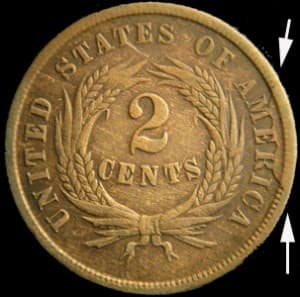
Description
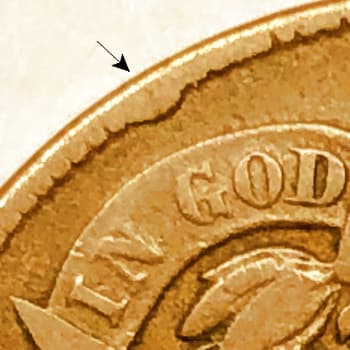
First reverse retained cud cataloged for the 1864 Two Cent Piece with Large Motto, RCD-2c-1864-1R documents the earliest die rim failure identified on the reverse of this historically significant denomination. The two-cent piece occupies a special position in United States coinage history as the first denomination to carry the motto IN GOD WE TRUST — a Civil War-era addition prompted by public appeals to Secretary of the Treasury Salmon P. Chase to acknowledge divine providence on the nation's currency. James B. Longacre designed both sides: an obverse shield with crossed arrows and laurel branch beneath the newly introduced motto, and a reverse wreath encircling the 2 CENTS denomination with UNITED STATES OF AMERICA around the periphery. Philadelphia struck approximately 19.85 million Large Motto examples in 1864, capitalizing on the enormous demand for small-denomination coinage created by wartime hoarding of silver and gold. The reverse (R) designation places this retained cud on the wreath side, where the die rim adjacent to the peripheral inscription experienced the fracture that characterizes this variety. Retained cuds form when the rim cracks through its full thickness but the fractured section remains mechanically connected, producing a raised displacement on struck coins with the crack trajectory preserved as a visible boundary line. Cataloged by Cuds on Coins without known cross-references, this variety provides direct physical evidence of die stress conditions during the two-cent piece's inaugural production year. The relatively thick copper planchet (weighing 6.22 grams compared to the cent's 3.11 grams) required substantial striking force to bring up the high-relief design details, creating the mechanical conditions that could initiate rim fractures on working dies subjected to extended production runs.
Attribution History
- Discovered by Fred Weinberg
- Expert attribution by Cuds on Coins
External References
Community & Reference
Related Errors

More Retained Cud Errors
Collector Essentials
Tools for examining and preserving error coins and die varieties.
10x-20x Jeweler's Loupe
Essential for examining die varieties, doubled dies, and RPMs
Cherry Picker's Guide
The definitive reference for U.S. error coins and die varieties
2x2 Coin Flips & Holders
Protect and organize your finds with archival-quality holders
USB Digital Microscope
Capture detailed images for documentation and community submissions
As an Amazon Associate, NumisDex earns from qualifying purchases.