
RCD-2c-1864-06R Retained Cud
Error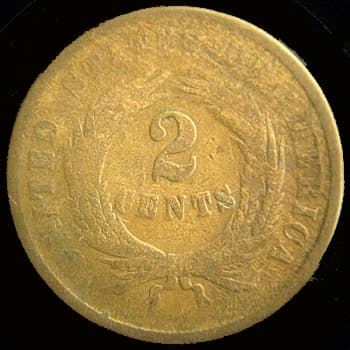
Description
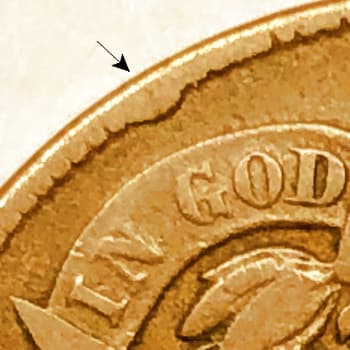
Sixth retained cud cataloged for the 1864 Two Cent Piece with Large Motto reverse by the Cuds on Coins attribution service, RCD-2c-1864-06R adds another documented die rim failure to the inaugural year of this Civil War-era denomination. The two cent piece, authorized by the Act of April 22, 1864, holds dual historical significance: it introduced the new denomination to American commerce and became the first United States coin to carry the motto IN GOD WE TRUST on its obverse. James B. Longacre's design placed the motto on a ribbon above the heraldic shield on the obverse, while the reverse featured a wreath encircling the numeral 2 with UNITED STATES OF AMERICA around the periphery. The "R" suffix confirms this retained cud appears on the reverse, where the wreath's detailed botanical elements — wheat, corn, cotton, and tobacco — create a complex die topography adjacent to the rim. Philadelphia struck two cent pieces exclusively throughout the denomination's 1864-1873 lifespan, and the 1864 Large Motto production was substantial as the new coin gained immediate public acceptance during the Civil War coin shortage. Six documented retained cuds for the first year's reverse production indicates notable die rim stress, likely driven by the coin's relatively large 23mm diameter and the deeply sculpted wreath design that required considerable striking force to fully render. Each retained cud represents a die where the rim cracked and the broken section sank while remaining attached, producing a raised shelf on struck coins. The reverse wreath design places its leaf tips and berry clusters near the rim, and the transitions between these high-relief elements and the flat rim create stress concentration points where fractures preferentially initiate. Collectors should examine the reverse rim under magnification, comparing any raised or softened rim areas against the surrounding sharp detail to locate the retained cud.
Attribution History
- Discovered by Chuck Newman
- Expert attribution by Cuds on Coins
External References
Community & Reference
Related Errors

More Retained Cud Errors
Collector Essentials
Tools for examining and preserving error coins and die varieties.
10x-20x Jeweler's Loupe
Essential for examining die varieties, doubled dies, and RPMs
Cherry Picker's Guide
The definitive reference for U.S. error coins and die varieties
2x2 Coin Flips & Holders
Protect and organize your finds with archival-quality holders
USB Digital Microscope
Capture detailed images for documentation and community submissions
As an Amazon Associate, NumisDex earns from qualifying purchases.