
In the catalog: 1971 Eisenhower Dollar, 1976 Eisenhower Dollar (Bicentennial) and Eisenhower Dollars 1971-1978
The Eisenhower Dollar: The Moon, the Liberty Bell, and Type 1 vs Type 2
The Eisenhower dollar was the last big dollar coin the United States made for circulation, and in eight years it wore two different backs.
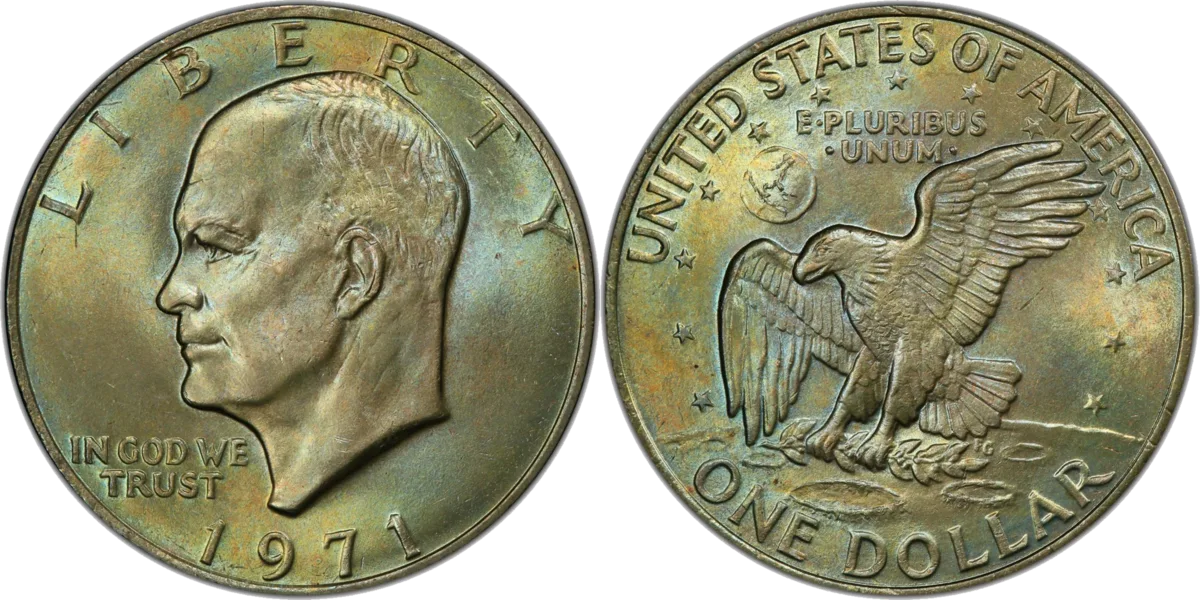
A Dollar for Ike and Apollo 11
The law that created the coin, Public Law 91-607, was signed on December 31, 1970. It honored President Dwight D. Eisenhower, who had died in March 1969, and the Apollo 11 Moon landing that July. Chief Engraver Frank Gasparro designed both sides. The reverse, an eagle landing on the Moon with an olive branch in its talons and the Earth above, is adapted from the Apollo 11 mission insignia, created by astronaut Michael Collins and others.
Circulation coins were copper-nickel clad, struck at Philadelphia and Denver. San Francisco made 40% silver versions for collectors: uncirculated coins in blue envelopes ("Blue Ikes") and proofs in brown boxes ("Brown Ikes").
The Bicentennial Back
For the nation's 200th birthday, the Mint held a public contest for new quarter, half dollar and dollar reverses. The dollar went to Dennis R. Williams, a 22-year-old student at the Columbus College of Art and Design in Columbus, Ohio. His design puts the Liberty Bell in front of the Moon. Gasparro adapted it for coinage, simplifying the lunar surface and adjusting the lettering and the bell.
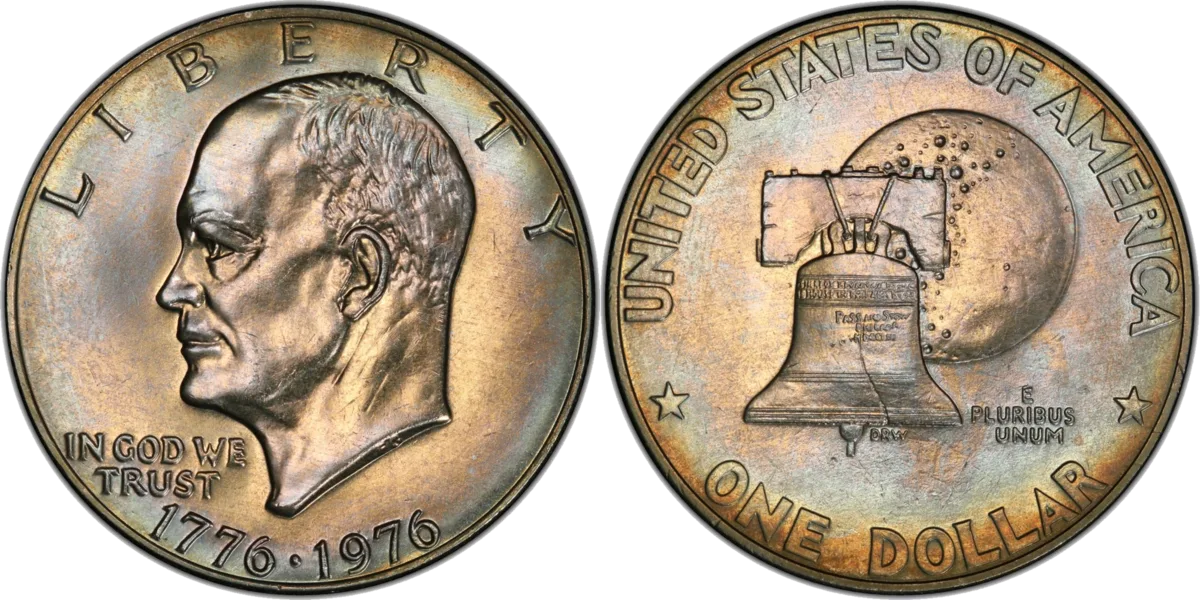
Dollars struck in 1975 and 1976 all carry the dual date 1776-1976, so no Eisenhower dollar is dated 1975.
Type 1 vs Type 2
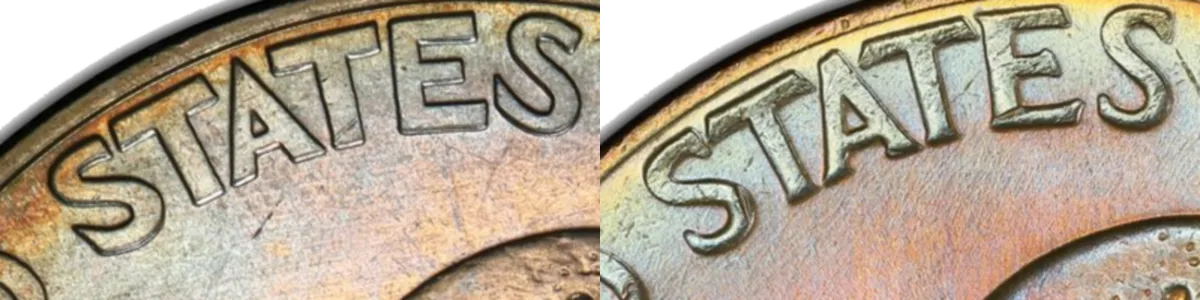
The first Bicentennial reverse had bold, blocky lettering. The copper-nickel coins weren't striking up crisply, so the Mint halted production and Gasparro reworked the dies with narrower, sharper letters. Collectors call the two Type 1 and Type 2. UNITED STATES OF AMERICA is the easiest place to compare them. Every 40% silver Bicentennial dollar is Type 1; the 1975 proof sets held Type 1 clad dollars and the 1976 proof sets held Type 2.
A Coin That Never Caught On
The Ike dollar was big, 38.1 mm across, and heavy, and Americans mostly left it alone. A 1976 Treasury study found that nearly every one paid out came straight back. Where it did work was Nevada's casinos, which used Ikes in place of private tokens. The Apollo reverse returned in 1977, and 1978 was the last year. The smaller Susan B. Anthony dollar replaced it in 1979.
See the series in the catalog: Eisenhower Dollars 1971-1978, including the 1976 Type 1 and 1976 Type 2.
Sources: U.S. Mint historical documents ("Description of New Eisenhower Dollar"; Bicentennial coin design competition winners; "Mint Announces Release of Bicentennial Dollar"); Wikipedia, "Eisenhower dollar"; PCGS CoinFacts.
0 Replies
Related Threads
- The $2.50 Coin Is Coming Back: What Collectors Need to Know About HR 56160 replies · 4mo ago
- The End of the Penny: What HR 4459 (MINT Act) Means for Collectors0 replies · 4mo ago
- What Is the CCAC? How America's Coin Designs Get Chosen0 replies · 4mo ago
- The Last Penny: US Mint Ends 232 Years of Cent Production on November 12, 20250 replies · 4mo ago