
Understanding PCGS and NGC Coin Grading
Understanding PCGS and NGC Coin Grading
PCGS (Professional Coin Grading Service) and NGC (Numismatic Guaranty Corporation) are the two leading third-party coin grading services in the United States. Understanding how these services work, what their grades mean, and when to use them is essential knowledge for any serious collector.
What Third-Party Grading Services Do
PCGS and NGC provide three core services:
- Authentication — They verify that a coin is genuine, not counterfeit or altered.
- Grading — They assign a grade on the Sheldon scale (1-70) based on the coin's condition.
- Encapsulation — They seal the coin in a tamper-evident plastic holder ("slab") with a label showing the grade and other information.
The sealed holder protects the coin from environmental damage and provides buyers confidence in the grade and authenticity.
The Sheldon Grading Scale
Both services use the same 1-70 scale, originally developed by Dr. William H. Sheldon for Large Cents and later adopted industry-wide:
Circulated Grades:
- AG-3 (About Good) — Heavily worn, outline visible
- G-4/6 (Good) — Major features visible but flat
- VG-8/10 (Very Good) — Design elements clear
- F-12/15 (Fine) — Moderate wear, all details visible
- VF-20/25/30/35 (Very Fine) — Light wear on high points
- EF-40/45 (Extremely Fine) — Slight wear on highest points
- AU-50/53/55/58 (About Uncirculated) — Trace wear only
Uncirculated Grades:
- MS-60/61/62 (Mint State) — No wear, but many marks and/or poor eye appeal
- MS-63 (Choice) — Few noticeable marks, average eye appeal
- MS-64 (Near Gem) — Minimal marks, above-average eye appeal
- MS-65 (Gem) — Strong luster and strike, minimal marks
- MS-66 (Superb Gem) — Outstanding quality, near-perfect
- MS-67/68/69 (Superb+) — Exceptional to virtually perfect
- MS-70 (Perfect) — Flawless under 5x magnification
Designations and Suffixes
Both services use additional designations to describe special characteristics:
- + (Plus) — Coins that fall at the upper end of a grade but don't quite qualify for the next grade up
- * (Star) — NGC designation for coins with exceptional eye appeal for the grade
- CAM/DCAM — Cameo and Deep Cameo for proof coins with frosted devices against mirrored fields
- FB/FBL/FH/FT — Full designation for specific series (Full Bands on Mercury Dimes, Full Bell Lines on Franklin Halves, Full Head on Standing Liberty Quarters, Full Torch on Roosevelt Dimes)
- RD/RB/BN — Color designations for copper coins (Red, Red-Brown, Brown)
PCGS vs. NGC: Key Differences
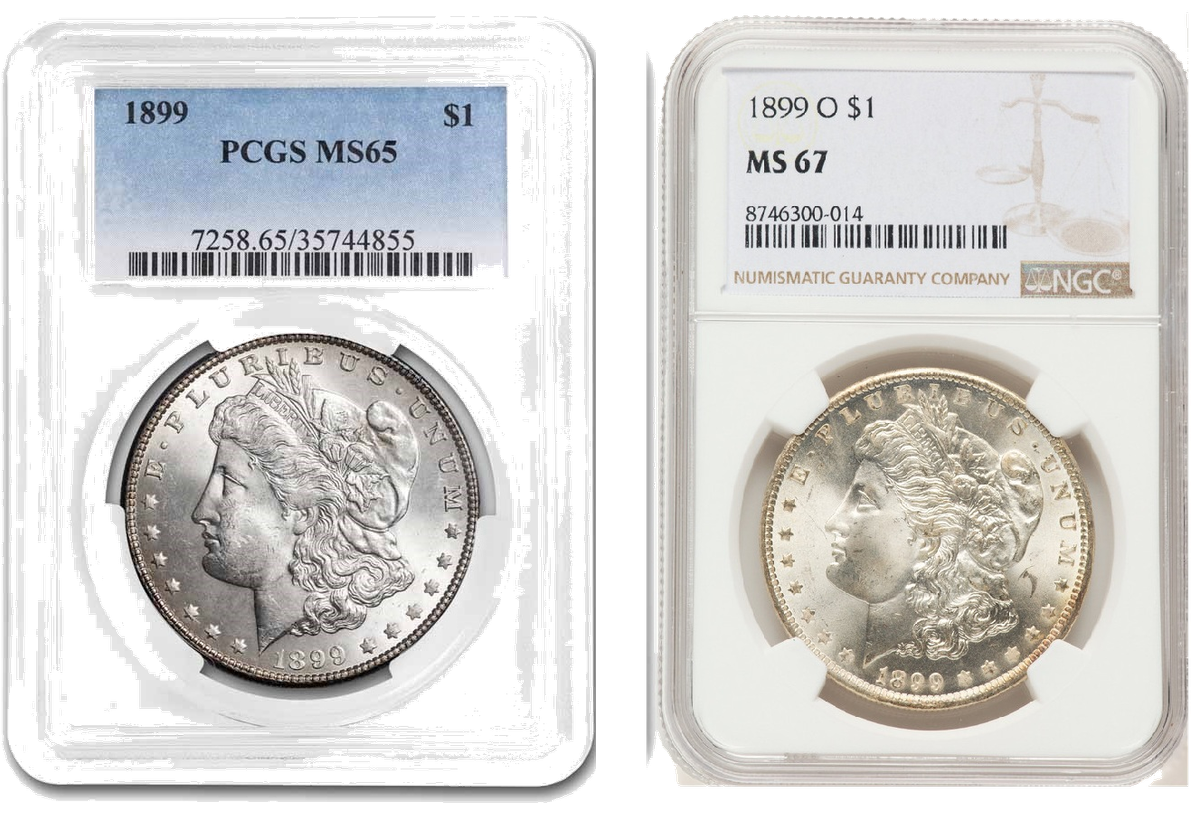
PCGS (left) and NGC (right) holders side by side — while the holder designs differ, both services provide authentication, grading, and tamper-evident encapsulation
While both services are highly respected, there are practical differences:
- Market perception — PCGS-graded coins have historically commanded slight premiums in certain series, particularly classic U.S. coins. NGC is equally respected and sometimes preferred for world coins and modern issues.
- Holder design — PCGS uses a blue/white color scheme; NGC uses a brown/tan or black scheme. Both regularly update holder designs.
- Population reports — Both maintain databases of all coins they've graded, searchable online. These reports help assess rarity within grade.
- Price guides — PCGS maintains the PCGS Price Guide; NGC maintains the NGC Price Guide. Both are useful references but reflect estimated retail values.
- Variety attribution — Both services can attribute die varieties (doubled dies, RPMs, etc.) for an additional fee. Check their supported attributions for your specific variety.
When to Submit Coins for Grading
Not every coin justifies the cost of professional grading. Consider submitting when:
- The coin's estimated value significantly exceeds the grading fee ($20-$150+ per coin)
- You want authentication for a potentially valuable variety or error
- You plan to sell the coin and a graded holder will increase buyer confidence
- You want protection for a high-value coin in your collection
For a detailed visual guide to holder anatomy and how to spot counterfeit slabs, see our guide to reading PCGS and NGC holders.
NumisDex cross-references NGC census data across our 72,000+ listings, helping you understand population counts and relative rarity for varieties you're researching.
0 Replies
Related Threads
- Rosa Parks Commemorative Coins: HR 916 Would Honor a Civil Rights Icon0 replies · 2mo ago
- Olympic Coins for LA 2028 and Salt Lake City 2034: S. 2265 Explained0 replies · 2mo ago
- The End of the Penny: What HR 4459 (MINT Act) Means for Collectors0 replies · 2mo ago
- The $2.50 Coin Is Coming Back: What Collectors Need to Know About HR 56160 replies · 2mo ago
- U.S. Mint Releasing 250,000 Special "July 4th" Privy Mark Declaration of Independence Quarters0 replies · 2mo ago