
Die Varieties vs. Die Errors: What's the Difference?
Die Varieties vs. Die Errors: What's the Difference?
In numismatics, "variety" and "error" are often used interchangeably, but they refer to distinct categories of coins that deviate from the norm. Understanding the difference helps you identify what you have, communicate accurately with other collectors, and properly attribute your finds.
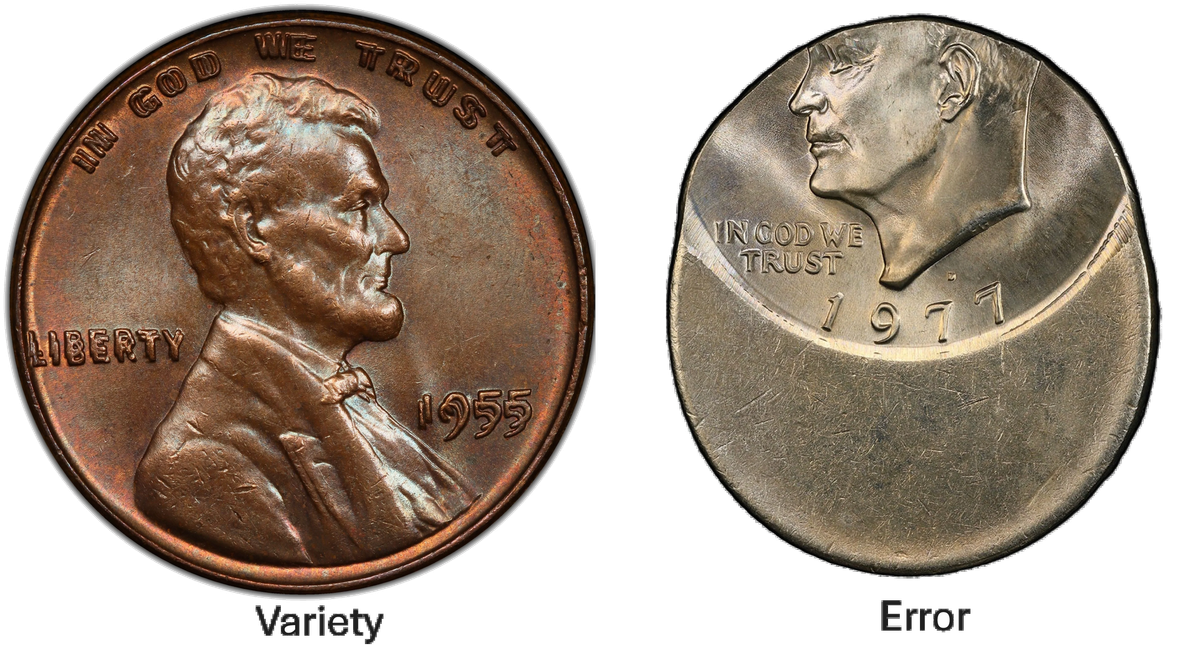
Variety vs. error at a glance — a doubled die obverse (left) is a die variety present on every coin from that die, while an off-center strike (right) is a production error unique to that individual coin
Die Varieties: Intentional (or Systematic) Differences
A die variety is a coin that differs from other coins of the same date and mint because of a characteristic specific to the die that struck it. Die varieties are systematic — every coin struck from that die shares the same characteristics.
Common types of die varieties include:
- Doubled Dies (DDO/DDR) — Doubling in the design elements caused by the hubbing process. Every coin from the affected die shows the same doubling. Browse our DDO and DDR listings, or see specific examples: 1969-S DDO, 1972 DDO, 1995 DDO.
- Repunched Mint Marks (RPM) — Multiple impressions of the mint mark punch on the working die. See our RPM catalog or read the complete RPM guide.
- Repunched Dates (RPD) — Multiple impressions of the date punch. See our RPD catalog.
- Overdates (OVD) — A new date punched over a previous date in the die. The underlying date remains partially visible.
- Over Mint Marks (OMM) — One mint mark punched over another in the working die.
- Die Cracks and Die Breaks — Progressive damage to the die surface that creates raised lines or blobs on struck coins. While technically die damage rather than intentional variation, these are classified as varieties because they're die-specific and consistent.
Mint Errors: Production Mistakes
A mint error is a coin that was produced incorrectly due to a problem during the striking process, planchet preparation, or handling. Unlike varieties, errors affect individual coins (or small groups) rather than all coins from a particular die.
Common types of mint errors include:
- Off-Center Strikes (OFC) — The planchet was not centered between the dies during striking, resulting in a partial design. Browse our off-center listings or learn how to tell off-center from clipped planchet.
- Wrong Planchet (WPL) — A coin struck on a planchet intended for a different denomination (e.g., a cent struck on a dime planchet).
- Broadstrikes (BRD) — A coin struck without the collar die, causing the planchet to spread wider than normal. See broadstrike vs. off-center comparison.
- Clipped Planchets (CLP) — A portion of the planchet was cut away before striking, usually from the blanking process.
- Strike Throughs (STT) — Foreign material (grease, thread, metal fragment) was between the die and planchet during striking, leaving an impression in the coin.
- Multi-Strikes (MST) — A coin struck multiple times, often with the planchet shifting between strikes.
The Gray Area
Some categories blur the line between variety and error:
- Die Clashes (DCL) — When the obverse and reverse dies strike each other without a planchet between them, the design elements transfer between dies. All subsequent coins show traces of the clashed design. This is a die characteristic (variety-like) caused by a production error. Learn more in our die clash guide and counter clash deep dive.
- Cuds (CUD) — A major die break at the rim creates a raised, featureless area on the coin. The break is in the die (variety), but it resulted from die failure (error-like). See die crack vs. die chip vs. cud.
- Rotated Dies (RTD) — The dies are misaligned rotationally. If the misalignment persists across many coins, it behaves like a variety; if it's a one-time event, it's more like an error.
Why the Distinction Matters
Understanding whether you have a variety or an error affects how you attribute, value, and discuss your coins:
- Attribution — Varieties get assigned catalog numbers (Wexler DDO-001, FS-101, VAM-3, etc.) because they're reproducible and identifiable across specimens. Errors are described by type but aren't individually cataloged the same way.
- Value — Varieties are valued by their attribution, rarity within the variety, and demand. Errors are valued primarily by their dramatic visual impact and the type of error.
- Collectibility — Many collectors specialize in one or the other. Variety collectors tend to be methodical completionists. Error collectors often seek dramatic, one-of-a-kind pieces.
NumisDex catalogs both varieties and errors across all U.S. coin denominations. Explore our full catalog to see the breadth of what's been discovered and documented.
0 Replies
Related Threads
- Rosa Parks Commemorative Coins: HR 916 Would Honor a Civil Rights Icon0 replies · 2mo ago
- Olympic Coins for LA 2028 and Salt Lake City 2034: S. 2265 Explained0 replies · 2mo ago
- The End of the Penny: What HR 4459 (MINT Act) Means for Collectors0 replies · 2mo ago
- The $2.50 Coin Is Coming Back: What Collectors Need to Know About HR 56160 replies · 2mo ago
- U.S. Mint Releasing 250,000 Special "July 4th" Privy Mark Declaration of Independence Quarters0 replies · 2mo ago