
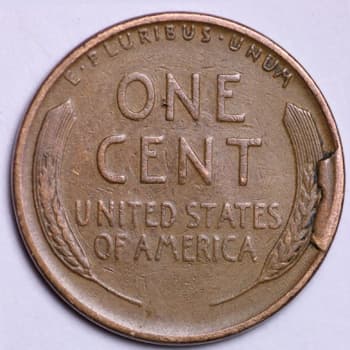
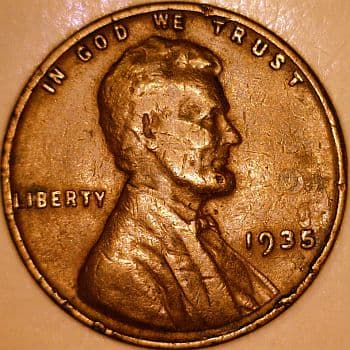
RCD-1c-1935-03R Retained Cud
Error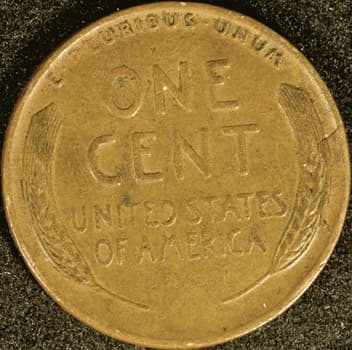
Description
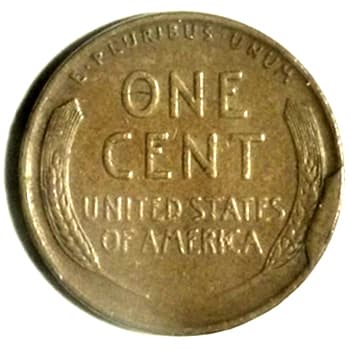
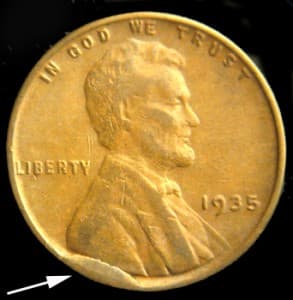
Third reverse retained cud cataloged for the 1935 Lincoln wheat cent by the Cuds on Coins attribution service, RCD-1c-1935-03R documents another instance of die rim failure during Depression-era production at the Philadelphia Mint. With three distinct reverse retained cuds now cataloged for 1935, this date shows a moderate level of die rim fracturing consistent with the standard bronze composition and the production volume of approximately 245.4 million cents. Retained cuds capture a specific moment in the die failure progression — the steel has cracked along the rim, but the fractured segment has not yet broken completely free, remaining attached and producing a raised irregular formation on struck coins that bridges the fracture zone. This intermediate state is metallurgically interesting because it documents the ductile behavior of die steel under repeated impact loading, where the fractured section flexes and deforms rather than snapping cleanly away. The "03R" suffix distinguishes this variety from the first and second reverse retained cuds (01R and 02R) for the same date, with each representing an independent working die that fractured at a different rim location. Victor David Brenner's wheat reverse design positions the inscriptions UNITED STATES OF AMERICA and E PLURIBUS UNUM near the rim, and the wheat ear stalks extend outward toward the periphery, meaning retained cuds at different positions around the rim affect different design elements. The 1935 cent was struck on standard 95% copper, 5% tin and zinc bronze planchets — a relatively soft composition that imposes moderate stress on working dies compared to harder alloys. Collectors should examine the reverse rim under 8-12x magnification, looking for any raised swelling or bridge-like formation that disrupts the normally uniform rim profile.
Attribution History
- Discovered by George dePozsgay
- Expert attribution by Cuds on Coins
External References
Community & Reference
Related Errors
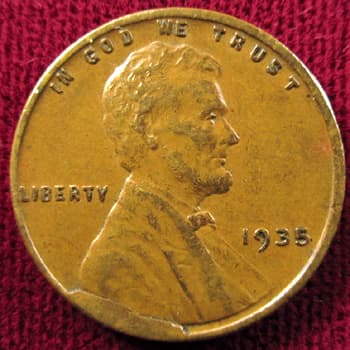
More Retained Cud Errors
Collector Essentials
Tools for examining and preserving error coins and die varieties.
10x-20x Jeweler's Loupe
Essential for examining die varieties, doubled dies, and RPMs
Cherry Picker's Guide
The definitive reference for U.S. error coins and die varieties
2x2 Coin Flips & Holders
Protect and organize your finds with archival-quality holders
USB Digital Microscope
Capture detailed images for documentation and community submissions
As an Amazon Associate, NumisDex earns from qualifying purchases.