
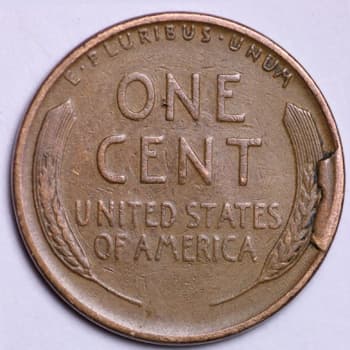
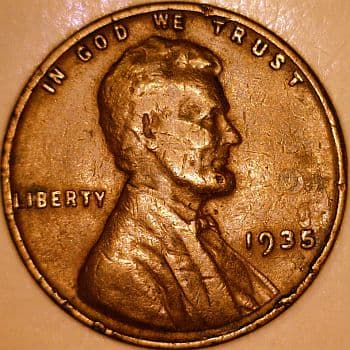
RCD-1c-1935-01R Retained Cud
Error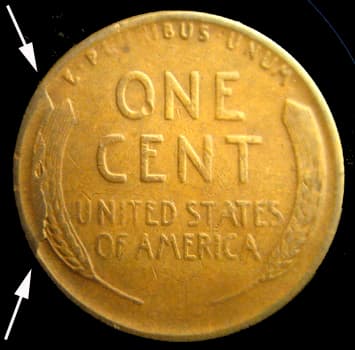
Description
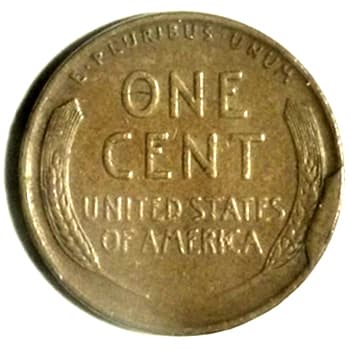
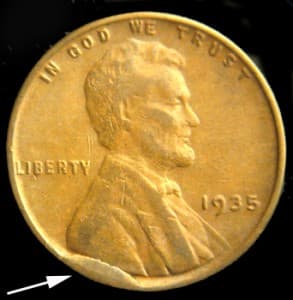
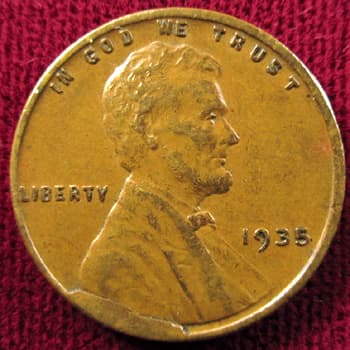
First reverse retained cud documented for the 1935 Lincoln wheat cent by the Cuds on Coins attribution service, RCD-1c-1935-01R captures a die rim failure from a mid-Depression production year at the Philadelphia Mint. Approximately 245.4 million cents were struck in 1935, a modest output reflecting reduced commercial demand during the economic downturn that had gripped the nation since 1929. Retained cuds form through a specific failure sequence: the die rim develops a crack due to the cumulative stress of repeated striking, and the fractured section begins to separate but remains physically attached to the main die body rather than breaking free entirely. This transitional state produces a distinctive raised area on the struck coin where the rim should be smooth and uniform — the attached fragment deflects slightly under striking pressure, creating a swollen or bridge-like formation that is the hallmark of a retained cud. The "01R" suffix indicates this is the first reverse retained cud cataloged for the 1935 date, establishing a baseline for any subsequent discoveries of additional retained cud dies from the same year. Victor David Brenner's wheat reverse design, with the paired wheat ear stalks framing ONE CENT, positions organic botanical detail near the rim that can be affected by the cud formation — depending on the specific location of the rim fracture, portions of the wheat ears or peripheral lettering may be distorted or partially obscured by the retained die fragment. The 1935 cent is struck on the standard 95% copper bronze alloy, which is relatively soft and does not impose the extreme die stress associated with harder compositions. Collectors should examine the reverse rim carefully under 8-12x magnification, looking for any irregular swelling or raised area that breaks the uniform rim profile.
Attribution History
- Discovered by Fred Weinberg
- Expert attribution by Cuds on Coins
External References
Community & Reference
Related Errors
More Retained Cud Errors
Collector Essentials
Tools for examining and preserving error coins and die varieties.
10x-20x Jeweler's Loupe
Essential for examining die varieties, doubled dies, and RPMs
Cherry Picker's Guide
The definitive reference for U.S. error coins and die varieties
2x2 Coin Flips & Holders
Protect and organize your finds with archival-quality holders
USB Digital Microscope
Capture detailed images for documentation and community submissions
As an Amazon Associate, NumisDex earns from qualifying purchases.