
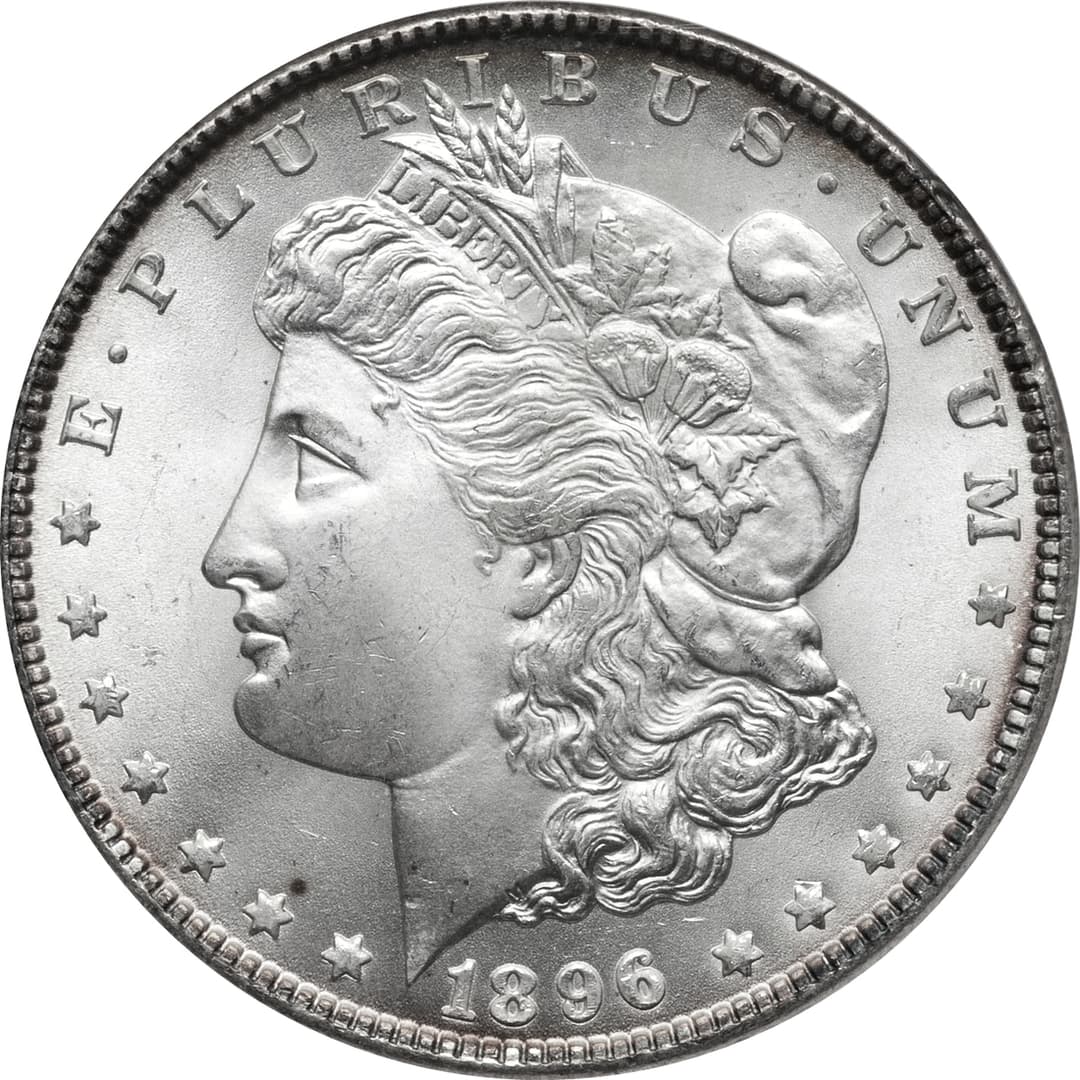
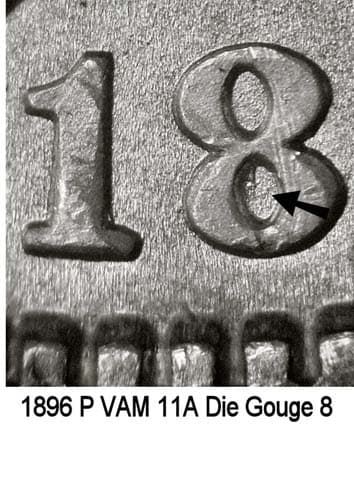
1896-P VAM-1H
Error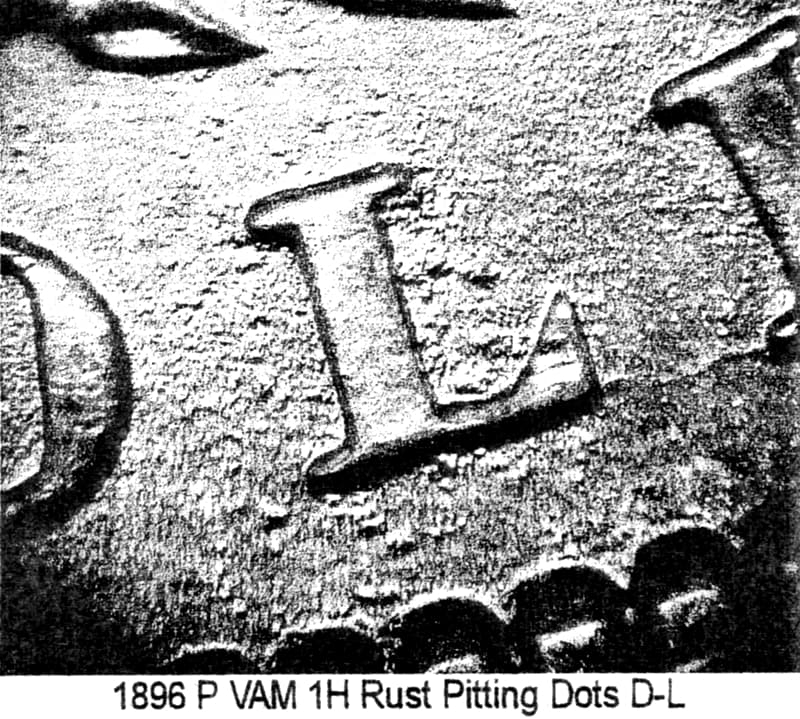
Description
Discovered in 2017, the 1896-P VAM-1H displays raised dots from die rust pitting — a distinctive form of die deterioration where moisture-induced corrosion creates small pits in the die surface that transfer as raised dots on struck coins. The pitting appears at the left side of the D and at the left L in DOLLAR on the C3a reverse, while the obverse uses a standard Type III2 die 1. Die rust pitting differs from die chips or die cracks in its mechanism: rather than mechanical fracture, rust forms when dies are stored in humid conditions or when moisture contacts the die surface during production breaks. The resulting corrosion eats small cavities into the steel, and these cavities fill with metal during striking, producing the characteristic raised dots. The location of pitting at specific letters — the D and the second L in DOLLAR — indicates that moisture was present in a localized area of the die face, possibly from condensation or a coolant drip during the striking process. The 1896 Philadelphia Morgan Dollar was produced in moderate quantities during the final years before the series' 1904 hiatus, and die rust varieties from this era document the environmental conditions in the Mint's press rooms. Die pitting varieties attract collectors who appreciate the intersection of metallurgy and numismatics.
External References
Community & Reference
Related Errors
More VAM Variety Errors


Collector Essentials
Tools for examining and preserving error coins and die varieties.
10x-20x Jeweler's Loupe
Essential for examining die varieties, doubled dies, and RPMs
Cherry Picker's Guide
The definitive reference for U.S. error coins and die varieties
2x2 Coin Flips & Holders
Protect and organize your finds with archival-quality holders
USB Digital Microscope
Capture detailed images for documentation and community submissions
As an Amazon Associate, NumisDex earns from qualifying purchases.