
PC-5c-1869-09 Pre-Cud
Error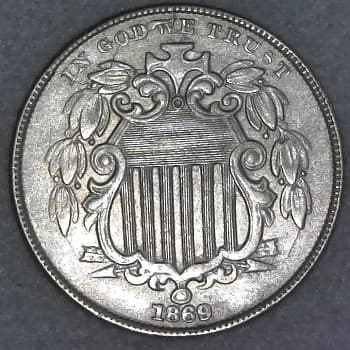
Description
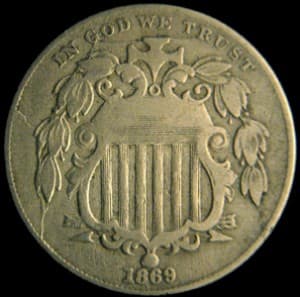
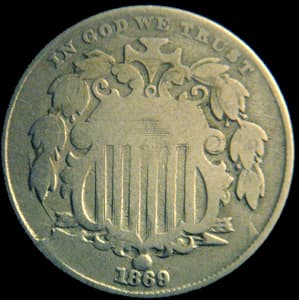
Ninth pre-cud cataloged for the 1869 Shield Nickel by the Cuds on Coins attribution service, PC-5c-1869-09 documents an advanced die rim crack on a coin from the early years of United States nickel five-cent coinage. The designation follows the standardized format: PC for pre-cud, 5c for the five-cent denomination, 1869 for the date, and 09 as the sequential variety number. A pre-cud represents an intermediate stage of die rim failure — the die steel has cracked at the rim but the fractured section has not yet separated from the die body, producing a raised irregular line or ridge on struck coins that traces the crack's path along the rim and into the adjacent design field. The source data notes "Reverse die cracks 'black arrows,'" indicating that the diagnostic die cracks are identified by black arrow markers on reference images, a convention used by Cuds on Coins to precisely locate fracture paths for collector reference. James B. Longacre's Shield nickel design, produced from 1866 through 1883, employed the demanding 75% copper, 25% nickel alloy that required substantially higher striking pressures than contemporary copper, silver, or gold denominations. Philadelphia struck approximately 16.40 million Shield nickels in 1869, the fourth year of production with the "Without Rays" reverse that replaced the original "With Rays" design in 1867. The existence of nine documented pre-cuds for the 1869 date alone provides quantitative evidence of the die stress inherent in striking this hard alloy, as rim fractures accumulate when repeated strike cycles propagate fatigue cracks through the die steel from the highest-stress rim areas inward toward the design field. Collectors should examine the rim area for a raised line tracing the die crack path, using 10-15x magnification with angled lighting that casts shadows along the ridge created by the fracture.
Attribution History
- Discovered by Robin Turgeon
- Expert attribution by Cuds on Coins
External References
Additional Notes
Note: Reverse die cracks ‘black arrows”.
Community & Reference
Related Errors
More Pre-Cud Errors
Collector Essentials
Tools for examining and preserving error coins and die varieties.
10x-20x Jeweler's Loupe
Essential for examining die varieties, doubled dies, and RPMs
Cherry Picker's Guide
The definitive reference for U.S. error coins and die varieties
2x2 Coin Flips & Holders
Protect and organize your finds with archival-quality holders
USB Digital Microscope
Capture detailed images for documentation and community submissions
As an Amazon Associate, NumisDex earns from qualifying purchases.