
1836 Capped Bust Half Dime - Large 5C - Capped Bust Half Dime Bisecting Rim to Rim Die Crack (Obverse) and Retained Cud (Reverse)
Error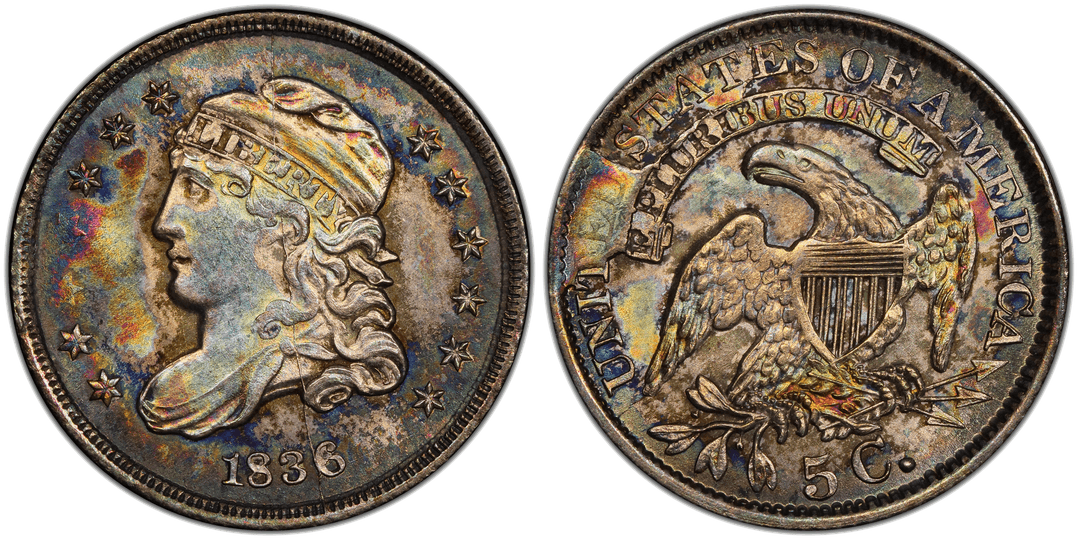
Description
A bisecting rim to rim die crack on the obverse and a retained cud on the reverse are visible on this 1836 Capped Bust half dime. A bisecting rim to rim die crack runs completely across the face of the die, from one edge of the rim to the other. Note that there is disagreement in the community between a split die and a rim to rim die crack; some experts use a separation of 0.5 mm to draw the line between the two. A retained cud occurs when a piece of the die breaks away but remains in the die, creating a filled area on the struck coin. In this case, the die crack on the obverse runs from 12 o'clock down through Liberty and between the “3” and “6” of the date to the rim. The retained cud on the reverse runs from the rim through “TED” of “UNITED” and to the “E. PLURIBUS UNUM” motto ribbon. The 1836 Capped Bust half dime was one of the final years of this design, with the Seated Liberty type introduced in 1837.
Community & Reference
More Bisecting Rim to Rim Die Crack Errors
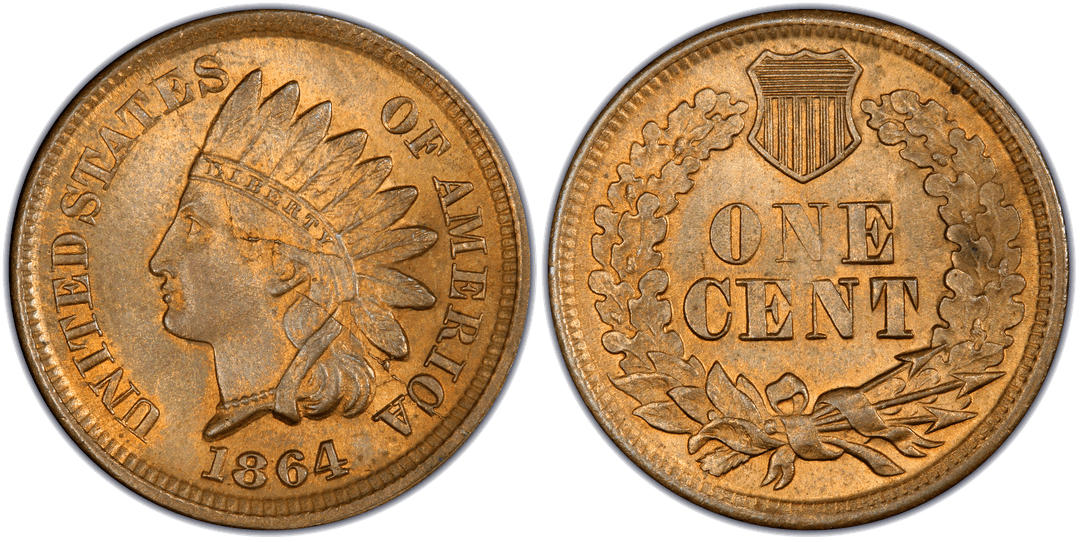
1864 Indian Head Cent (Bronze No L) Bisecting Rim to Rim Die Crack
Bisecting Rim to Rim Die Crack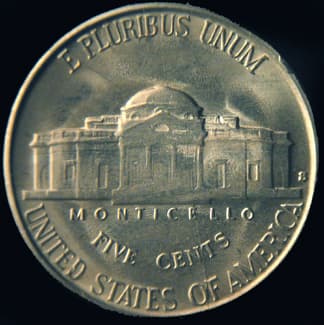
RRDC-5c-1941S-01R Bisecting Rim to Rim Die Crack
Bisecting Rim to Rim Die Crack
RRDC-10c-1837-01 Bisecting Rim to Rim Die Crack
Bisecting Rim to Rim Die Crack
RRDC-10c-1940S-01 Bisecting Rim to Rim Die Crack
Bisecting Rim to Rim Die Crack
RRDC-10c-1940S-02 Bisecting Rim to Rim Die Crack
Bisecting Rim to Rim Die CrackCollector Essentials
Tools for examining and preserving error coins and die varieties.
10x-20x Jeweler's Loupe
Essential for examining die varieties, doubled dies, and RPMs
Cherry Picker's Guide
The definitive reference for U.S. error coins and die varieties
2x2 Coin Flips & Holders
Protect and organize your finds with archival-quality holders
USB Digital Microscope
Capture detailed images for documentation and community submissions
As an Amazon Associate, NumisDex earns from qualifying purchases.