
In the catalog: 1942 Jefferson Nickel, 1944 Jefferson Nickel and Jefferson Nickels Original Design 1938-2003
Wartime Nickels: The Nickel With No Nickel and the First P Mint Mark
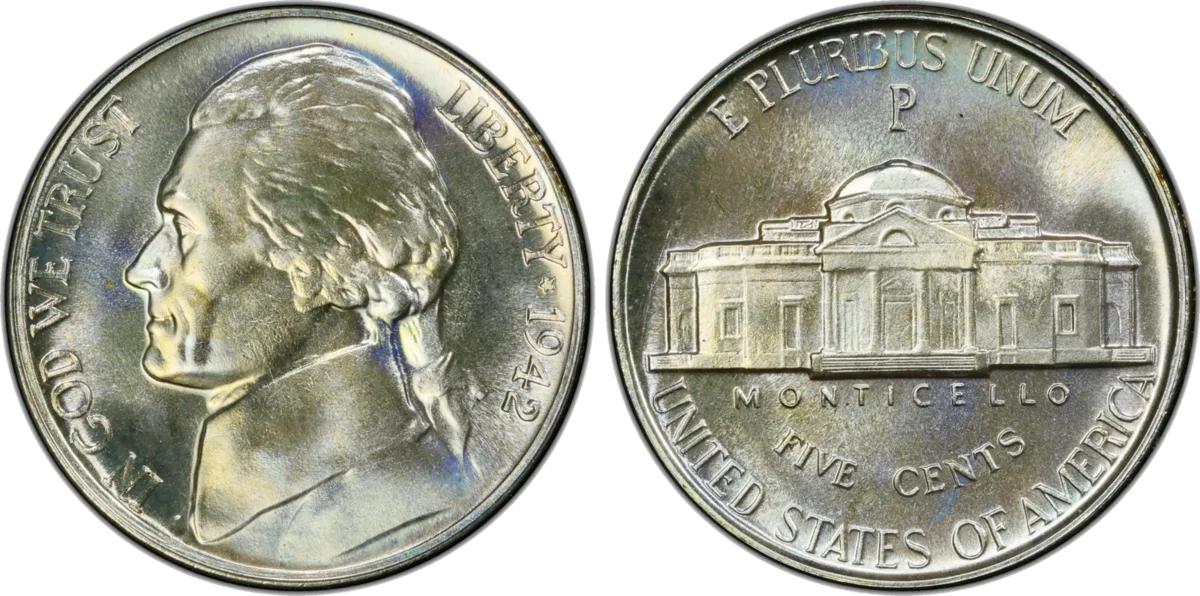
In 1942 the United States started making five-cent pieces with no nickel in them. To mark the change, the Mint did something it had never done on a U.S. coin: it put a mint mark on coins struck in Philadelphia.
Nickel Went to War
An act of Congress on March 27, 1942 let the Treasury change the five-cent piece to remove nickel, a metal the war effort needed. The act suggested half copper and half silver, but let the Mint adjust the mix. A 50/50 alloy had a problem: it lacked nickel's magnetism, so vending machines and turnstiles would have rejected it. Adding manganese fixed that. The final alloy was 56% copper, 35% silver and 9% manganese, and it was coined for circulation from October 1942.
The Big Mint Mark
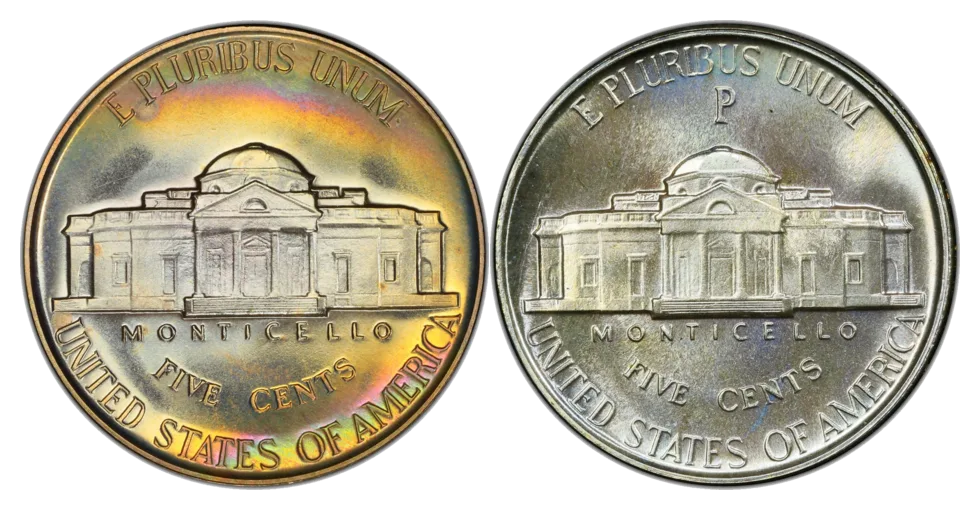
Every wartime nickel carries a large mint mark above Monticello's dome. The point was to make the coins easy to sort out and withdraw after the war. Philadelphia, which had never marked its coins, got a large P. That was the first time a P appeared on a U.S. coin.
1942 Had Both Kinds
Earlier in 1942, Philadelphia and Denver struck the regular copper-nickel coin. In the closing months of the year, Philadelphia and San Francisco struck the new wartime alloy. From 1943 through 1945, all three mints made it. The big mark above Monticello is how you tell them apart.
The Twist
The five-cent piece was only 25% nickel to begin with, and the nickel it saved made little difference to the war effort. Numismatist David W. Lange concluded the change was made "more for the sake of propaganda than for its practical value": statistically insignificant, but a highly visible reminder that everyone was sacrificing.
The Famous Fake
A 1944 nickel with no mint mark above Monticello isn't a real Mint coin. It's a Henning nickel. In the 1950s, Francis LeRoy Henning of Erial, New Jersey made hundreds of thousands of fake nickels dated 1939, 1944, 1946, 1947 and 1953. The 1944 gave him away, because every genuine 1944 carries the big P, D or S. He was arrested by 1955, and the Secret Service recovered some of his coins from a New Jersey creek.
Don't toss one if you find it. Henning nickels have become collectible for their story. (CoinWeek notes that counterfeits are technically illegal to own, though as it puts it, it's "highly unlikely that the Secret Service will be knocking on your door.")
The regular alloy and the small mint mark came back in 1946. See the series in the catalog: Jefferson Nickels Original Design 1938-2003, and the 1942 and 1944 year pages.
Sources: David W. Lange, "The Wartime Silver Nickels of 1942-45" (The Numismatist / NGC, 2008); Wikipedia, "Jefferson nickel" (citing Q. David Bowers, 2007); Tyler Rossi, "A Collectible Counterfeit? The Story of Henning Nickels" (CoinWeek, 2025).