
By Brandon Norris
Series: Flowing Hair Dollars 1794-1795 in the catalog
The 1794 Flowing Hair Dollar: America's First Silver Dollar and Its Record Sales
From the First Silver Dollar to a $12 Million Sale
Published June 12, 2026. Sale prices are as reported at the time by the auction houses and dealers named below.
The 1794 Flowing Hair Silver Dollar has a place no later American coin can take: it was the first silver dollar struck by the United States Mint. Numismatic historian Jack Collins estimated in the early 1990s that 120 to 130 survive from the 1,758 coins delivered, which makes it one of the most historically significant coins in existence, and its finest example has set more than one price record.
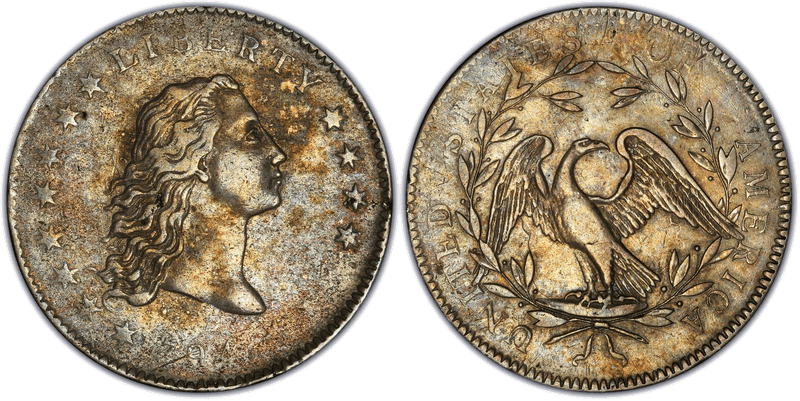
The 1794 Flowing Hair Dollar. View all 1794 dollar varieties in the NumisDex catalog.
The Sale Record
The finest known example is graded PCGS SP-66 (Specimen) with CAC approval. Its recorded sales:
- 2010: Sold privately to the Cardinal Collection Educational Foundation for $7.85 million, a record for any coin at the time
- 2013: Sold by Stack's Bowers in January 2013 for $10,016,875, which coin-press reports at the time described as the first coin to pass $10 million
- 2022: Bought privately by GreatCollections in January 2022 for $12,000,000. Wikipedia's list of the most expensive coins still ranks it second, behind the $18.9 million paid for a 1933 double eagle at Sotheby's in June 2021
PCGS has said this is the only 1794 dollar it has designated "Specimen." When GreatCollections bought it, the firm's president, Ian Russell, said it was probably struck with special care, perhaps as a presentation piece for the nation's first dollar coin.
Other 1794 dollars have also brought large sums. Stack's Bowers reported that a different example, graded PCGS MS-63+ with CAC, sold for $4,500,000 at its November 2025 Rarities Night. In December 2025 a third example, graded PCGS EF-45 with CAC, brought $1,020,000 in Stack's Bowers' sale of the James A. Stack, Sr. Collection; Numismatic News reported it as a record for a 1794 dollar below Mint State.
Historical Context
The Flowing Hair design, created by engraver Robert Scot, appeared on the dollar, half dollar and half dime in 1794-1795. It depicts Liberty facing right with flowing hair on the obverse, and a small eagle within a wreath on the reverse. The design was replaced by the Draped Bust type in 1795.
The original 1,758 dollars delivered on October 15, 1794, were produced on a hand-operated screw press built for coins no larger than a half dollar. It could not bring up the full design on a coin this size, which is why surviving examples are typically weak on the left side. The Mint accepted 1,758 of about 2,000 struck; the rejects were probably kept for restriking once a stronger press was ready in 1795.
Why the 1794 Dollar Stands Apart
Several factors combine to set the 1794 dollar apart:
- Historical primacy — The first silver dollar denomination struck by the U.S. Mint
- Survival — An estimated 120 to 130 survivors from a one-day production run
- Condition — Most survivors are worn
- Cross-market appeal — Collected by both numismatists and historical artifact collectors
The Broader Flowing Hair Series
While the 1794 dollar dominates headlines, the 1795 Flowing Hair dollar was struck in far larger numbers. The Red Book estimates the 1795 mintage at 160,295 (some estimates run higher), so the 1795 gives collectors the same design in much greater supply.
Explore the Flowing Hair Dollar series in the NumisDex catalog.
0 Replies
Related Threads
- The $2.50 Coin Is Coming Back: What Collectors Need to Know About HR 56160 replies · 4mo ago
- The End of the Penny: What HR 4459 (MINT Act) Means for Collectors0 replies · 4mo ago
- What Is the CCAC? How America's Coin Designs Get Chosen0 replies · 5mo ago
- The Last Penny: US Mint Ends 232 Years of Cent Production on November 12, 20250 replies · 5mo ago