
Billie Jean King Congressional Gold Medal: Tennis Legend Reviews Her Own Coin Designs at CCAC
A Rare Moment: The Honoree in the Room
Congressional Gold Medal ceremonies are typically formal affairs where the honoree receives the finished medal in a Capitol ceremony. What is far rarer — and what made the February 24, 2026 CCAC meeting genuinely historic — is when the living honoree attends the design review meeting itself, sitting alongside committee members as candidates for their own medal are presented and scored. That is exactly what happened when Billie Jean King attended the CCAC's review of her Congressional Gold Medal designs in person.
King's presence at the meeting allowed for a real-time dialogue between the CCAC, the U.S. Mint's design staff, and the woman being honored — a conversation about how a life of extraordinary achievement could be distilled into two sides of a gold medal. Committee members directed questions to King about her preferences, her identity, and what she felt was most essential to represent. This kind of direct input from an honoree is extraordinarily uncommon and added a dimension to the design discussion that is rarely seen in CCAC proceedings.
The Congressional Gold Medal: America's Highest Civilian Honor
The Congressional Gold Medal is the highest civilian honor that the United States Congress can bestow. It is awarded by a joint resolution of Congress and requires the approval of the President. Unlike the Presidential Medal of Freedom — which is awarded by the executive branch — the CGM requires a legislative act, making each award a formal statement by the entire legislative body of the United States.
Previous recipients include George Washington (the first, awarded 1776), Winston Churchill, Robert Frost, Rosa Parks, Neil Armstrong, the Tuskegee Airmen, the Navajo Code Talkers, and the Congressional Gold Medal has been awarded to individuals, groups, and institutions across American history. Each medal is a unique, single-strike gold piece — not a circulating coin, not a bullion coin, but a one-of-a-kind artifact of official recognition.
The Obverse Candidates
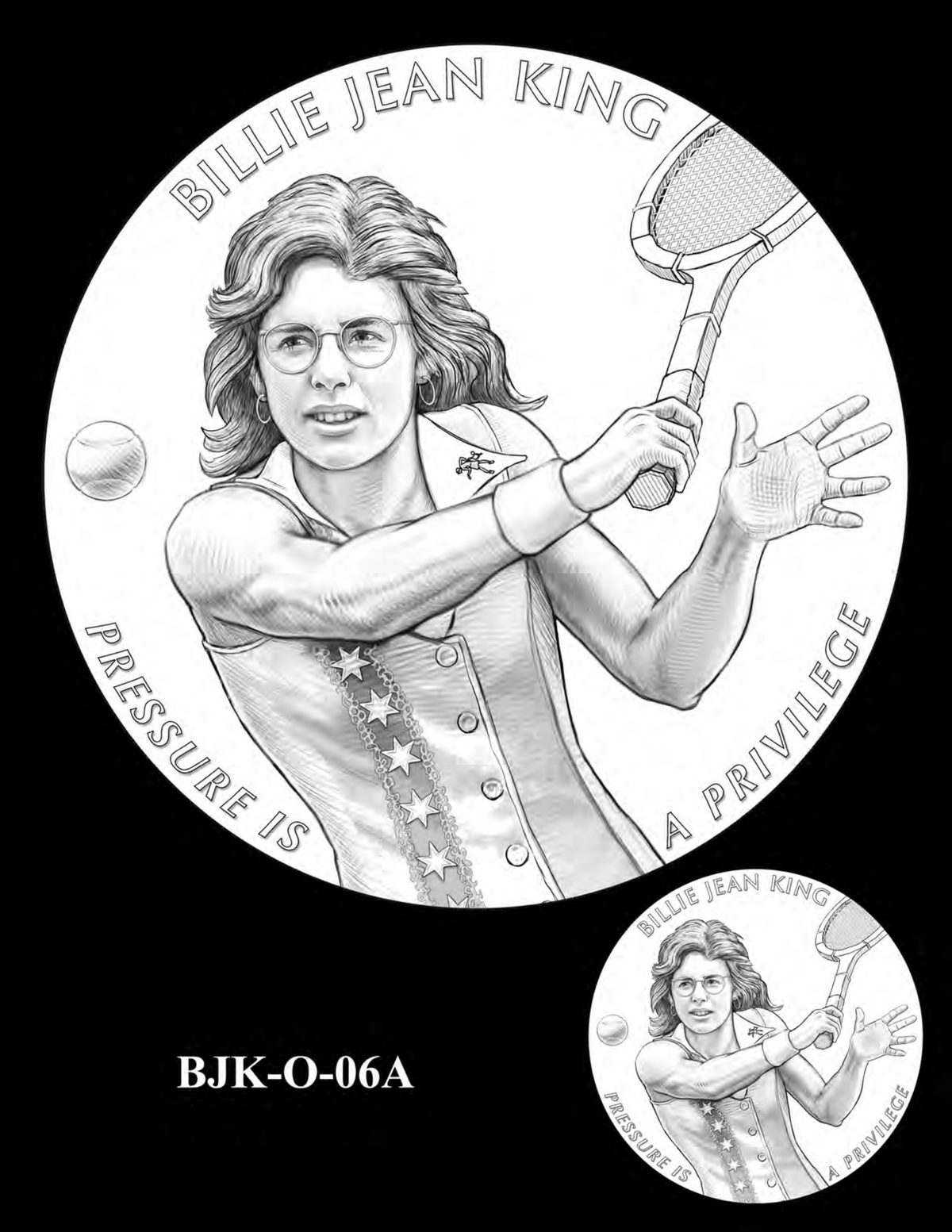
Billie Jean King CGM — obverse candidate 1. The obverse traditionally features a portrait of the honoree, and these candidates explored different artistic interpretations of King's likeness at the ages most associated with her peak achievements.
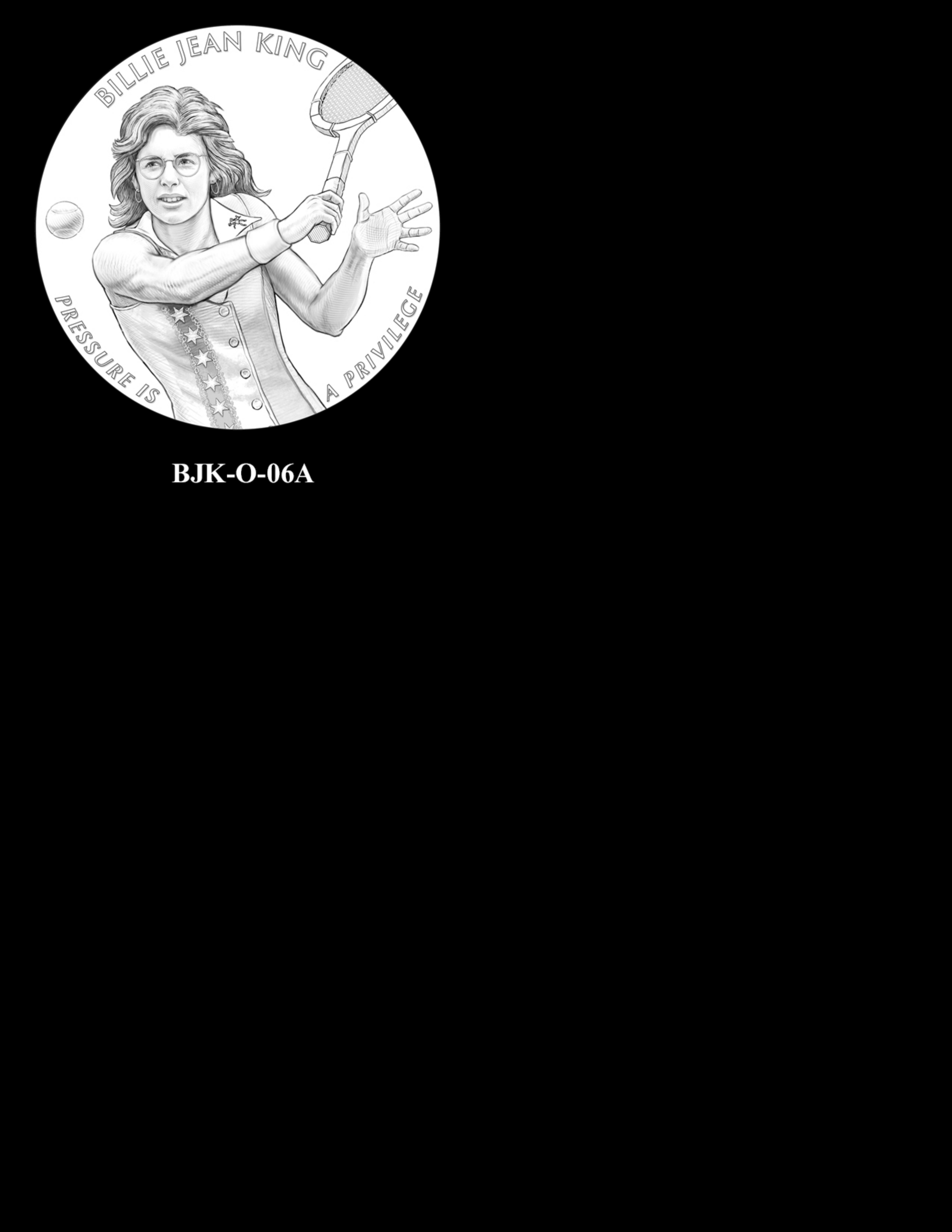
Billie Jean King CGM — obverse candidate 2. CCAC members discussed the portrait angle, expression, and whether the design evoked the energy and intensity that characterized King's playing style during her competitive career.
The Reverse Candidates
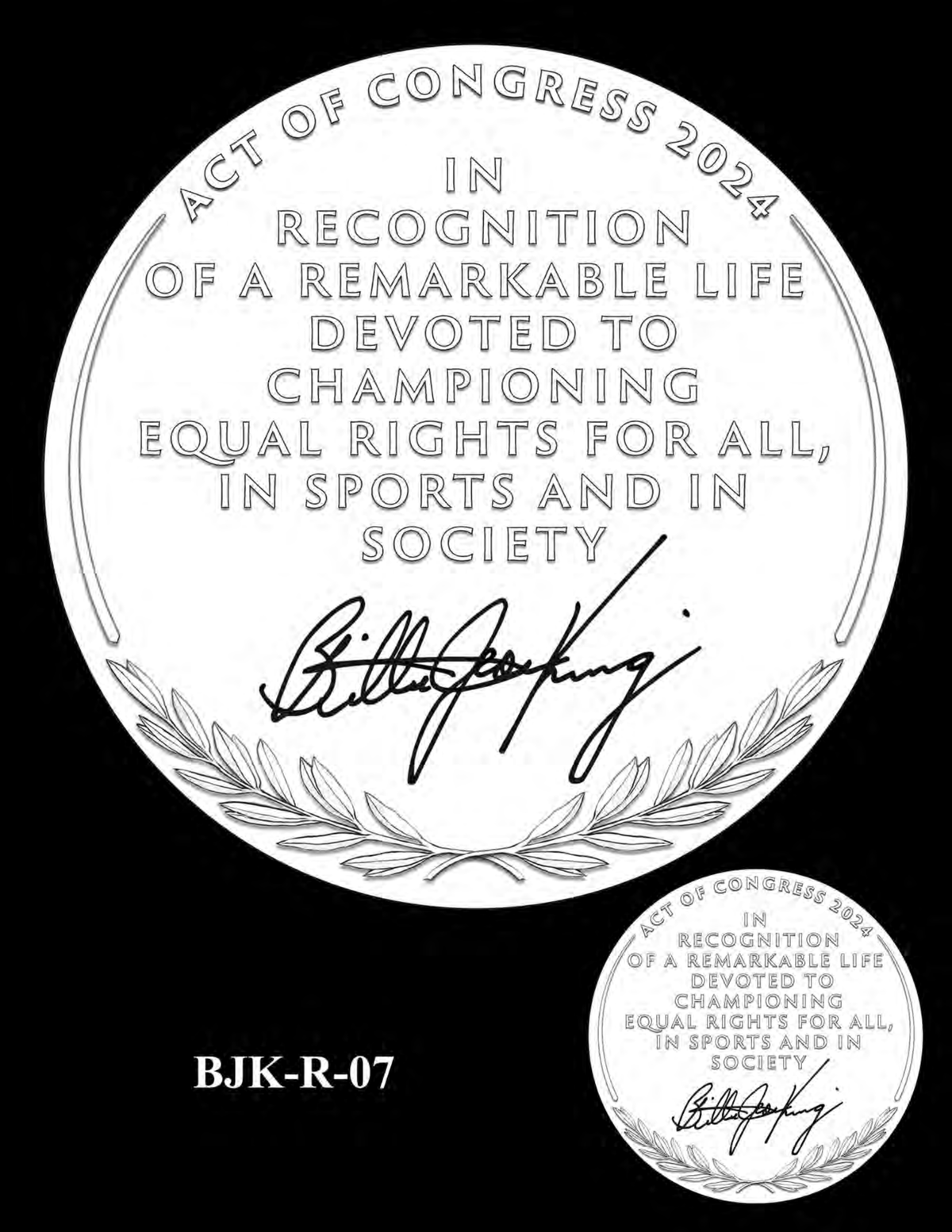
Billie Jean King CGM — reverse candidate 1. The reverse of a Congressional Gold Medal typically incorporates symbolic imagery related to the honoree's achievements, career, or legacy. Tennis imagery, equality symbolism, and references to King's advocacy work all featured in the candidate pool.
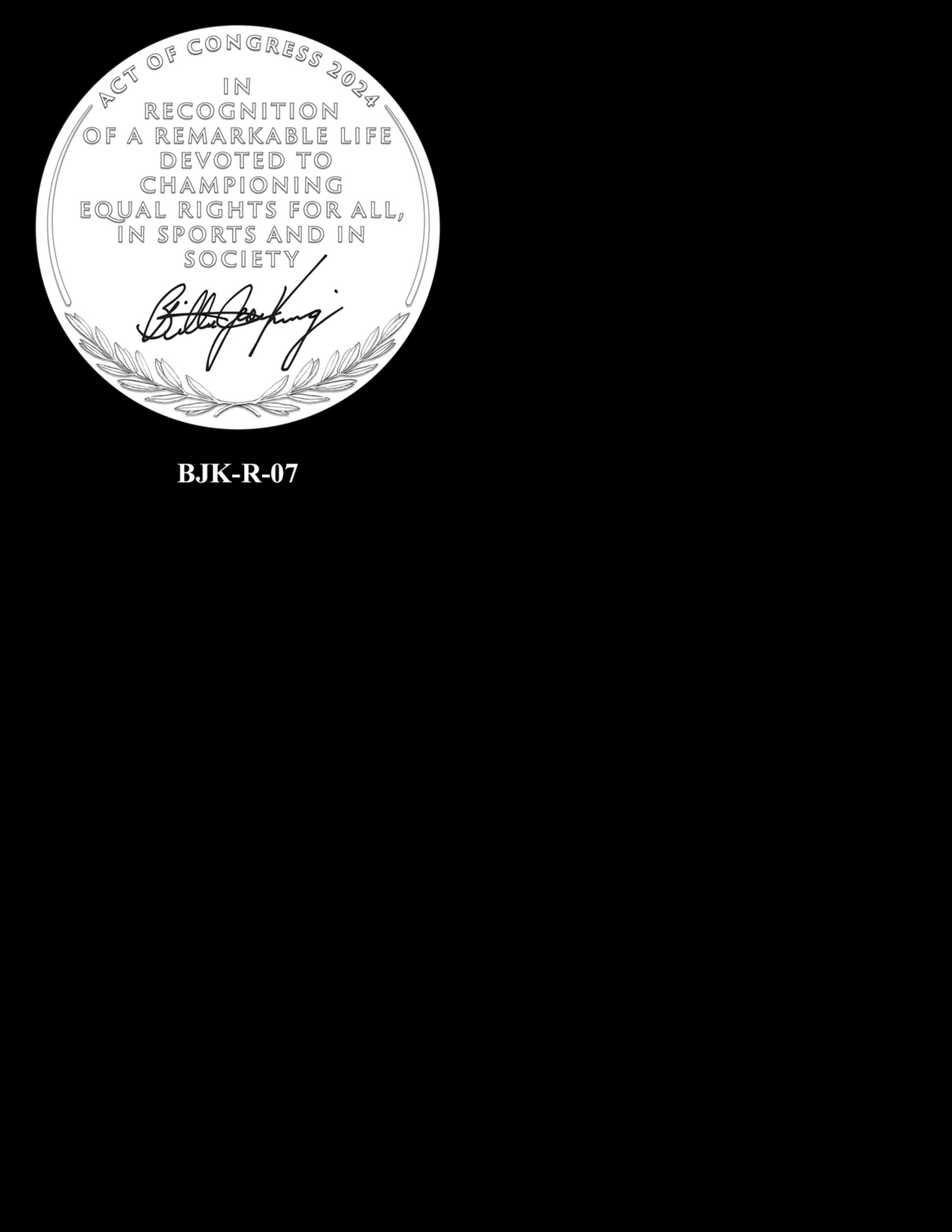
Billie Jean King CGM — reverse candidate 2. The CCAC discussed whether King's signature or a specific inscription related to gender equality and Title IX advocacy should appear on the reverse — a point on which King herself offered perspective during the meeting.
Who Is Billie Jean King?
For numismatists unfamiliar with Billie Jean King's broader significance, the Congressional Gold Medal designation reflects a career that extended far beyond the tennis court:
- 39 Grand Slam titles — including 12 singles, 16 doubles, and 11 mixed doubles championships
- Battle of the Sexes (1973) — King defeated Bobby Riggs 6-4, 6-3, 6-3 in a match watched by over 90 million television viewers worldwide, becoming a defining cultural moment in the women's rights movement
- Title IX advocacy — King was a leading advocate for Title IX of the Education Amendments of 1972, which prohibits sex-based discrimination in federally funded education programs and has transformed women's athletics in America
- Equal prize money — King threatened to boycott the 1973 U.S. Open unless women received equal prize money; the tournament became the first major to award equal pay to men and women
- WTA founding — King was instrumental in founding the Women's Tennis Association (WTA) in 1973
- Presidential Medal of Freedom — awarded by President Obama in 2009, recognizing her lifetime of achievement and advocacy
CCAC Vote and Recommendation
The CCAC recommended the winning designs for both the obverse and reverse by unanimous voice vote — a strong signal of consensus that is not always achieved in CCAC design proceedings. The presence of King herself, and the direct input she provided during the meeting, likely contributed to the committee's unified recommendation. Having the honoree confirm that a design accurately captures her identity and legacy removes a layer of interpretive uncertainty that typically complicates CGM deliberations.
Important Note: This Is Not a Coin
Congressional Gold Medals are unique artifacts — each one is a single-strike gold medal, not a circulating coin, not a bullion piece, and not part of any collector series. They are struck at the U.S. Mint in Philadelphia and presented to the honoree in a formal ceremony. Bronze duplicates are sometimes produced for institutional display and numismatic collections, but the gold originals are singular objects.
This distinction matters to collectors: unlike a commemorative coin program, there is no "mintage" of Billie Jean King Congressional Gold Medals available for purchase through the Mint's numismatic catalog. The medal belongs to King. Bronze duplicates, if produced, would be the collectible version accessible to the public.
For more on Congressional Gold Medals and other U.S. medals in the numismatic tradition, explore the medals section of the NumisDex catalog.
0 Replies
Related Threads
- Cherry-Picking Error Coins at Coin Shows: What to Bring and Where to Look0 replies · 3mo ago
- Working Dog Commemorative Coins: CCAC Recommends Designs for Three New Denominations0 replies · 3mo ago
- How to Safely Store and Handle Coins to Protect Their Value0 replies · 3mo ago
- What Tools Do You Actually Need for Coin Collecting? (and at What Magnification)0 replies · 3mo ago
- What Does "Details" Mean on a Graded Coin? Understanding Problem Coins0 replies · 3mo ago