
Wrong Planchet Errors: When a Coin Gets Struck on the Wrong Metal
WPLWhen the Wrong Blank Ends Up in the Press
The U.S. Mint produces billions of coins per year across multiple denominations, often running adjacent press lines in the same facility. Cent planchets, nickel planchets, dime planchets, quarter planchets — all moving through the same building, stored in nearby bins, fed through parallel supply systems. The process is industrial-scale manufacturing at high speed.
A wrong planchet error occurs when a blank intended for one denomination ends up in the press for another. The dies don’t check what’s placed between them — they close with full force on whatever the feeder delivers. The result is a coin with one denomination’s design impressed onto another denomination’s blank.
These are among the most dramatic and valuable minting errors because they’re immediately recognizable: the size, color, or weight is obviously wrong. A Lincoln cent design on a silver-colored dime planchet. A quarter design on a smaller, copper-colored cent blank. The visual mismatch tells the story at a glance.
How Wrong Planchet Errors Happen
The minting process begins with planchet production. Blanks are punched from metal strip, then processed through an upsetting mill that raises the rim. The finished planchets are stored in bins and fed into coining presses through automated tube feeders.
In a facility running multiple denominations simultaneously, the bins and feeders for different denominations sit in proximity on the production floor. Cross-contamination can occur at several points:
- Stray planchets in the production area. A planchet that bounces out of one bin or feeder can land in an adjacent one for a different denomination.
- Bin transfer errors. When planchet bins are moved or refilled, blanks from one denomination can accidentally be mixed into another’s supply.
- Contractor mixing. Some planchets are produced by external contractors and shipped to the Mint. If a contractor supplies blanks for multiple denominations (or multiple countries), foreign or wrong-denomination planchets can be mixed into a shipment.
- Retained planchets from previous runs. When a press is switched from one denomination to another, leftover planchets from the previous run can remain in the feeder.
Once a wrong planchet enters the press, the automated striking process treats it like any other blank. The dies close, the design transfers, and the coin exits. Unless the planchet is so wrong-sized that it jams the press, the error coin is produced normally and joins the rest of the run.
Types of Wrong Planchet Errors
Wrong Denomination (Same Country)
The most common type: a U.S. planchet for one denomination is struck by dies for another. Examples include cents struck on dime planchets, quarters struck on nickel planchets, and half dollars struck on quarter planchets.
Here is an example of a Lincoln Wheat Cent struck on a Roosevelt dime planchet:
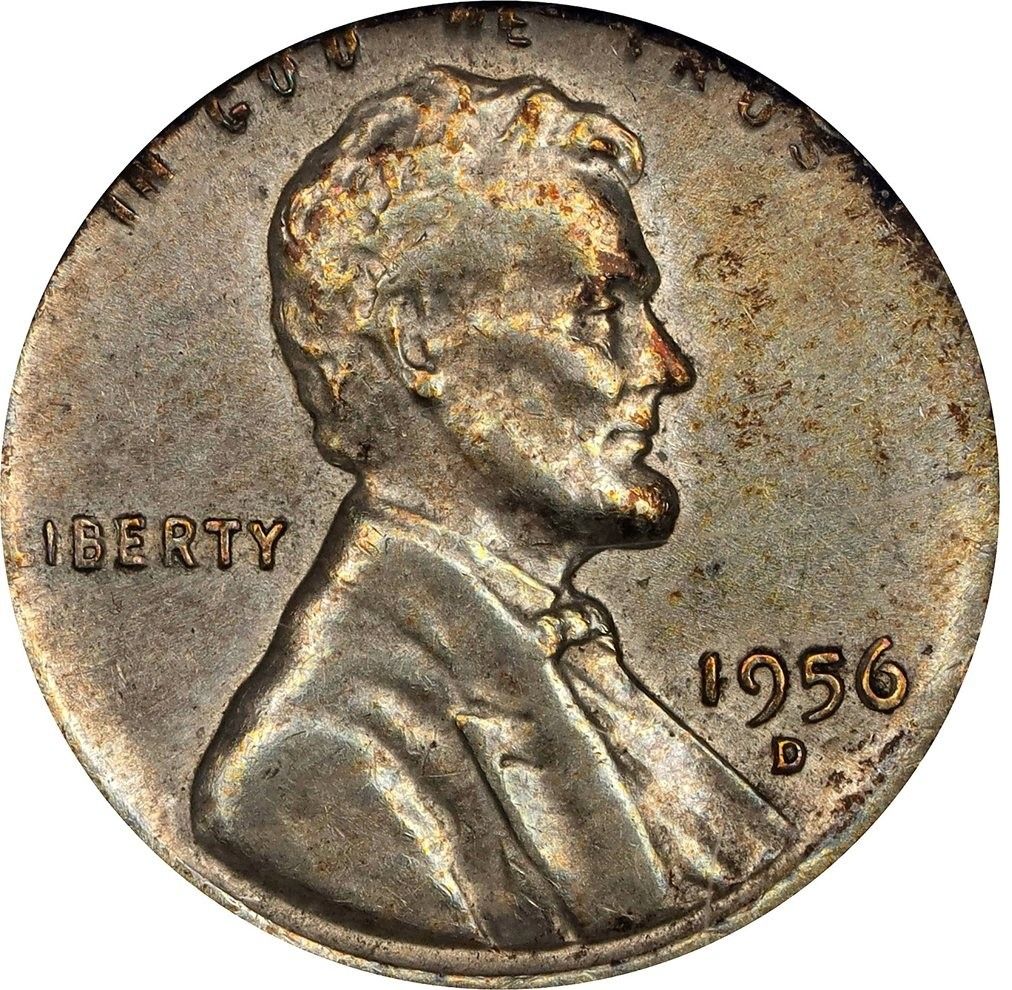
A 1956-D Lincoln Wheat Cent struck on a 90% silver dime planchet (WPL 001). The cent design is impressed on a noticeably smaller and lighter silver disc. The size difference between the cent and dime planchets means the design is partially cut off at the edges.
When the planchets are different sizes, the design is truncated — parts of the intended design extend beyond the planchet’s edge and are never struck. When the planchets are the same size (like the Sacagawea dollar and Susan B. Anthony dollar, both 26.5mm), the full design appears but on the wrong metal.
The Size Comparison
To understand just how dramatic the size mismatch can be, here is a normal Lincoln cent alongside the WPL 001 error (cent on dime planchet) and a normal Roosevelt dime:
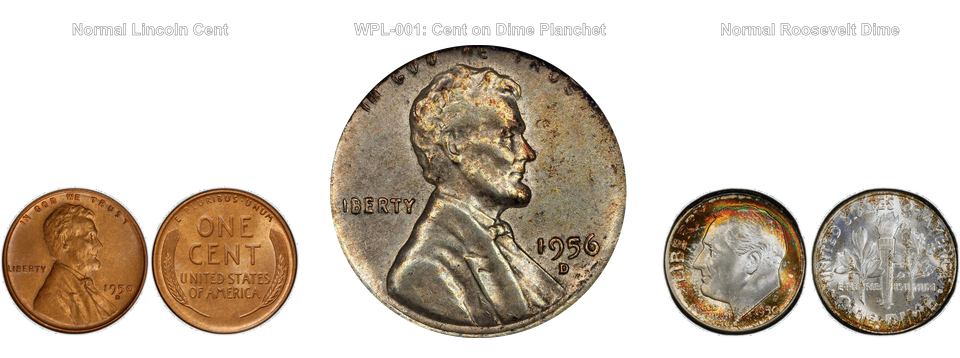
Left: A normal 1950-D Lincoln cent (19mm, 3.1g copper). Center: WPL 001 — a 1956-D Lincoln cent struck on a dime planchet (17.9mm, 2.5g silver). Right: A normal 1950-D Roosevelt dime. The cent-on-dime-planchet is visibly smaller and lighter than a standard cent, and its silver color is immediately apparent.
The Extreme Mismatch: Half Dollar on a Cent Planchet
Some wrong planchet errors involve dramatically different-sized denominations. When a small planchet enters a press with much larger dies, only the central portion of the design is struck:
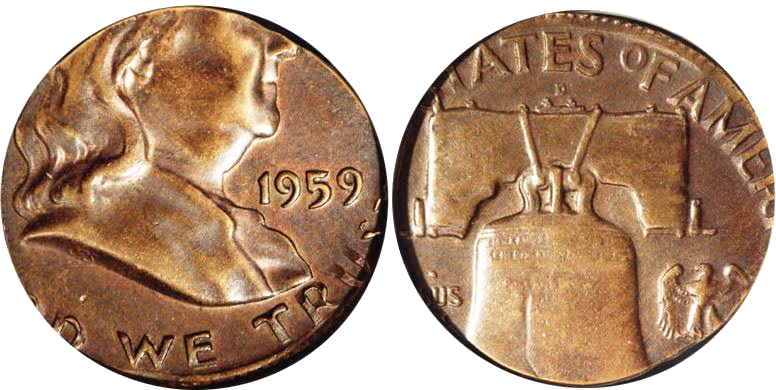
A 1959-D Franklin Half Dollar struck on a Lincoln cent planchet (WPL 004). The half dollar dies are designed for a 30.6mm planchet, but this cent-sized blank is only 19mm. Roughly 62% of the design extends beyond the planchet and is never struck, leaving only a fragment of Franklin’s portrait. The copper color of the cent planchet contrasts sharply with the silver expected on a half dollar.
Transitional Errors
A special category of wrong planchet error occurs when the Mint transitions from one coin type to another. Leftover planchets from the discontinued type can be struck with the new type’s dies. These are called transitional errors.
The most famous modern example is the 2000 Sacagawea dollar struck on a Susan B. Anthony dollar planchet:
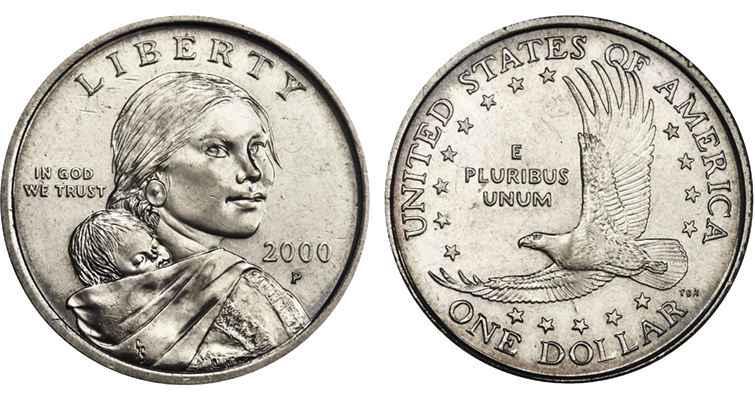
A 2000-P Sacagawea Dollar struck on a Susan B. Anthony planchet (WPL 003). Both planchets are the same diameter (26.5mm), so the full design is present. But the composition is wrong: manganese brass (golden) versus copper-nickel clad (silver-white). The reeded edge of the SBA planchet is the definitive diagnostic — genuine Sacagawea dollars have a plain edge.
Transitional errors from the SBA-to-Sacagawea changeover in 2000 are among the most famous modern U.S. error coins. They document the moment when two dollar coin programs overlapped at the Mint.
Bicentennial Coins on Wrong Planchets
Commemorative and special-issue coins can also appear on wrong planchets. The high production volume of the 1976 Bicentennial coinage created opportunities for cross-contamination:
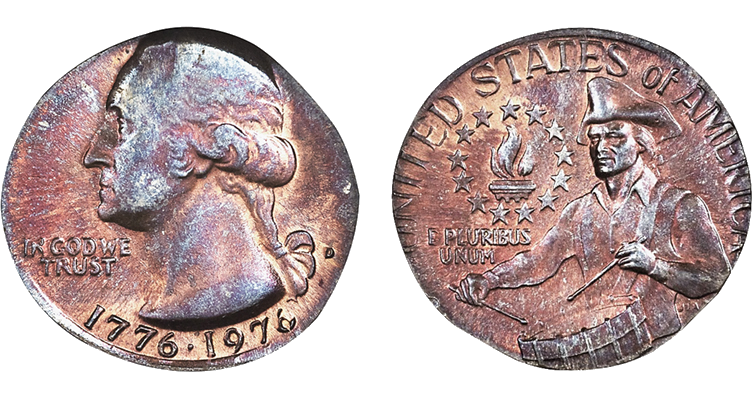
A 1976-D Bicentennial Washington Quarter struck on a Lincoln cent planchet (WPL 002). The quarter design (24.3mm) on a cent blank (19mm) means much of the design — including most of the peripheral lettering and the dual “1776-1976” date — extends beyond the planchet. The copper color immediately identifies the wrong metal.
Foreign Planchet Errors
Some U.S. coins have been found struck on planchets intended for foreign countries. This occurs because the U.S. Mint has historically contracted with the same suppliers that produce planchets for other nations’ mints, and because the U.S. Mint itself has produced coinage for foreign governments. A foreign planchet mixed into the U.S. supply creates an error that can be identified by unusual weight, diameter, or composition.
How to Identify Wrong Planchet Errors
Weight is always the first test. Every denomination has a specified weight, and a coin struck on the wrong planchet will weigh wrong for its design type. Key reference weights:
- Lincoln cent (post-1982): 2.5g (zinc core)
- Lincoln cent (pre-1982): 3.1g (bronze)
- Jefferson nickel: 5.0g
- Roosevelt dime: 2.27g (clad) or 2.5g (90% silver, pre-1965)
- Washington quarter: 5.67g (clad) or 6.25g (90% silver, pre-1965)
- Kennedy/Franklin half: 11.34g (clad) or 12.5g (90% silver, pre-1965)
If a coin’s weight doesn’t match its denomination, it may be on the wrong planchet. A precision scale (accurate to 0.01g) is essential equipment for error coin authentication.
Additional diagnostics:
- Color/composition. Copper versus silver, clad versus brass, copper-nickel versus manganese brass — the wrong metal is often visible to the naked eye.
- Diameter. If the planchet is smaller than the dies, the design will be truncated. If it’s the same size, look for composition and edge differences.
- Edge. Clad coins show a visible copper core layer at the edge. Reeded versus plain edges indicate the planchet type. A Sacagawea dollar should have a plain edge; one with reeding is on an SBA planchet.
- Magnetic properties. Some foreign planchets are steel-based and will attract a magnet. No regular U.S. coin since the 1943 steel cent should be magnetic.
What Is NOT a Wrong Planchet Error
- Environmental toning or corrosion — discolored coins are not wrong planchets. A green or darkened coin is surface chemistry, not wrong metal.
- Plated coins — gold-plated, silver-plated, or painted coins are post-mint alterations, not Mint errors.
- Damaged coins — coins that have been compressed, filed, or altered in size are not wrong planchets. Check the edge for signs of tooling.
- Science project coins — coins exposed to chemicals that change their color (copper pennies turned silver with zinc, or gold with brass) are classroom experiments, not Mint errors.
Value Factors
- Denomination mismatch. Greater differences between the intended and actual planchet generally command higher premiums. A half dollar on a cent planchet is more dramatic than a dime on a cent planchet.
- Composition contrast. Wrong planchets that involve a different base metal (copper versus silver, clad versus brass) are more visually dramatic and easier to authenticate than same-metal mismatches.
- Era. Pre-1965 wrong planchets involving silver are scarcer and more valuable. Modern clad wrong planchets are more available but still command strong prices.
- Grade. Higher-grade examples are always more valuable. Uncirculated wrong planchets with full mint luster are the most sought-after.
- Design completeness. When the planchets are similar in size and the full design is present, the coin has broader appeal. But extreme mismatches (small blank, big design) have their own dramatic appeal.
Wrong planchet errors represent one of the most accessible and rewarding areas of error coin collecting. They’re easy to understand, easy to authenticate (weight and composition don’t lie), and visually compelling. Every one of them tells the story of an industrial process where, for one brief moment, the wrong blank was in the right place at the right time.
Browse wrong planchet listings in the NumisDex catalog.
0 Replies
Related Threads
- Wrong Planchet Errors: How to Tell If Your Coin Is Struck on the Wrong Blank0 replies · 3mo ago
- Lamination Error vs. Environmental Damage: How to Tell3 replies · 3w ago
- Split Planchets: When a Coin Breaks in Half (And Why the Other Half Might Be Out There)0 replies · 3mo ago
- Wrong Planchet Errors: When a Coin Gets the Wrong Body0 replies · 4mo ago