
The Rise of Chinese Counterfeit Coins: What Collectors Need to Know About the Scale of the Problem
An Industrial-Scale Counterfeiting Operation
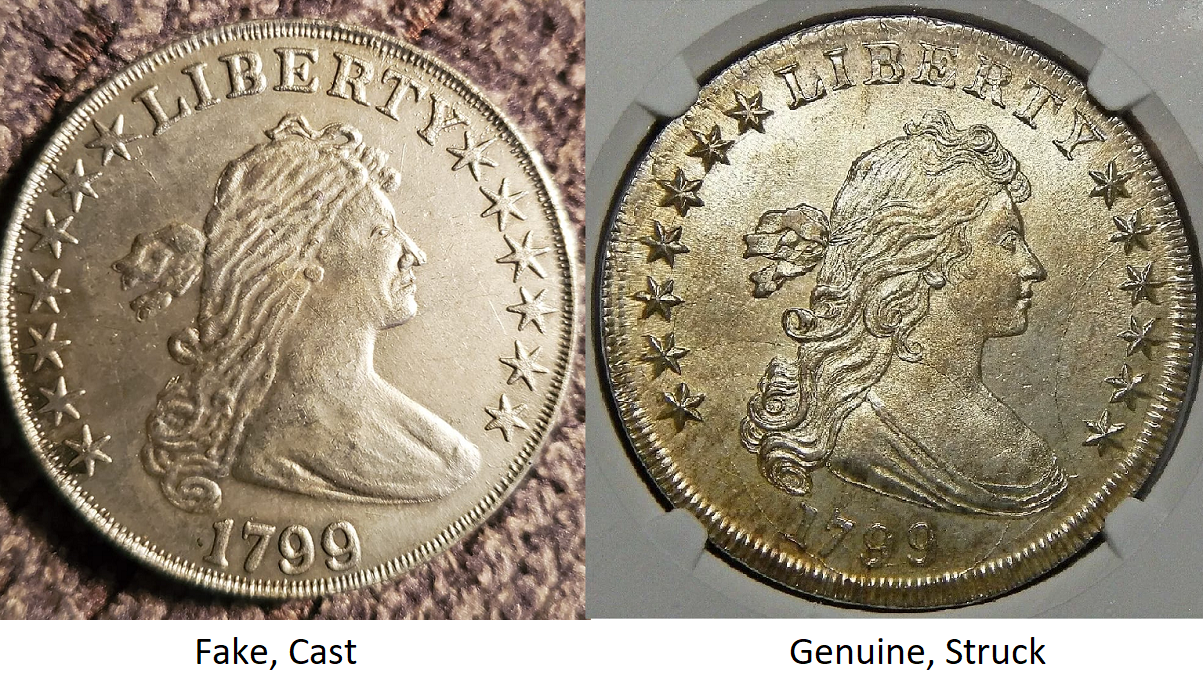
Side-by-side: a counterfeit coin (left) next to a genuine example. Subtle differences in detail and luster reveal the fraud under close examination.
The coin counterfeiting problem has evolved from individual forgers working with hand tools to factory-scale operations producing counterfeit coins in vast quantities. The primary source is China — specifically, manufacturing centers in Guangdong and Fujian provinces — where replica coins are mass-produced using modern die-striking equipment, often from base metals plated to mimic silver or gold.
The Scale
Hard numbers are difficult to pin down because most counterfeit coins enter circulation without being detected or reported. But the data we do have is sobering:
- Europol Operation DECOY III (June–November 2025): An 18-country operation led by Austria, Portugal, and Spain seized approximately €1.2 billion in counterfeit currency — including banknotes and coins. Over 7 million counterfeit items were identified across the operation: 4.8 million euro banknotes/coins, 2.3 million U.S. dollar notes, and hundreds of thousands of other currencies. Over 90% of seized counterfeit items were traced to shipments originating in China. The operation launched 70 investigations.
- U.S. Customs and Border Protection (2021 data): A single CBP operation at the Chicago International Mail Facility seized 6,667 counterfeit coins and 1,589 counterfeit $100 bills across 281 shipments. 95% originated from China. The coins included 6,345 counterfeit $1 gold coins, 283 quarter eagles, and 39 half dollars.
- Open online sales: Platforms like AliExpress and Taobao host sellers openly listing replica U.S. coins — Morgan dollars, gold pieces, key-date rarities — often labeled as "souvenirs" or "replicas." Many of these coins are subsequently relisted on eBay, Facebook Marketplace, and other platforms as genuine.
What Gets Counterfeited Most
According to NGC's Top 50 Most Counterfeited U.S. Coins list and industry surveys:
- Morgan Silver Dollars are the #1 most counterfeited U.S. coin type. Key dates like the 1893-S are particularly targeted — counterfeiters add "S" mintmarks to genuine 1893 Philadelphia coins.
- Gold coins dominate the value-counterfeiting market. In a 2018 Anti-Counterfeiting Task Force survey: 36% of dealers reported encountering fake $5 gold pieces, 33% reported fake $20 gold pieces, 33% reported fake $1 gold coins, and 28% reported fake $10 gold pieces.
- Key-date Lincoln cents (1909-S VDB, 1914-D, 1922 no-D) are frequently counterfeited due to their high value relative to production cost.
- Classic commemoratives and patterns are increasingly targeted as counterfeiters move beyond common types.
How to Protect Yourself
1. Buy certified coins from reputable sources.
PCGS and NGC authentication catches the vast majority of counterfeits. But remember: counterfeit slabs exist too (see our post on Counterfeit Coin Slabs). Verify the cert number on the official website.
2. Learn basic diagnostics.
- Weight: A genuine Morgan dollar weighs 26.73 grams. Many counterfeits are measurably off because base metals have different densities than silver.
- Sound: A genuine silver coin produces a clear, sustained ring when tapped. Base metal counterfeits produce a dull thud.
- Edge quality: Look for casting seams on the edge — a telltale sign of cast (rather than struck) counterfeits.
- Magnification: Under 10x magnification, genuine coins show flow lines from the striking process. Cast counterfeits show a grainy, porous surface texture.
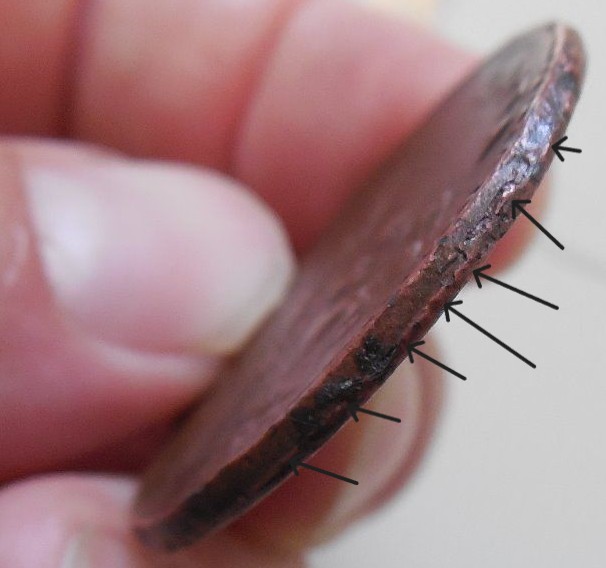
Close-up of a counterfeit showing an edge seam — a casting artifact that genuine struck coins never exhibit.
3. Know the legal landscape.
- The Hobby Protection Act (1973) makes it illegal to produce or sell imitation coins not marked "COPY."
- The Collectible Coin Protection Act (2014) extended the Hobby Protection Act's reach to sellers of unmarked imitations.
- The U.S. Secret Service has jurisdiction over currency counterfeiting and has worked with industry groups to disrupt supply chains.
4. Report counterfeits.
If you encounter a counterfeit, report it to the seller, the auction platform, and the relevant grading service. PCGS and NGC both maintain databases of known counterfeit cert numbers and die combinations.
Browse the NumisDex catalog for authenticated coin information and reference images.
0 Replies
Related Threads
- Mirror-Clone Grading Websites: The Newest Counterfeit Scam Targeting Coin Collectors0 replies · 3mo ago
- Counterfeit Coin Slabs Are Getting Dangerously Good — How to Spot Fake PCGS and NGC Holders in 20260 replies · 3mo ago
- How to Read PCGS and NGC Holders — and Spot a Counterfeit Slab0 replies · 3mo ago
- 1804 Dollar and Other "Too Good to Be True" Coins: How to Recognize Replicas0 replies · 3mo ago
- 1877 Indian Head Cent: How to Spot a Fake0 replies · 3mo ago