
Counterfeit Coin Slabs Are Getting Dangerously Good — How to Spot Fake PCGS and NGC Holders in 2026
The Holder Is Part of the Fraud
Counterfeit coins are not new. But counterfeit slabs — fake PCGS and NGC holders designed to make a counterfeit coin look professionally graded — represent an escalation that every collector needs to understand. A convincing fake holder transforms a $5 counterfeit coin into what appears to be a $5,000 certified rarity. Here's how to protect yourself.
What Genuine PCGS Holders Include
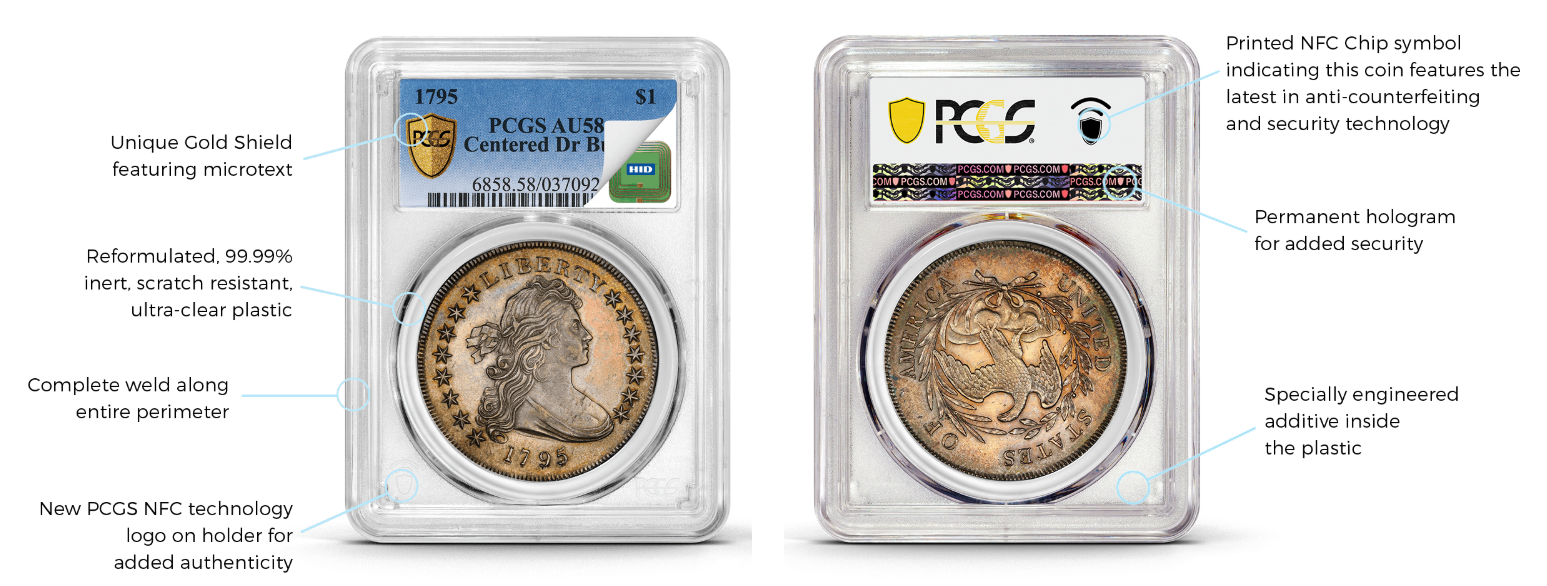
A genuine PCGS holder — note the hologram, barcode, and label precision.
PCGS has invested heavily in anti-counterfeiting technology. A genuine current-generation PCGS holder includes:
- NFC (Near Field Communication) chip: Embedded in all PCGS holders since October 2020. Uses HID Trusted Tag Cloud Authentication with a cryptographic one-time password (OTP) that changes with every tap. You can verify a PCGS coin by holding your phone near the holder — the NFC chip communicates with HID's cloud server to confirm authenticity. This is extremely difficult to counterfeit because the OTP is generated by the chip itself and verified server-side.
- DuPont Izon 3D Security Hologram: Tip the holder 90° right to see a "PCGS" pattern; tip 90° left to see "GOLD SHIELD." The hologram uses multi-layer diffractive technology that cannot be reproduced with standard printing.
- Gold Shield logo: Features micro-text and color-shifting elements visible under magnification.
- Proprietary plastic composition: PCGS holders use a specific chemical formulation (99.99% chemically inert) that can be detected with a handheld device.
- Barcode and QR code: Both link to the PCGS Cert Verification system at pcgs.com/cert.
What Genuine NGC Holders Include
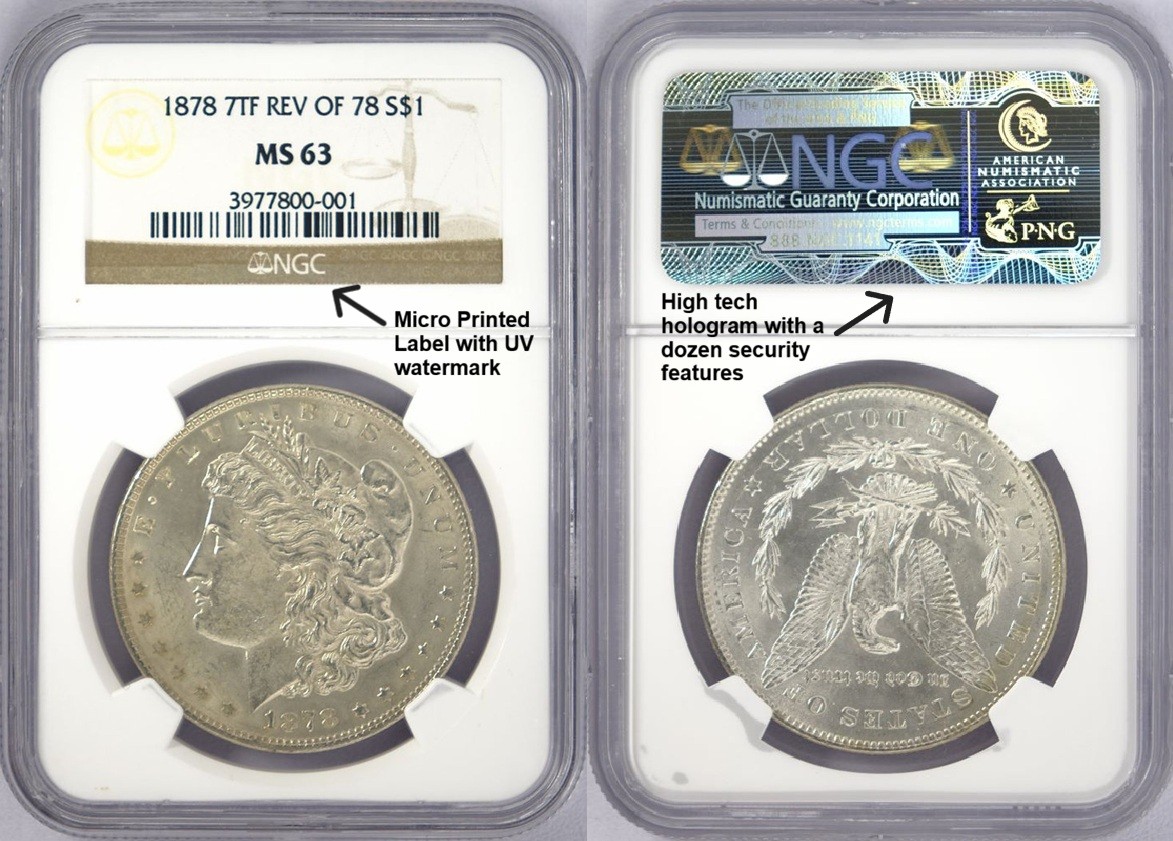
A genuine NGC holder — showing the hologram with unique QR code, certification label, and ultrasonic weld seam.
NGC has its own multi-layer security approach:
- High-security hologram (since 2023): Fused to the back of the holder with over a dozen covert and overt security elements. Each hologram includes a unique QR code that links directly to that specific coin's verification page on ngccoin.com.
- 8-digit numerical security code: Unique to each coin, verifiable at ngccoin.com/certlookup.
- Ultrasonic welding: NGC holders are sealed using ultrasonic welding, which makes any attempt to open and reseal the holder evident through visible damage to the seam.
- Detailed certification label: Includes the NGC grade, coin description, certification number, and barcode.
Red Flags: How to Spot a Fake Slab
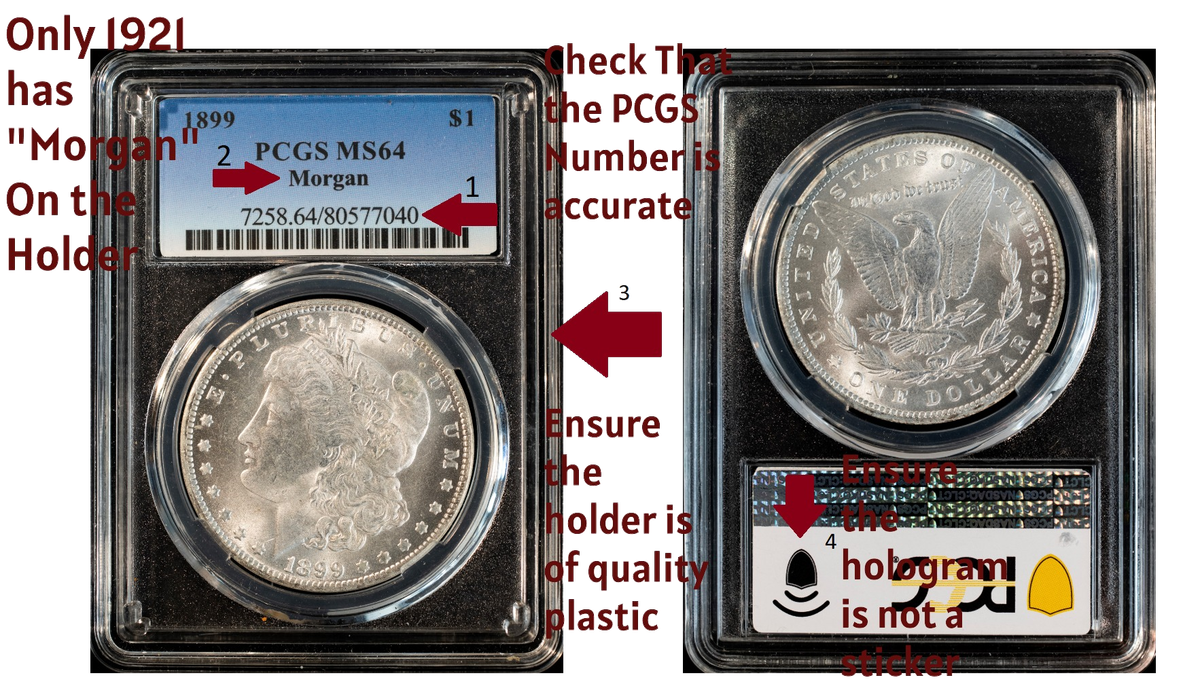
A counterfeit slab — look carefully at the label alignment, hologram quality, and seam details compared to genuine holders above.
Despite these security features, counterfeit holders continue to circulate. Here's what to look for:
- Label alignment and font quality. Genuine PCGS and NGC labels are printed with commercial-grade precision. Counterfeit labels often show slightly off-center text, inconsistent font weight, or blurry micro-text. Compare against a known genuine holder.
- Hologram behavior. Genuine holograms produce crisp, multi-angle color shifts. Counterfeits typically show flat or muddy color changes. The PCGS "tilt test" (PCGS → 90° right, GOLD SHIELD → 90° left) should be clean and unmistakable.
- Barcode and QR code functionality. Scan every barcode and QR code. On a genuine holder, they link to pcgs.com/cert or ngccoin.com/certlookup and return the correct coin information. On a fake, they either don't scan, return "not found," or — in sophisticated counterfeits — redirect to clone websites (see our post on Mirror-Clone Grading Websites).
- NFC tap (PCGS only). If the holder has no NFC response at all, it's either a pre-2020 genuine holder or a fake. If you're buying a coin claimed to be recently graded and it has no NFC, that's a red flag.
- Cert number verification. Every PCGS and NGC holder has a certification number. Look it up on the official website — type the URL manually, don't follow links from QR codes on suspicious holders. If the cert number returns "not found" on pcgs.com or ngccoin.com, the holder is counterfeit.
- Seam quality. Examine the edges where the holder halves meet. Genuine holders have clean, uniform seams. Counterfeits may show visible glue, uneven gaps, or tool marks from attempted resealing.
- Weight and feel. Experienced collectors can sometimes detect fake holders by weight (slightly lighter or heavier than genuine) or by the plastic's feel and clarity.
The Bottom Line
No single check is sufficient. Use multiple verification methods: NFC tap + cert number lookup + visual inspection of the hologram + barcode scan. The more checks you perform, the harder it is for a counterfeiter to pass all of them.
When buying online — particularly from unfamiliar sellers — request high-resolution photos of the holder's label, hologram, and edges. And always verify the cert number yourself before completing a purchase.
Explore the NumisDex catalog for authenticated coin information.
0 Replies
Related Threads
- Mirror-Clone Grading Websites: The Newest Counterfeit Scam Targeting Coin Collectors0 replies · 3mo ago
- The Rise of Chinese Counterfeit Coins: What Collectors Need to Know About the Scale of the Problem0 replies · 3mo ago
- How to Read PCGS and NGC Holders — and Spot a Counterfeit Slab0 replies · 3mo ago
- 1804 Dollar and Other "Too Good to Be True" Coins: How to Recognize Replicas0 replies · 3mo ago
- 1877 Indian Head Cent: How to Spot a Fake0 replies · 3mo ago