
1953 (S) Lincoln Wheat Cent - RCD-1c-1953S-12R Retained Cud
Error
Attribution
Discovered by
Chuck Newman
Verified by
Cuds on Coins
Original Research
Description
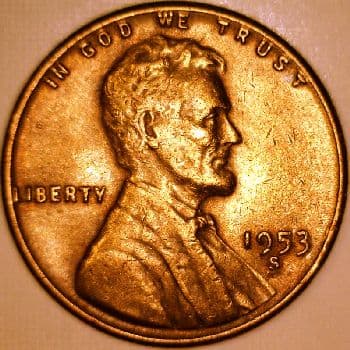
Twelfth reverse retained cud cataloged for the 1953-S Lincoln wheat cent, RCD-1c-1953S-12R documents a die rim failure from San Francisco's production during the twilight years of the wheat ears reverse design. With at least 12 reverse retained cuds recorded, the 1953-S date shows a moderate level of die rim deterioration consistent with the facility's cent production volume of approximately 181.8 million pieces. San Francisco continued as an active cent-producing mint throughout the 1950s, shipping finished coins alongside Philadelphia and Denver to meet the postwar economy's growing demand for circulating small change. The retained cud mechanism involves a fracture in the die rim that frees a segment completely — held in place rather than lost, but loose enough to move and alter the striking dynamics in the fracture zone. Coins produced from such a die show a flat, raised, or otherwise disturbed area at the rim where the broken die segment's imperfect contact with the planchet produces incomplete design transfer. Victor David Brenner's wheat ears reverse, which had served as the Lincoln cent's reverse design since 1909, places the grain stalks close to the rim border where retained cuds most commonly manifest. The parallel lines of the wheat grains function as a natural gauge of die contact pressure — where the die is fully seated against the planchet, the lines appear sharp and complete, but where a retained cud disrupts the contact, the lines fade, flatten, or blur. At number 12 in the reverse retained cud census, this variety joins a meaningful body of documented die failures for the 1953-S that collectively illustrate the mechanical lifecycle of working dies under sustained production. Cataloged by the Cuds on Coins service with no cross-references to other attribution systems, collectors can identify this variety by matching the retained cud's rim position against published diagnostic images.
Cross References
- Cross reference: none. 02/21/2019.
External References
Community & Reference
Related Errors


More Retained Cud Errors
Collector Essentials
Tools for examining and preserving error coins and die varieties.
10x-20x Jeweler's Loupe
Essential for examining die varieties, doubled dies, and RPMs
Cherry Picker's Guide
The definitive reference for U.S. error coins and die varieties
2x2 Coin Flips & Holders
Protect and organize your finds with archival-quality holders
USB Digital Microscope
Capture detailed images for documentation and community submissions
As an Amazon Associate, NumisDex earns from qualifying purchases.