
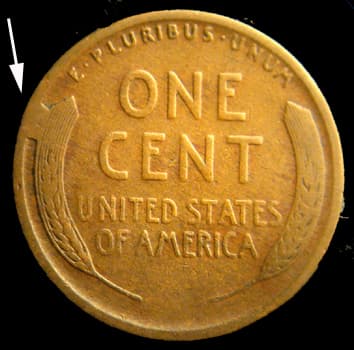
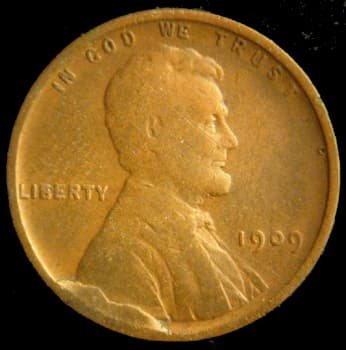
RCD-1c-1909-01R Retained Cud
Error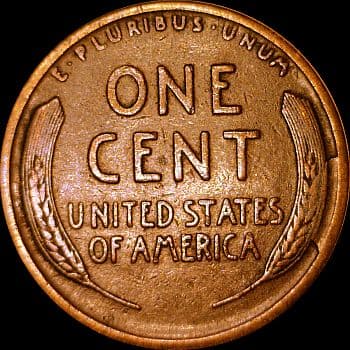
Description
Marking the inaugural year of Victor David Brenner's Lincoln cent design, RCD-1c-1909-01R is the first reverse retained cud documented for the 1909 wheat cent by the Cuds on Coins attribution service — capturing a die rim failure from a year celebrated for introducing the first portrait of an actual historical figure on regular-issue United States circulating coinage — a year celebrated by collectors for introducing the first portrait of an actual historical figure on regular-issue United States circulating coinage. Philadelphia struck approximately 72.7 million Lincoln cents in 1909, the VDB initials year that also saw production of the famous 1909-S VDB key date. The inaugural production year carried special significance for die preparation and usage, as the Mint was working with freshly prepared master hubs and dies for a brand-new design that had not yet been refined through years of manufacturing experience. Retained cuds develop through progressive die rim failure: the steel fractures under repeated striking stress but the broken fragment remains attached, creating a raised irregular formation on struck coins where the rim should present a smooth, uniform profile. The "01R" designation marks this as the first reverse retained cud identified for 1909, establishing the earliest known retained cud in the Lincoln cent series for this denomination. The reverse wheat ear design — paired stalks of wheat flanking the denomination and national identity — extends close to the rim, and the retained cud formation would affect whichever rim zone the specific fracture occupied, potentially distorting portions of the wheat stalks, peripheral lettering, or both. As a first-year-of-issue variety, RCD-1c-1909-01R holds particular appeal for collectors who specialize in the inaugural year of the Lincoln cent, adding a die deterioration dimension to a date already rich with the VDB, no-VDB, and S-mint varieties. Collectors should examine the reverse rim carefully under 8-12x magnification for the characteristic raised swelling that distinguishes a retained cud from normal rim detail.
External References
Community & Reference
Related Errors
More Retained Cud Errors
Collector Essentials
Tools for examining and preserving error coins and die varieties.
10x-20x Jeweler's Loupe
Essential for examining die varieties, doubled dies, and RPMs
Cherry Picker's Guide
The definitive reference for U.S. error coins and die varieties
2x2 Coin Flips & Holders
Protect and organize your finds with archival-quality holders
USB Digital Microscope
Capture detailed images for documentation and community submissions
As an Amazon Associate, NumisDex earns from qualifying purchases.