
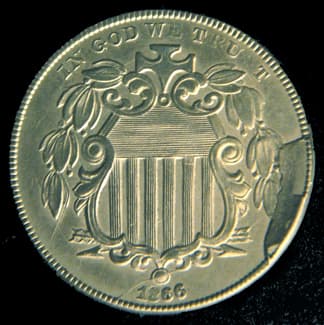
1866 Shield Nickel - Rays - RCD-5c-1866-08 Retained Cud
Error
Attribution
Discovered by
Chuck Newman
Verified by
Cuds on Coins
Original Research
Description
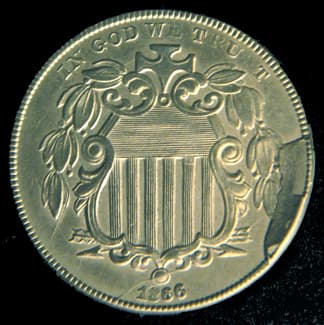
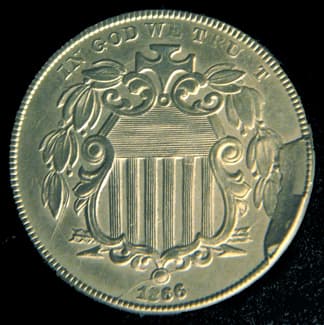
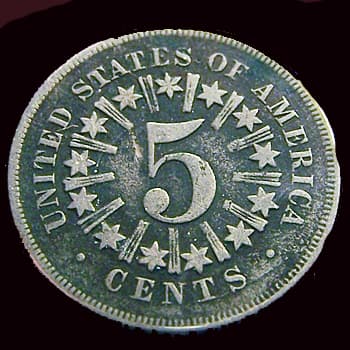
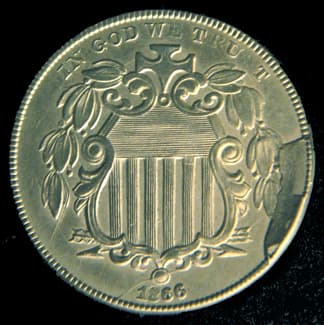
RCD-5c-1866-08 documents a retained cud, one of the die rim failures that plagued this first-year nickel coinage, on the 1866 Shield Nickel with Rays. James B. Longacre's Shield nickel represented the nation's first venture into mass-produced nickel coinage, and the alloy's hardness required striking pressures that pushed contemporary die steel beyond its design limits. Retained cuds occur when a portion of the die rim fractures under repeated striking stress, creating a crack that frees the broken section completely and lets it sink slightly below the surrounding die face while the collar keeps it from falling out. Each subsequent strike produces coins with a raised, slightly flattened area at the corresponding rim location — a shelf of displaced metal that carries the design on top, set above the adjacent, unfractured areas. Philadelphia's 1866 production of approximately 14.74 million Shield nickels with the Rays reverse consumed working dies at an accelerated rate. The "With Rays" reverse design — featuring rays radiating between thirteen stars surrounding the large numeral 5 — was itself abandoned early in 1867, partly because of striking difficulties. Collectors should examine the rim perimeter under magnification, comparing any raised or out-of-line areas against confirmed attribution images, as the specific rim location distinguishes RCD-5c-1866-08 from the other 1866 retained cuds.
External References
Community & Reference
Related Errors
More Retained Cud Errors
Collector Essentials
Tools for examining and preserving error coins and die varieties.
10x-20x Jeweler's Loupe
Essential for examining die varieties, doubled dies, and RPMs
Cherry Picker's Guide
The definitive reference for U.S. error coins and die varieties
2x2 Coin Flips & Holders
Protect and organize your finds with archival-quality holders
USB Digital Microscope
Capture detailed images for documentation and community submissions
As an Amazon Associate, NumisDex earns from qualifying purchases.