
RCD-5c-1866-05 Retained Cud
Error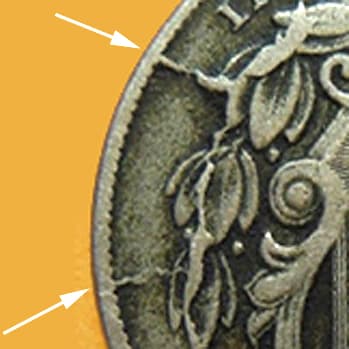
Description
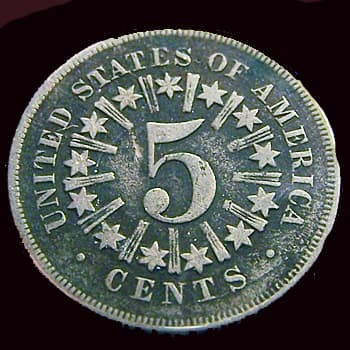
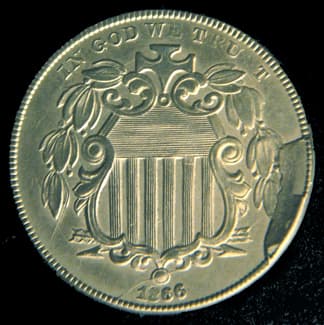
The fifth retained cud documented for the inaugural year of the Shield Nickel, RCD-5c-1866-05 records another instance of die failure on the 1866 Shield Nickel with Rays — the first base-metal five-cent coin in United States history. A retained cud occurs when a die crack at the rim penetrates deeply enough to partially liberate a fragment of die metal, but the fragment remains lodged in place rather than separating. The result is a raised, slightly irregular area on struck coins that preserves partial design detail, distinguishing it from a full cud's featureless plateau. The 1866 Rays variety is particularly susceptible to die breakage because the distinctive rays radiating between the stars on the reverse created stress concentration points in the die — a design flaw recognized by the Mint, which removed the rays partway through 1867 to extend die life. Designed by James B. Longacre, the obverse displays the Union shield symbolizing national unity during Reconstruction, while the reverse features a bold numeral 5 encircled by stars with the short-lived rays. Struck in 75% copper and 25% nickel at 5.0 grams at the Philadelphia Mint. Cataloged by Cuds on Coins as RCD (retained cud), 5c (nickel), 1866 (year), 05 (fifth documented). Examine the rim for the raised irregular mass marking the retained fracture.
External References
Community & Reference
Related Errors
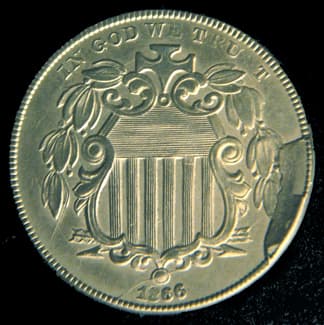
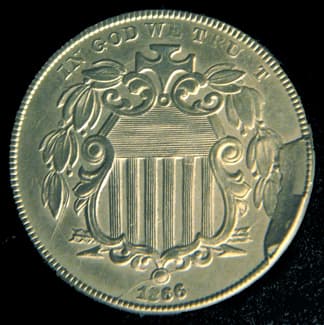
More Retained Cud Errors
Collector Essentials
Tools for examining and preserving error coins and die varieties.
10x-20x Jeweler's Loupe
Essential for examining die varieties, doubled dies, and RPMs
Cherry Picker's Guide
The definitive reference for U.S. error coins and die varieties
2x2 Coin Flips & Holders
Protect and organize your finds with archival-quality holders
USB Digital Microscope
Capture detailed images for documentation and community submissions
As an Amazon Associate, NumisDex earns from qualifying purchases.