
RCD-5c-1866-04R Retained Cud
Error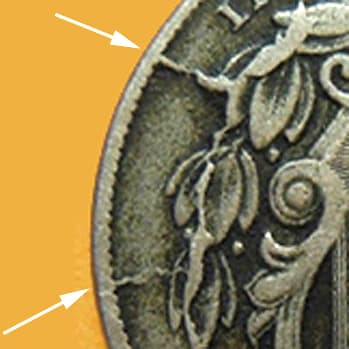
Description
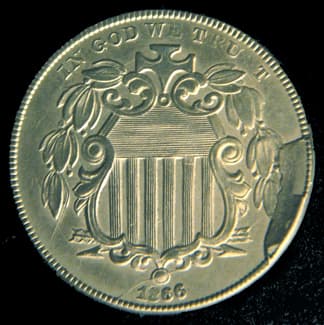
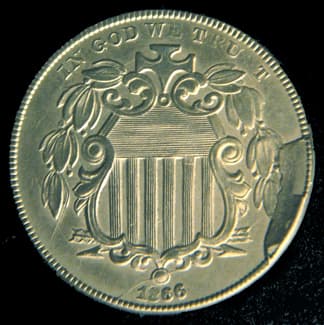
Fourth retained cud cataloged on the reverse of the 1866 Shield Nickel with Rays by the Cuds on Coins attribution service, RCD-5c-1866-04R documents yet another instance of die rim failure on this historically significant inaugural five-cent nickel issue. The designation follows standard nomenclature: RCD for retained cud, 5c for the nickel denomination, 1866 for the date, 04 as the fourth reverse variety, and R confirming the reverse location. James B. Longacre designed the Shield nickel, which debuted in 1866 as the first United States five-cent coin struck in the 75% copper, 25% nickel alloy that would define the denomination for over a century. The "With Rays" reverse design — featuring a large numeral 5 surrounded by thirteen stars with prominent rays radiating between them — was used only in 1866 and part of 1867 before being simplified to the "Without Rays" version due to severe striking difficulties. Philadelphia produced approximately 14.74 million Shield nickels with rays in 1866, and the hard nickel alloy required substantially higher striking pressures than any composition previously used in American coinage. The existence of four distinct retained cud varieties on the 1866 reverse alone quantifies the toll that the new alloy exacted on working dies — each retained cud represents an independent die that developed a rim fracture where a fragment cracked but remained attached, producing a raised irregular swelling on struck coins along the affected rim segment. Retained cuds differ from full cuds in that the broken fragment has not yet separated from the die body, creating a transitional state between normal rim detail and complete die failure. Collectors should inspect the reverse rim under 8-12x magnification for any raised, irregularly textured area where the normally sharp rim transitions into a swollen, bridge-like formation connecting the intact rim to the fractured die segment.
External References
Community & Reference
Related Errors
More Retained Cud Errors
Collector Essentials
Tools for examining and preserving error coins and die varieties.
10x-20x Jeweler's Loupe
Essential for examining die varieties, doubled dies, and RPMs
Cherry Picker's Guide
The definitive reference for U.S. error coins and die varieties
2x2 Coin Flips & Holders
Protect and organize your finds with archival-quality holders
USB Digital Microscope
Capture detailed images for documentation and community submissions
As an Amazon Associate, NumisDex earns from qualifying purchases.