
In the catalog: Confederate States of America (1861-1863), Confederate States of America Original Strikes and Confederate States of America Restrikes
Confederate Coins: Four Originals and a Lot of Restrikes
In 1861 the Confederacy struck its own half dollar. Only four were made, and that's why almost every Confederate coin you'll see is something else.
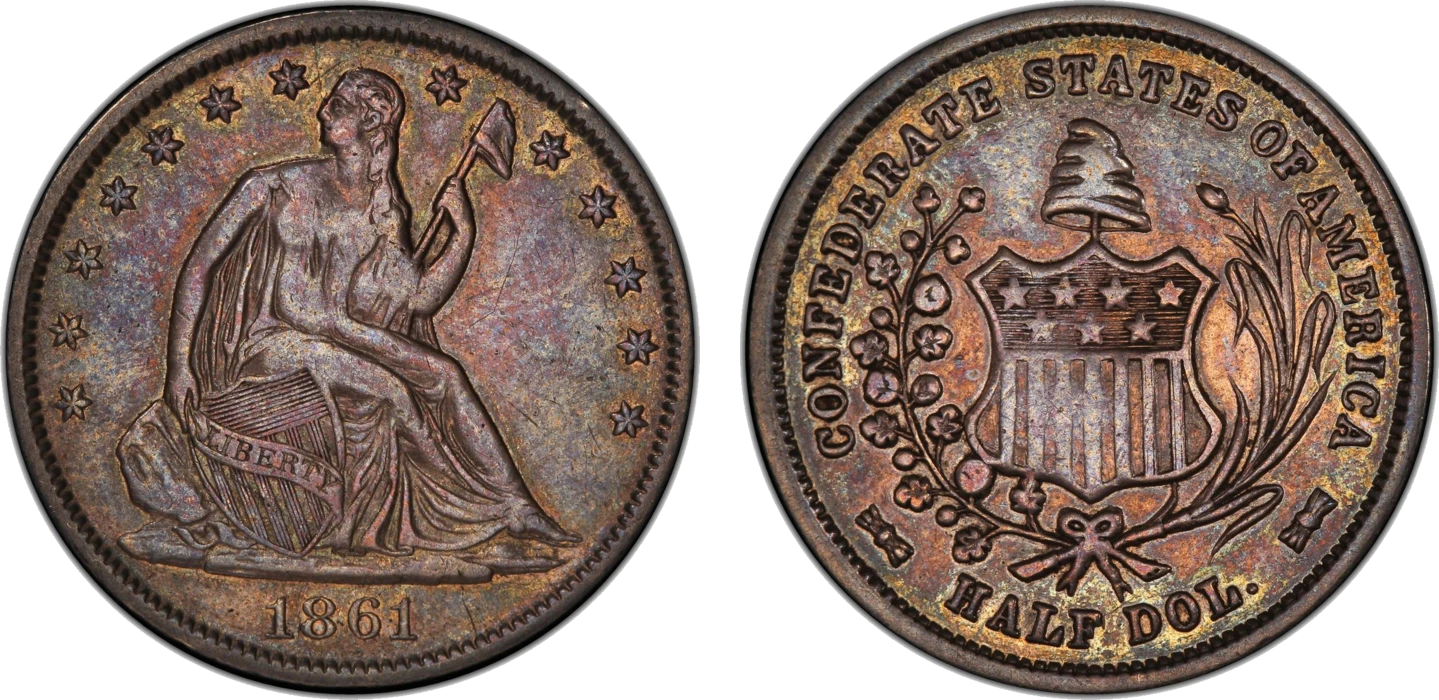
Four Half Dollars
After Louisiana seceded in January 1861, the New Orleans Mint came under Confederate control. In April, at the request of Confederate Treasury Secretary C. G. Memminger, a local engraver (usually named as A. H. M. Patterson) cut a new reverse: a shield with seven stars under a liberty cap, between sugar cane and cotton, reading CONFEDERATE STATES OF AMERICA. It was paired with a regular 1861 Seated Liberty obverse die. Four coins were struck.
Why Only Four?
That's still argued. The chief coiner, B. F. Taylor, wrote in 1879 that production stopped for lack of bullion. Numismatic historian Bertram has argued the reverse die was cut too deep for the steam press to strike well.
The Scott Restrikes
In 1879 E. Mason acquired Taylor's coin and the reverse die and sold them to the New York dealer J. W. Scott. Scott struck 500 white-metal tokens with the die, then planed the backs off 500 genuine 1861 half dollars and restruck them with the Confederate reverse. The flattened Seated Liberty design and date of the host coin still show on the front of a restrike.
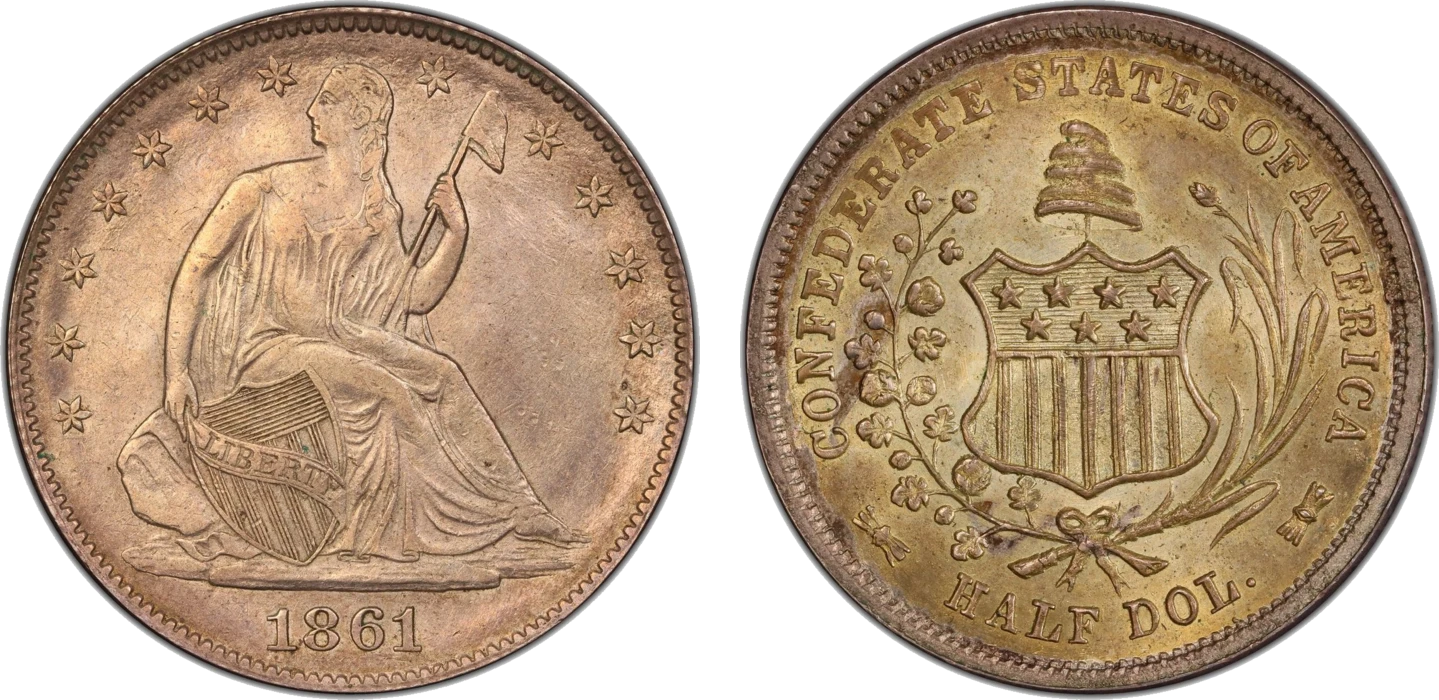
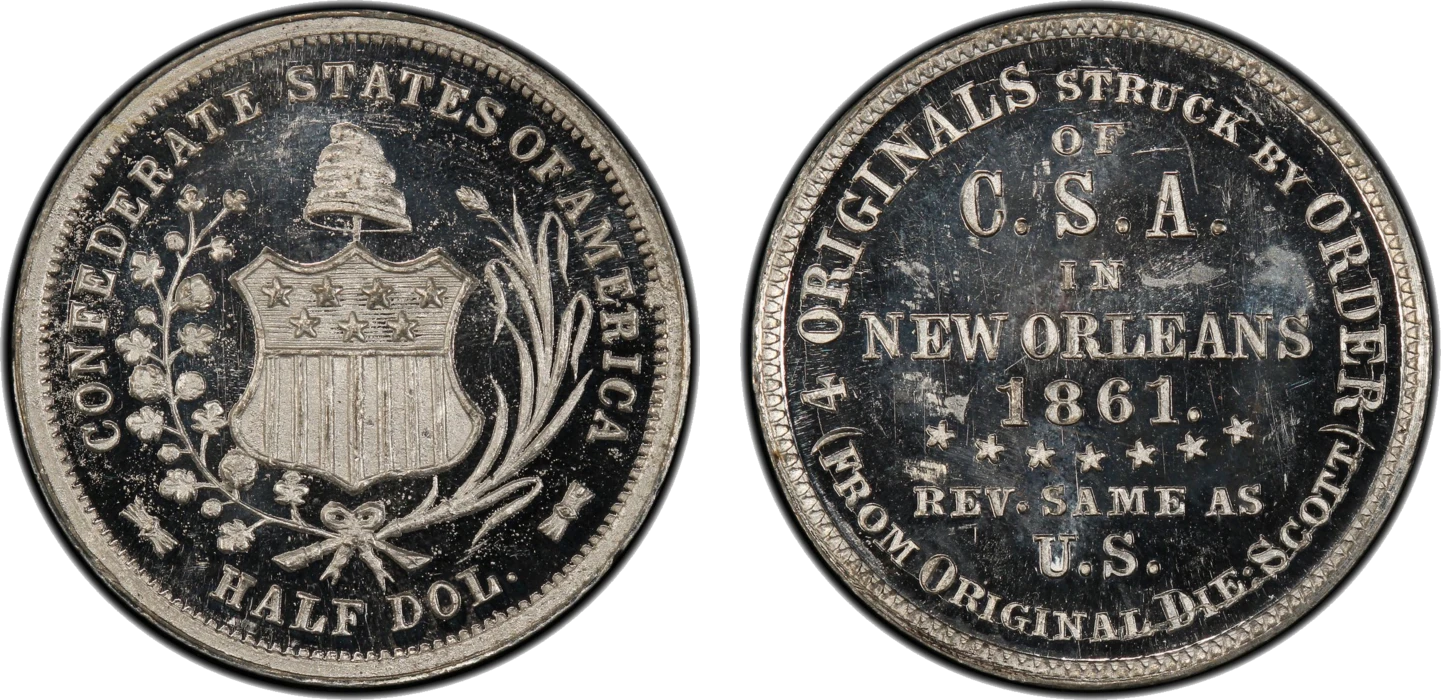
The Lovett Cent
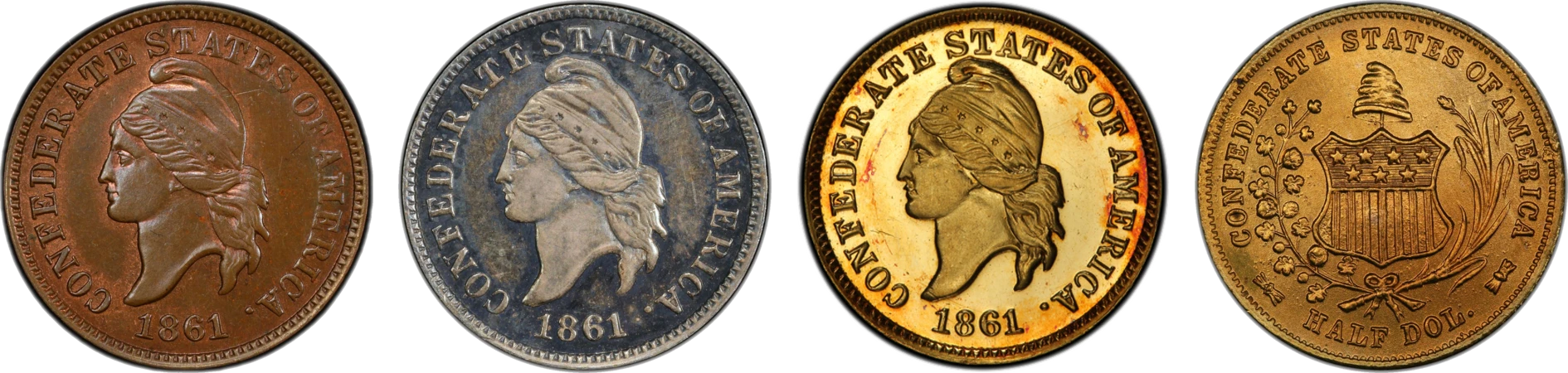
There's a Confederate cent too. Robert Lovett Jr., an engraver in Philadelphia, cut dies for a one-cent piece early in 1861 and struck a small number in copper-nickel: twelve by most accounts, up to sixteen in one estimate, with thirteen known today. The dies were never delivered. The story that Lovett hid the coins for fear of arrest first appears in Haseltine's 1874 sale catalogue, and nobody has found evidence for it.
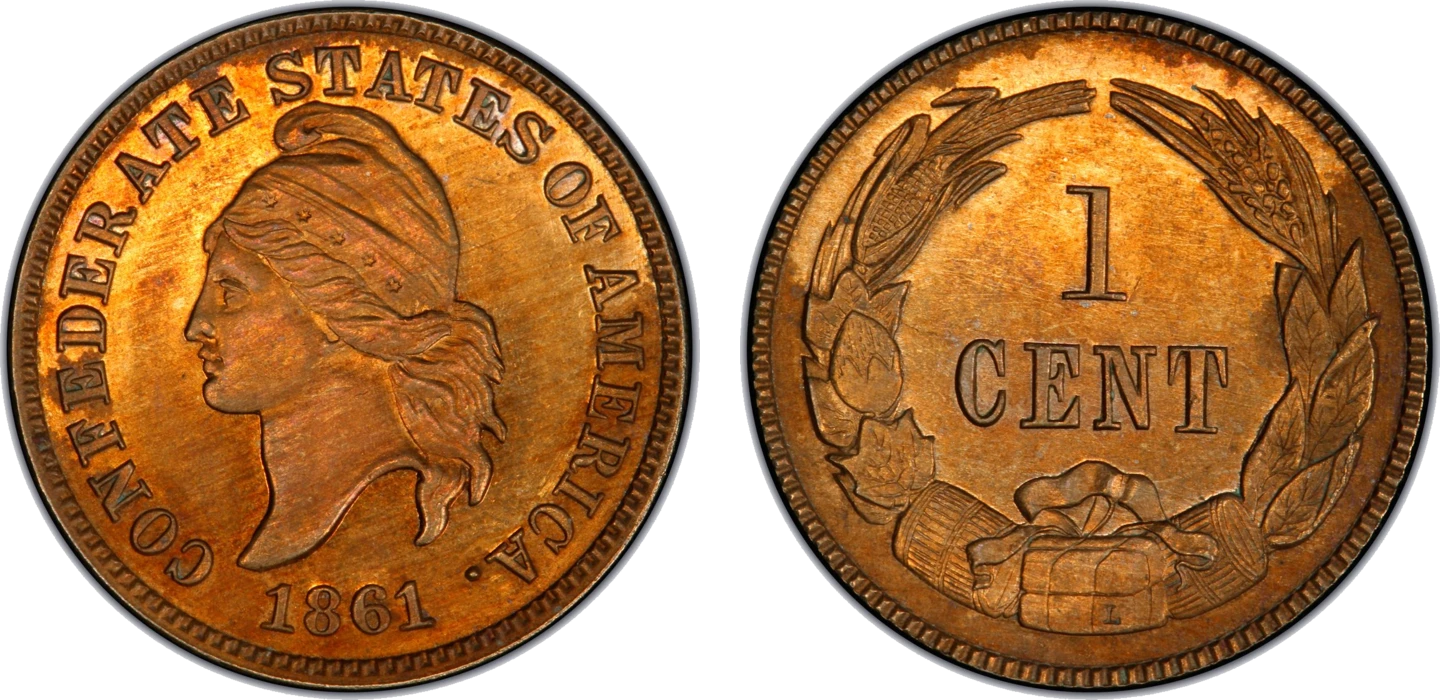
Restrikes Everywhere
John W. Haseltine bought Lovett's dies and in 1874 restruck the cent in gold, silver and copper (the ANA gives 7, 12 and 55). In 1961 and 1962 the dealer Robert Bashlow added centennial pieces: cents from transfer dies of Lovett's dies, and copies of Scott's token from new dies. So most Confederate coins you'll meet are restrikes or copies, not originals.
The Price of an Original
An original half dollar sold for $960,000 at Heritage on November 1, 2017.
See the originals and the restrikes in the Confederate States of America (1861-1863) series, including the W-12 original half dollar, the Scott restrike, the Scott token, the original Lovett cent and Haseltine's gold restrike.
Sources: NGC (2014, 2017); Coin World (Roach, 2017; 2023); CoinWeek (Aug. 31, 2026); B. F. Taylor's letter, New Orleans Picayune (Apr. 9, 1879); The E-Sylum v17n37a15 (Bertram) and v19n07a20 (P. Scott Rubin, The Numismatist, Jan. 2016); ANA (Meisky, 2015); Rumsey Auctions; Littleton Coin Company blog (2019); Heritage/CoinWeek (2013).