
By Brandon Norris
Reference: Wrong Planchet (WPL) in Learn
1966 Silver Quarter Found in 2025: What a Transitional Error Is and Why This One Matters
Wrong PlanchetA Quarter That Shouldn't Exist: Silver in a Clad World
In 2025, a 1966 Washington quarter struck on a 90% silver planchet surfaced, and PCGS certified it as AU53 later that year. In 2026 it was offered at auction by Stack's Bowers. According to the auction description, the consignor found it in 2025 while searching 90% silver Washington quarters. The Mint was still striking 1964-dated silver quarters in 1965 and 1966, alongside the new clad coins, which is how a silver planchet could still be at hand.
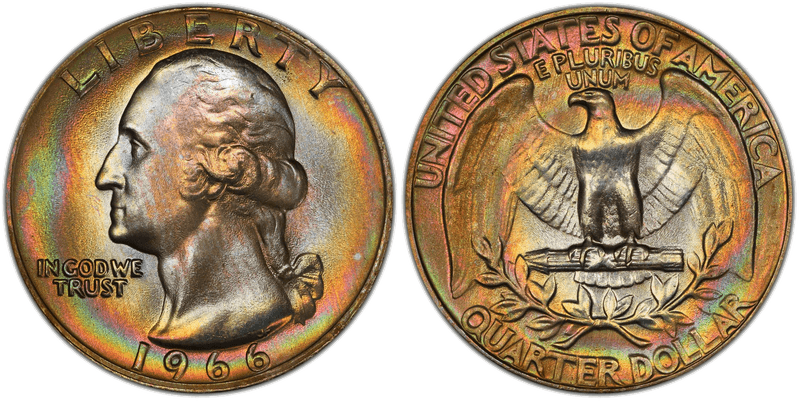
A standard 1966 Washington Quarter on clad planchet. Browse the 1966 Washington Quarter in the NumisDex catalog.
What Is a Transitional Error?
A transitional error occurs when a coin is struck on the wrong planchet due to a composition change between years. In 1965, the U.S. Mint switched from 90% silver to copper-nickel clad for dimes and quarters as part of the Coinage Act of 1965. Any leftover silver planchet that accidentally made it into a press after the switch would produce a transitional error — a coin with a current-year date struck on the previous year's metal composition.
The most famous transitional errors are:
- 1965 silver dime — Roosevelt dime struck on a leftover 90% silver planchet
- 1965 and 1966 silver quarters — Washington quarters on silver planchets
- 1943 copper cent — Lincoln cent struck on a leftover bronze planchet during the WWII zinc-coated steel cent year
- 1944 steel cent — Lincoln cent struck on a leftover steel planchet after the Mint returned to copper
How to Identify a Silver Quarter vs. Clad
Two tests separate a silver quarter from a clad one:
1. Weight: A silver quarter weighs approximately 6.25 grams. A clad quarter weighs approximately 5.67 grams. A precision scale accurate to 0.01 grams is essential — kitchen scales are not precise enough for this purpose.
2. Edge examination: A clad quarter shows the distinctive copper "sandwich" at the edge — a thin copper core visible between the outer nickel-copper layers. A silver quarter's edge appears uniformly silver throughout, with no copper line.
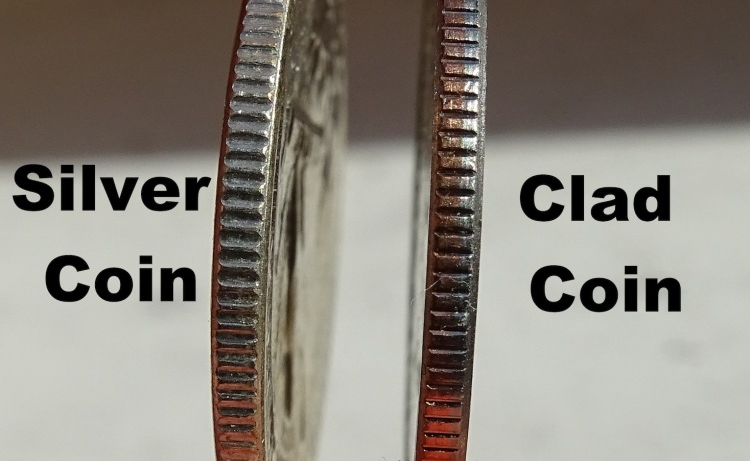
Edge comparison: silver shows uniform metal throughout, while clad reveals the copper core between outer layers.
Authentication Challenges
Claiming a post-1964 silver quarter is serious business. The authentication process for transitional errors is rigorous because:
- Canadian quarters were 80% silver until 1967 and also show a silver edge, so a silver-looking quarter in a roll is not automatically a U.S. error
- Silver-plated clad quarters exist as novelty items and can fool visual inspection
- XRF (X-ray fluorescence) testing or specific gravity testing may be needed beyond simple weighing
Professional certification by PCGS or NGC is the accepted way to confirm any transitional error claim.
Why These Happen So Seldom
When the Mint changed compositions, entire production lines were converted. Leftover planchets had to physically remain in a hopper or bin to be accidentally fed into a press. The Mint's quality control procedures made this unlikely but not impossible.
If you suspect you have a transitional error, start with weight. If it's the right weight for the wrong metal, seek professional authentication immediately.