
Three Coins, One Denomination: The Complete Story of the Small Cent (1856-Present)
When the Mint Act of 1857 killed the large cent and the half cent, the U.S. needed a new penny. The replacement would be smaller, cheaper to produce, and -- for the first time -- not made of pure copper.
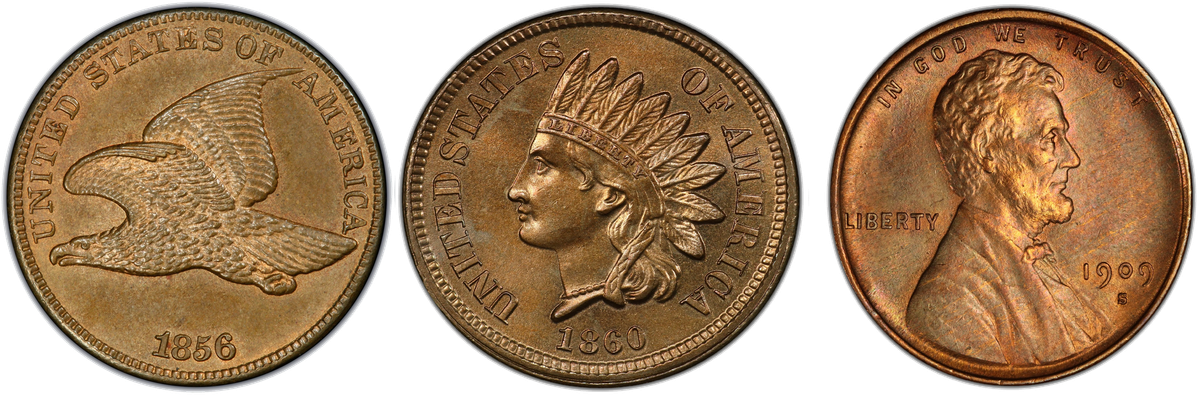
The three faces of the American small cent — Flying Eagle (1856-1858), Indian Head (1859-1909), and Lincoln (1909-present)
That transition produced three entirely different coins under the same denomination. Together they span 170 years of American history, and one of them is still being made today.
The Flying Eagle Cent (1856-1858)
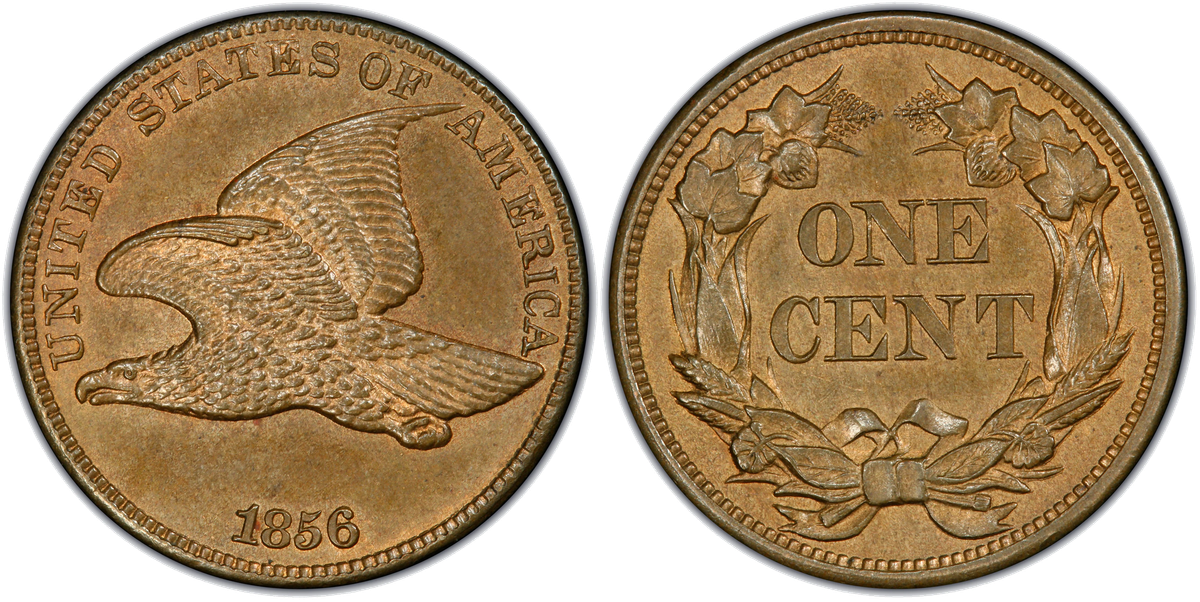
The Flying Eagle cent (1856-1858) — America's first small cent, replacing the large copper cents that had been in circulation since 1793
The Flying Eagle cent was the first small-format cent and the coin that proved the concept. At 19mm in diameter (compared to the large cent's 28mm), it was dramatically smaller. Instead of pure copper, it was struck in copper-nickel -- 88% copper, 12% nickel -- giving it a pale, whitish appearance that looked nothing like the old copper cents.
The design featured a flying eagle on the obverse (adapted from the reverse of the Gobrecht dollar) and a wreath on the reverse. It was beautiful, but it had a problem: the eagle design was too high in relief, and the opposing wreath design was also raised. The two high points on opposite sides of the coin caused striking issues -- the dies wore out quickly and many coins came out weakly struck.
Key facts:
- 1856 Flying Eagle: Technically a pattern coin, roughly 2,000-3,000 were struck and distributed to members of Congress to promote the new denomination. Today it's one of the most famous and valuable U.S. coins, with even damaged examples selling for thousands.
- 1857-1858: Regular production. About 42 million struck. Common and affordable -- a great type coin for the series.
- The striking problems were severe enough that the Mint scrapped the design after just three years.
The Indian Head Cent (1859-1909)
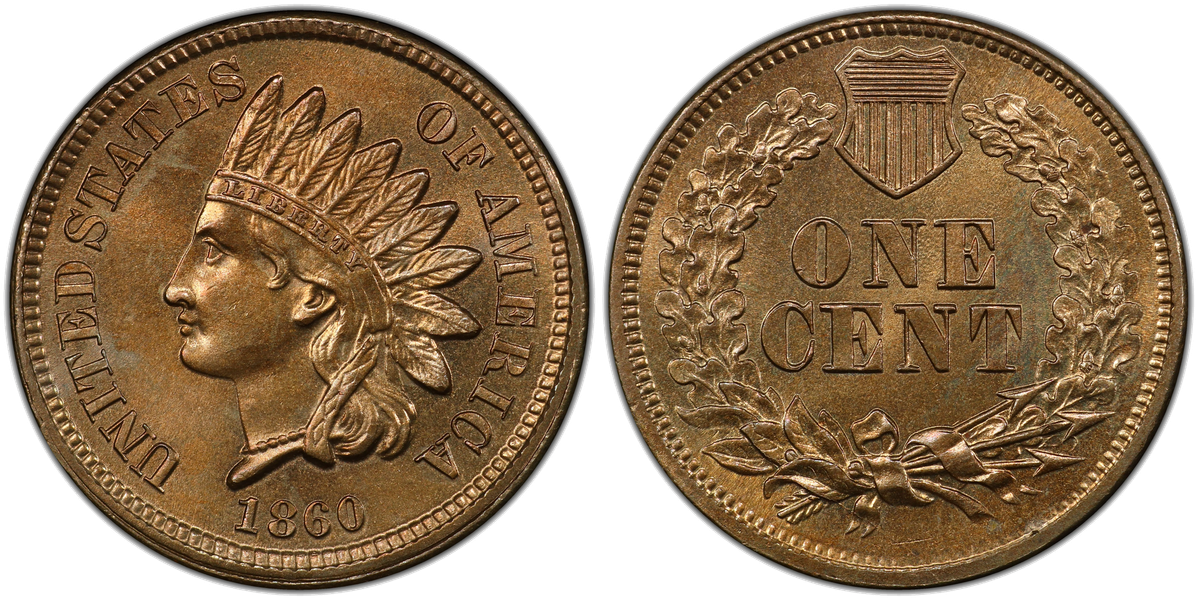
The Indian Head cent (1859-1909) — James B. Longacre's iconic design featuring Lady Liberty in a feathered headdress
The Mint's solution to the Flying Eagle's striking problems was a new design with lower relief. Chief Engraver James B. Longacre's Indian Head cent featured Liberty wearing a feathered headdress on the obverse and a wreath on the reverse.
Despite the name, the figure on the obverse isn't a Native American. It's a Caucasian representation of Liberty wearing a headdress. The exact model has been debated for over 150 years -- Longacre may have used his daughter Sarah as a model, though he denied it.
The Indian Head cent went through a significant composition change:
- 1859-1864: Copper-nickel (same composition as the Flying Eagle). These are thicker and heavier.
- 1864-1909: Bronze (95% copper, 5% tin and zinc). The switch was driven by the Civil War -- nickel was needed for military applications, and the copper-nickel cents were being hoarded. The bronze version was thinner and lighter.
Key dates and varieties:
- 1877: The key date. Mintage of only 852,500 -- the lowest in the series. A Good condition example sells for $800+.
- 1864 L: The first year an "L" (for Longacre) was added to the ribbon on the headdress. Look for it with a loupe.
- 1908-S and 1909-S: The only San Francisco mintages. Both are scarce, with the 1909-S being a significant key date.
The Lincoln Cent (1909-Present)
In 1909, the Lincoln cent made history. It was the first U.S. coin to feature a real, identifiable person rather than an allegorical figure. Until then, every "Liberty" portrait was a fictional representation. Putting Abraham Lincoln's face on a coin was genuinely controversial -- critics argued it was monarchical and un-American.
President Theodore Roosevelt championed the idea as part of his broader effort to improve U.S. coin design (the same initiative that produced the Saint-Gaudens gold coins). Lithuanian-born sculptor Victor David Brenner designed the obverse portrait, which has appeared on every cent since.
The V.D.B. Controversy
Brenner's initials "V.D.B." were placed prominently on the reverse of the first cents struck in 1909. The public and the press immediately objected -- they felt the initials were too large and amounted to advertising for the designer. The Mint removed the initials after just four days of production.
The result: the 1909 V.D.B. cent became an instant collectible. The 1909-S V.D.B. (struck at San Francisco with Brenner's initials) had a mintage of only 484,000 and is one of the most sought-after coins in all of U.S. numismatics. In 1918, Brenner's initials were quietly restored to the coin in much smaller form, on Lincoln's shoulder -- where they remain today.
Four Reverse Designs
The Lincoln cent has had four different reverses, each marking a distinct era:
| Reverse | Years | Designer | Notes |
|---|---|---|---|
| Wheat Ears | 1909-1958 | V.D. Brenner | The original. "Wheat pennies" are the most collected U.S. coin series. |
| Lincoln Memorial | 1959-2008 | Frank Gasparro | Introduced for Lincoln's 150th birthday. Lincoln appears on both sides -- the only U.S. coin where the same person is on obverse and reverse. |
| Bicentennial (4 designs) | 2009 | Various | Four designs celebrating Lincoln's birth, formative years, professional life, and presidency. One-year only. |
| Union Shield | 2010-present | Lyndall Bass | The current design. Represents Lincoln's preservation of the Union. |
Why Small Cents Matter to Collectors
Small cents are the most widely collected U.S. coin series. Period. Every collector who has ever filled a Whitman folder started with Lincoln cents. Every coin roll hunter searches cent rolls. The variety landscape is enormous -- doubled dies, repunched mint marks, die clashes, cuds, and more are documented across tens of thousands of die pairs.
And unlike many classic series, small cents are accessible at every price point. You can build a complete set of Lincoln Memorial cents from circulation for essentially nothing. You can chase key dates like the 1909-S V.D.B. or the 1914-D as grail coins. You can hunt varieties for pennies per roll. There's a reason "penny collecting" is synonymous with the hobby itself.
Browse small cent listings on NumisDex:
- [Flying Eagle Cents](https://www.numisdex.community/catalog/search?series=Flying+Eagle+Cents+1856-1858)
- [Indian Head Cents](https://www.numisdex.community/catalog/search?series=Indian+Head+Cents+1859-1909)
- [Lincoln Wheat Cents](https://www.numisdex.community/catalog/search?series=Lincoln+Wheat+Cents+1909-1958)
- [Lincoln Memorial Cents](https://www.numisdex.community/catalog/search?series=Lincoln+Memorial+Cents+1959-2008)
- [Lincoln Bicentennial Cents](https://www.numisdex.community/catalog/search?series=Lincoln+Bicentennial+Cents+2009)
- [Lincoln Shield Cents](https://www.numisdex.community/catalog/search?series=Lincoln+Shield+Cents+2010+to+Date)
---
0 Replies
Related Threads
- Top 10 Lincoln Cent Varieties You Can Still Find in Change0 replies · 3mo ago
- 1982-D Small Date Copper Cent: The Modern Rarity Nobody Knew Existed Until 20160 replies · 3mo ago
- Wheat vs. Memorial vs. Shield Reverse: Dating Lincoln Cents at a Glance0 replies · 3mo ago
- 1982 Lincoln Cents: How to Tell Copper from Zinc (and Find the Rare One)0 replies · 3mo ago
- Large Date vs. Small Date Cents: How to Tell (1960, 1970-S, 1982)0 replies · 3mo ago