
Full Bands and Full Torch on Dimes: What Counts and Why It Matters
Strike Quality Designations for Dimes
When you see "FB" (Full Bands) on a Mercury dime holder or "FT" (Full Torch) on a Roosevelt dime holder, it means the coin received an exceptionally strong strike. These strike quality designations can add significant premium to an already valuable coin — sometimes doubling or tripling the price.
Full Bands (FB) — Mercury Dimes
The fasces (a bundle of rods bound together) on the reverse of the Mercury dime has two horizontal bands that wrap around the rods. On a well-struck coin, these bands are fully separated — you can see a clear, complete split between the upper and lower bands across their entire width.

Full Bands (FB) — complete split between the upper and lower horizontal bands

No Full Bands — the horizontal bands merge together due to weak strike or die wear
Why Full Bands coins are scarce:
- The bands are located in one of the highest-relief areas of the reverse design
- They require an exceptionally strong strike to fully form
- Die wear quickly eliminates the ability to produce fully separated bands
- Even uncirculated coins often lack Full Bands due to weak strikes
Certain dates are especially difficult to find with Full Bands (1916-D, 1921, 1921-D among the hardest), and the FB premium on these dates can be enormous.
Full Bands (FB) and Full Torch (FT) — Roosevelt Dimes
The Roosevelt dime's reverse features a torch flanked by olive and oak branches. Both major grading services recognize strike quality on Roosevelt dimes, but they use different names and different standards:
- PCGS — Full Bands (FB): Requires that both the upper and lower pairs of horizontal bands on the torch show full separation and distinction. The dividing line between each pair of bands must be unbroken and complete.
- NGC — Full Torch (FT): Requires the same band separation as PCGS, plus full separation and definition of the vertical lines of the torch. This makes the NGC standard stricter — a coin can qualify for PCGS FB but fail NGC FT if the vertical torch lines are not fully separated.
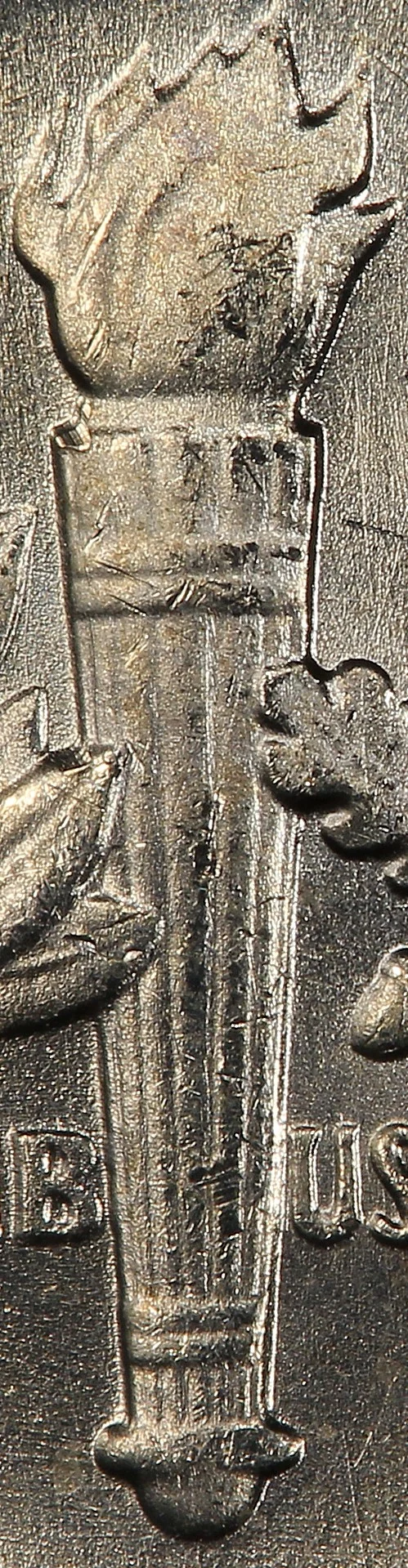
Full Torch (FT) — horizontal bands and vertical torch lines fully separated
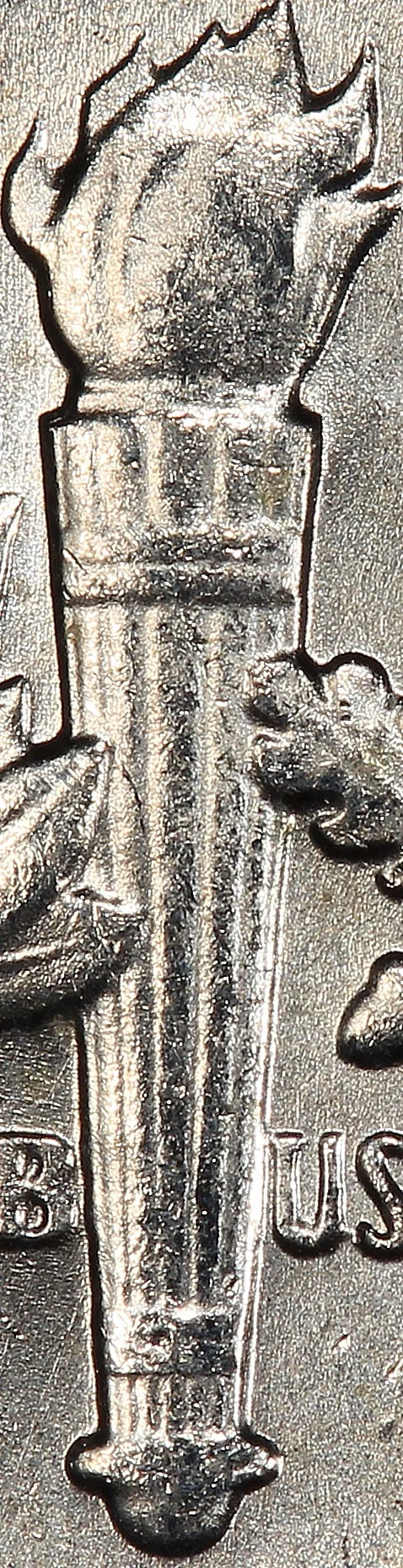
No Full Torch — flame lines merge together, lacking full separation
The FB/FT designation for Roosevelt dimes typically carries less premium than FB on Mercury dimes because Roosevelt dimes are generally better struck. However, certain dates (especially from the 1950s and 1960s) are notably difficult to find with full strike details.
What to Look For
When evaluating strike quality on dimes:
- Use at least 5x magnification
- The separation must be complete — any point where the bands/flames merge disqualifies the coin
- The bands/flames must be fully formed, not just partially visible
- Wear and contact marks can erase band separation even on otherwise uncirculated coins — look at the highest points carefully
Browse Mercury dimes with Full Bands and Roosevelt dimes with Full Torch in the NumisDex catalog.