
Off-Center Strikes — When Coins Miss Their Mark
OCWhen Coins Miss Their Mark
Off-center strikes are among the most visually dramatic errors in U.S. coinage. They occur when a planchet (blank coin) is not properly centered between the dies before striking, resulting in a coin where the design is shifted to one side and part of the planchet remains blank.
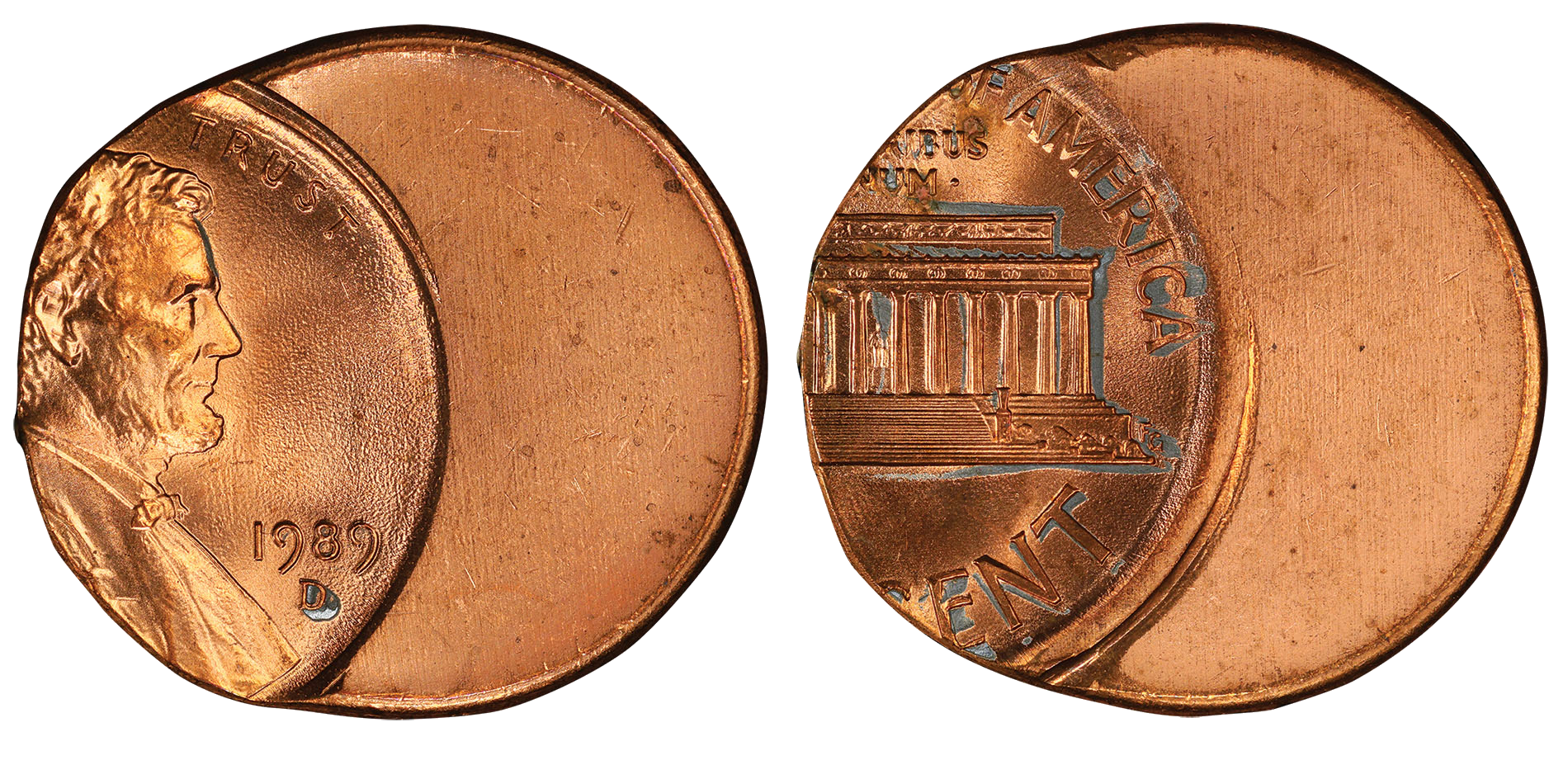
Unlike subtle die varieties that require magnification to appreciate, off-center strikes are immediately recognizable. The blank crescent of unstruck metal alongside a partial design makes these coins unmistakable — and they have been captivating error collectors for generations.
How Do Off-Center Strikes Happen?
The U.S. Mint's coining presses are designed with remarkable precision. A planchet is fed into the press by an automated feed system, and it must land precisely on the lower (anvil) die, centered within the collar that forms the coin's edge. When the upper (hammer) die descends, it strikes the planchet against the anvil die, impressing the design onto both sides of the coin simultaneously.
When the feed mechanism malfunctions, or a planchet bounces or shifts after landing on the anvil die, the coin is struck with part of the planchet extending beyond the die faces. The portion of the planchet that was positioned between the dies receives the full design impression, while the portion that extended beyond the dies remains completely blank — a flat, featureless expanse of metal.
The degree of off-center varies widely. Some coins are only slightly misaligned, with perhaps 1-2% of the design shifted, while extreme examples can show 50% or more of the planchet left blank, with half or more of the design missing entirely. The collar die, which normally constrains the coin to its proper diameter and imparts reeding on denominations like quarters and dimes, cannot contain a misaligned planchet — so off-center strikes also lack normal rim and edge details on the shifted side.
Modern Mint quality control systems catch the vast majority of off-center strikes before they leave the facility. Automated rejection mechanisms detect coins that do not meet weight and dimensional tolerances. However, examples still escape into circulation, particularly from higher-volume production runs where the sheer speed of production — hundreds of coins per minute — means some defective pieces slip through.
Understanding the Percentage
Off-center strikes are described by the approximate percentage the design is shifted from center. This percentage represents how far off-center the strike occurred, and it directly affects both the visual impact and the collector value of the coin.
5-10% Off-Center
At 5-10% off-center, most of the design is still visible. Part of the rim is missing on one side, replaced by a thin crescent of blank planchet. The opposite side of the rim may appear slightly thicker than normal. These are the most common off-center errors to find in circulation, as they are subtle enough to sometimes pass through quality control undetected.
20-30% Off-Center
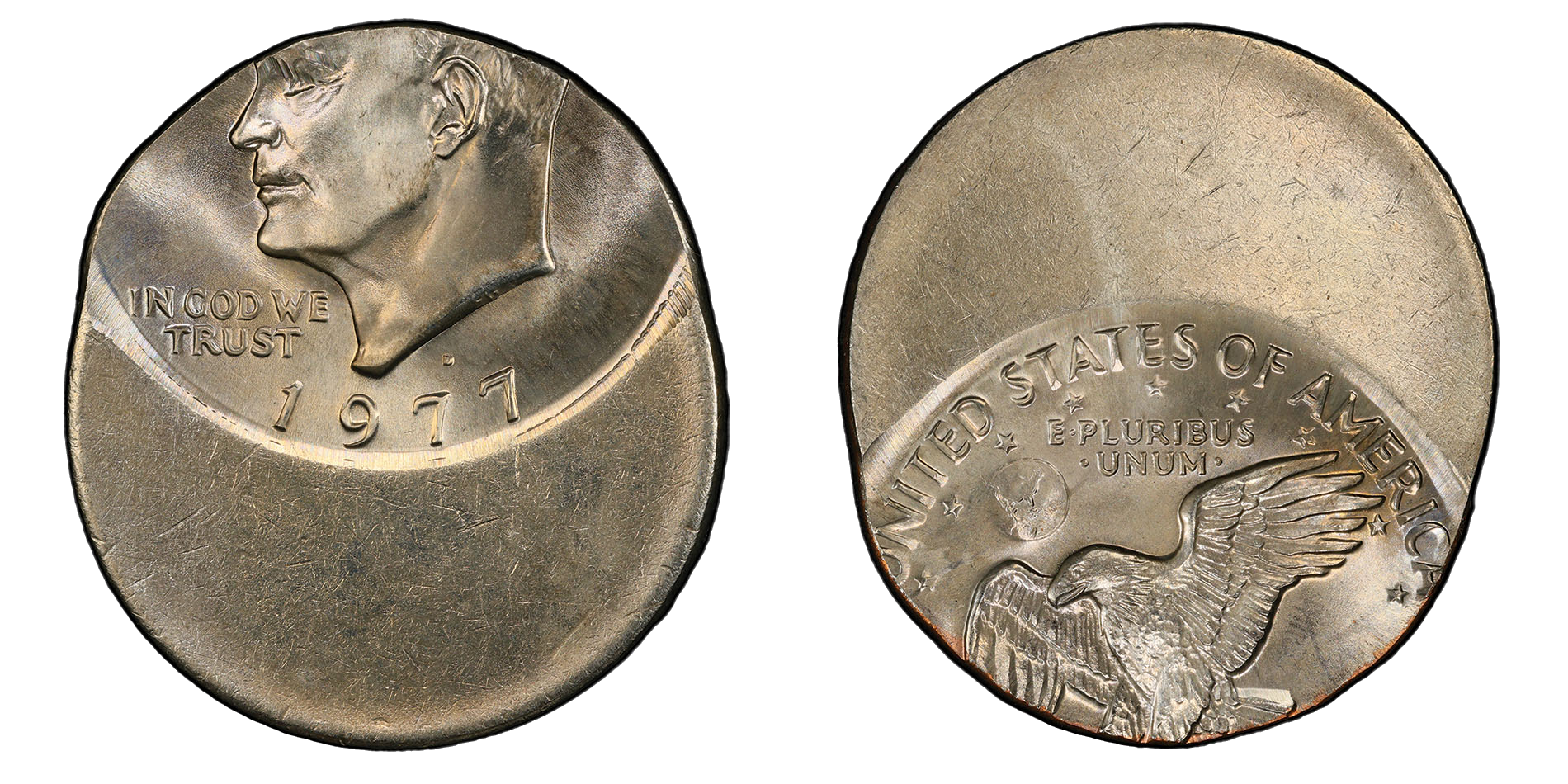
At 20-30%, a significant crescent of blank planchet is visible. Design elements begin to disappear on the shifted side — letters from the motto, parts of the portrait, or sections of the reverse design are simply absent. These are the "sweet spot" for most collectors: dramatic enough to be visually striking, with enough of the design remaining to identify the coin's denomination, date, and mint mark.
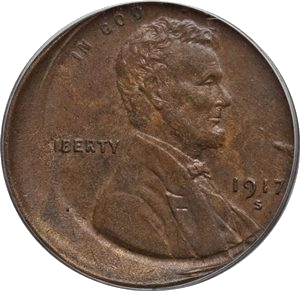
A 1917-S Lincoln Cent struck approximately 20% off-center. The date and S mint mark are fully readable, which is the key factor in this coin's collector value. Notice how the rim is missing on one side while the opposite side shows a thicker-than-normal rim.
50% Off-Center
At 50% off-center, half the coin is blank. Only half the design is present, creating a dramatic split between the struck and unstruck portions of the planchet. These are visually arresting coins that command immediate attention.
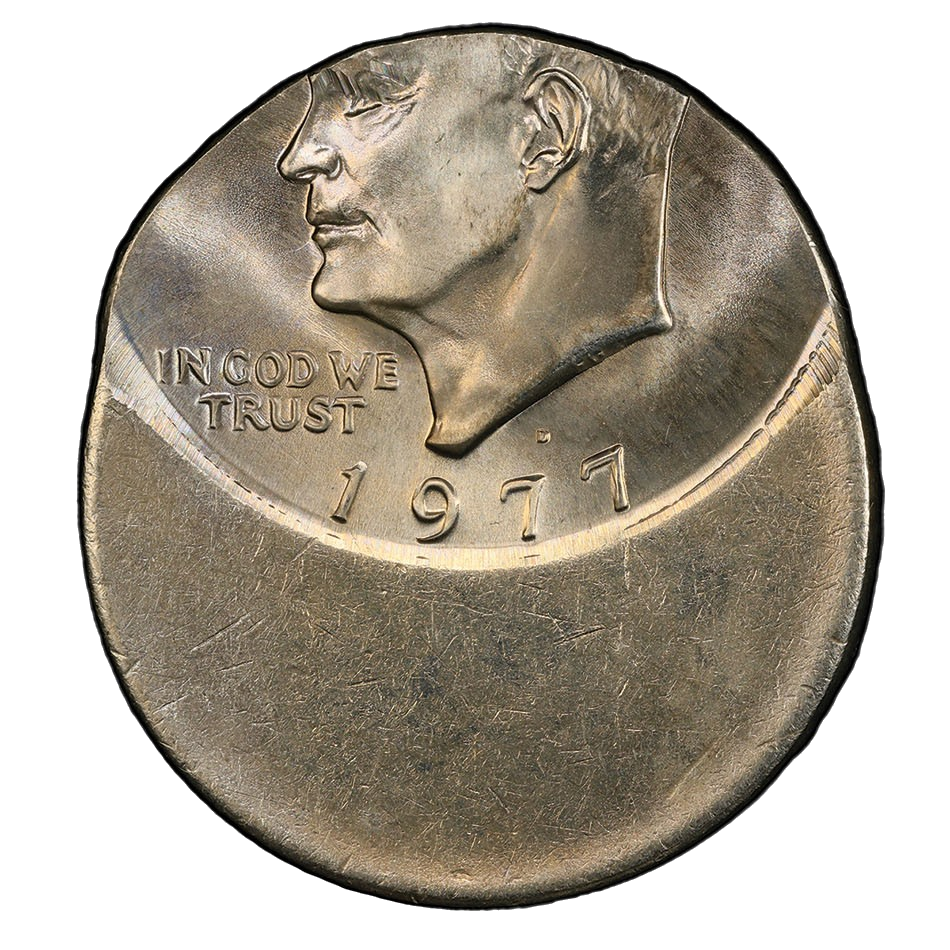
A 1977 Eisenhower Dollar struck approximately 50% off-center. The larger the denomination, the more dramatic the visual effect.
80-90% Off-Center
At the extreme end of the spectrum, 80-90% off-center strikes are almost entirely blank. Only a small sliver of the design is visible at the edge of the planchet. These coins are visually dramatic but present a paradox for collectors: while the error itself is extreme and rare, the near-total absence of design elements makes it difficult or impossible to identify the coin's date, denomination, or mint mark.
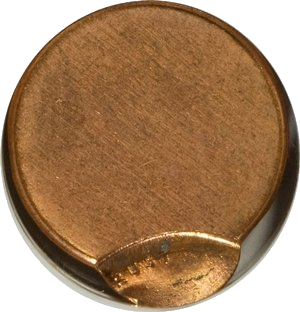
A Lincoln Cent struck approximately 90% off-center. Only a small fraction of the design remains visible at the bottom edge. At this extreme, identifying the specific date becomes impossible, which limits collector value despite the dramatic nature of the error.
What Makes an Off-Center Strike Valuable?
Not all off-center strikes are created equal. Several factors determine the collector value of a given example:
- Date and mint mark visibility: This is the single most important factor. An off-center coin where you can still read the full date and mint mark is worth significantly more than one where the date is partially or fully missing. Collectors need to be able to identify exactly what the coin is — without a readable date, the coin becomes a generic curiosity rather than a specific collectible.
- Percentage: Generally, more dramatic off-center strikes (30-50%) are more valuable than slight ones (5-10%), as long as the date remains visible. The combination of a high percentage with a readable date is what drives top values.
- Denomination: Off-center errors on larger denominations — quarters, half dollars, and dollars — are considerably rarer and more valuable than on cents. The Mint's quality control for higher denominations is more stringent, meaning fewer escape the facility.
- Era: Older off-center strikes from before the 1960s are scarcer than modern ones. As Mint quality control technology has improved over the decades, fewer errors escape — but conversely, when older examples do surface, they often carry substantial premiums.
- Condition: Uncirculated off-center strikes command significant premiums over circulated examples. Most off-center coins that escape the Mint are eventually found in circulation, so examples that were set aside immediately and preserved in mint state are uncommon.
Off-Center vs. Related Striking Errors
Off-center strikes are sometimes confused with other striking errors that produce superficially similar results. Understanding the differences is important for accurate identification and proper attribution.
Broadstrike
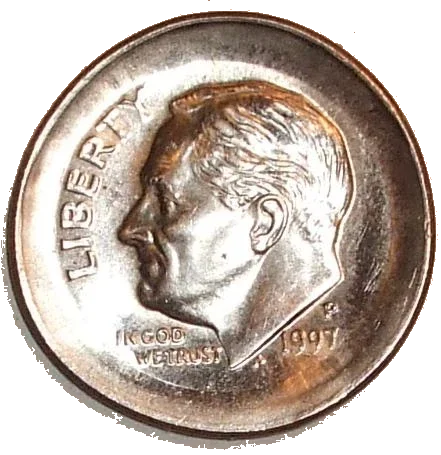
A broadstrike occurs when a coin is struck without the collar die in place. The collar normally constrains the coin to its proper diameter and imparts the reeded or plain edge. Without it, the coin spreads wider than normal under the force of the strike. However, the key distinction is that the design is still centered on a broadstrike — both dies made full contact with the planchet. The coin simply expanded outward because the collar was not there to contain it. Broadstrikes are slightly larger than normal coins, have no reeding (even on denominations that should have it), and show the complete design.
Clipped Planchet
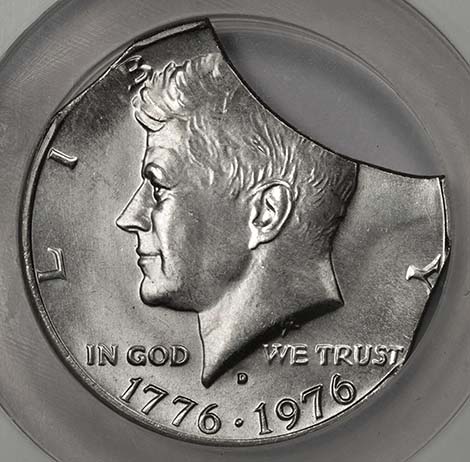
A clipped planchet error occurs when the planchet itself is incompletely punched from the strip of metal during the blanking process. The resulting planchet has a curved missing section where the punch overlapped with a previously punched hole in the strip. Unlike off-center strikes, the design is centered on a clipped planchet coin — the planchet was properly positioned between the dies during striking. It is the planchet itself that is incomplete, not the alignment of the strike.
Blakesley Effect
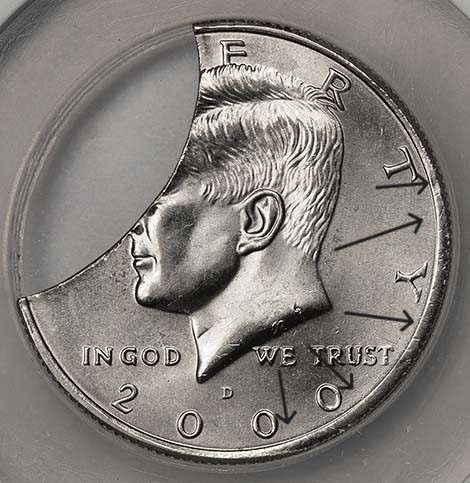
On clipped planchet coins, the area of the rim directly opposite the clip often shows weakness or incompleteness. This diagnostic feature is named for researcher Thomas Blakesley, who documented the phenomenon. The Blakesley effect occurs because the missing metal at the clip site prevents the collar from exerting uniform pressure during the strike, resulting in incomplete metal flow on the opposite side. This feature is an important diagnostic for confirming a genuine clip versus post-mint damage, since post-mint damage would not produce corresponding weakness on the opposite rim.
Collecting Tips
- Start affordable: Off-center cents from the 1990s and 2000s are the most accessible entry point for new error collectors. Examples in the 10-20% range can be found for $5–$20, making them excellent introductory pieces.
- Prioritize the date: Always prioritize date visibility when evaluating an off-center strike. An off-center coin without a readable date has limited collector appeal regardless of how dramatic the percentage may be.
- Consider certification: Third-party certification from PCGS or NGC adds significant value for off-center strikes over 10%, as grading services confirm the error is genuine and not the result of post-mint damage. Certification also provides a standardized grade and description that facilitate buying and selling with confidence.
- Check both sides: Both the obverse and reverse shift proportionally on a genuine off-center strike. If only one side appears off-center while the other is properly centered, the coin may be a different type of error entirely (such as a misaligned die) or may not be a genuine mint error.
- Proof off-centers are extraordinary: Off-center strikes on proof coins are extremely rare and valuable. Proof production involves hand-feeding individual planchets into the press, so the opportunity for misalignment is minimal — making proof off-center strikes among the rarest of all error categories.
Browse off-center strike listings in the NumisDex catalog, or visit our Off-Center Strike learn page for more detailed information about this error type.
A Window Into the Process
Off-center strikes remind us that behind every coin is a mechanical process — and sometimes that process goes spectacularly wrong. From slight shifts that barely affect the rim to dramatic 50% off-centers where half the coin is a blank canvas, these errors offer a fascinating window into how coins are made and what happens when the machinery does not cooperate.
For error collectors, off-center strikes represent one of the most accessible and visually rewarding areas of the hobby. They are easy to understand, immediately recognizable, and available across a wide range of price points — from pocket change discoveries to five-figure auction highlights.
0 Replies
Related Threads
- Capped Die Errors: When a Coin Refuses to Leave the Press0 replies · 1mo ago
- Broadstrike Errors: When the Collar Fails0 replies · 1mo ago
- Strike Through Errors: When the Mint’s Factory Floor Leaves Its Mark0 replies · 1mo ago
- Broadstrike vs. Off-Center Strike: What Is the Difference?0 replies · 3mo ago
- Broadstrikes: Full Design, No Collar0 replies · 4mo ago