
Capped Die Errors: When a Coin Refuses to Leave the Press
CAPEvery Coin Is Supposed to Leave
A coin press operates hundreds of times per minute. The upper die (hammer die) descends, strikes the planchet against the lower die (anvil die), then retracts. The finished coin is ejected, and the next blank feeds in. The entire cycle takes a fraction of a second, and it works correctly millions of times in a row.
Until it doesn’t.
A capped die error occurs when a freshly struck coin sticks to one of the dies — usually the upper die — instead of ejecting. The coin adheres to the die face, and the press keeps running. The next blank that enters the press gets struck between the lower die (which is normal) and the stuck coin (which is now acting as a substitute die). The result is one of the most dramatic and visually striking errors in all of numismatics.
How a Cap Forms
The sequence that produces a capped die error follows a specific mechanical progression:
- A coin sticks to the die. After a normal strike, the finished coin adheres to the upper die instead of falling away. This can happen due to excessive die polish (which creates a slightly sticky surface), grease or oil on the die face, burrs on the die’s rim, or simply the hydraulic suction of a tightly fitted coin being pulled upward as the die retracts.
- The press keeps running. The coin press doesn’t know a coin is stuck. It feeds the next blank planchet onto the anvil die and brings the hammer die down for another strike.
- The stuck coin becomes a die. The new blank gets struck between the lower die (which imparts a normal design) and the stuck coin (which imparts an incuse, mirror-image impression of whatever design is on its face). The stuck coin is now functioning as a replacement die face.
- The cap deepens. Each successive strike pushes the stuck coin’s edges outward and downward. The rim of the stuck coin wraps around the edge of the upper die, creating a cap-like shape — hence the name. With each strike, the bowl gets deeper, the cap’s diameter increases, and any remaining design on the cap becomes more distorted.
The Progression: From Early Cap to Deep Cap
Capped die errors exist on a spectrum. The defining variable is how many strikes occurred while the cap was on the die. Each additional strike deepens the bowl, distorts the design, and increases the cap’s diameter.
Early-Stage Cap
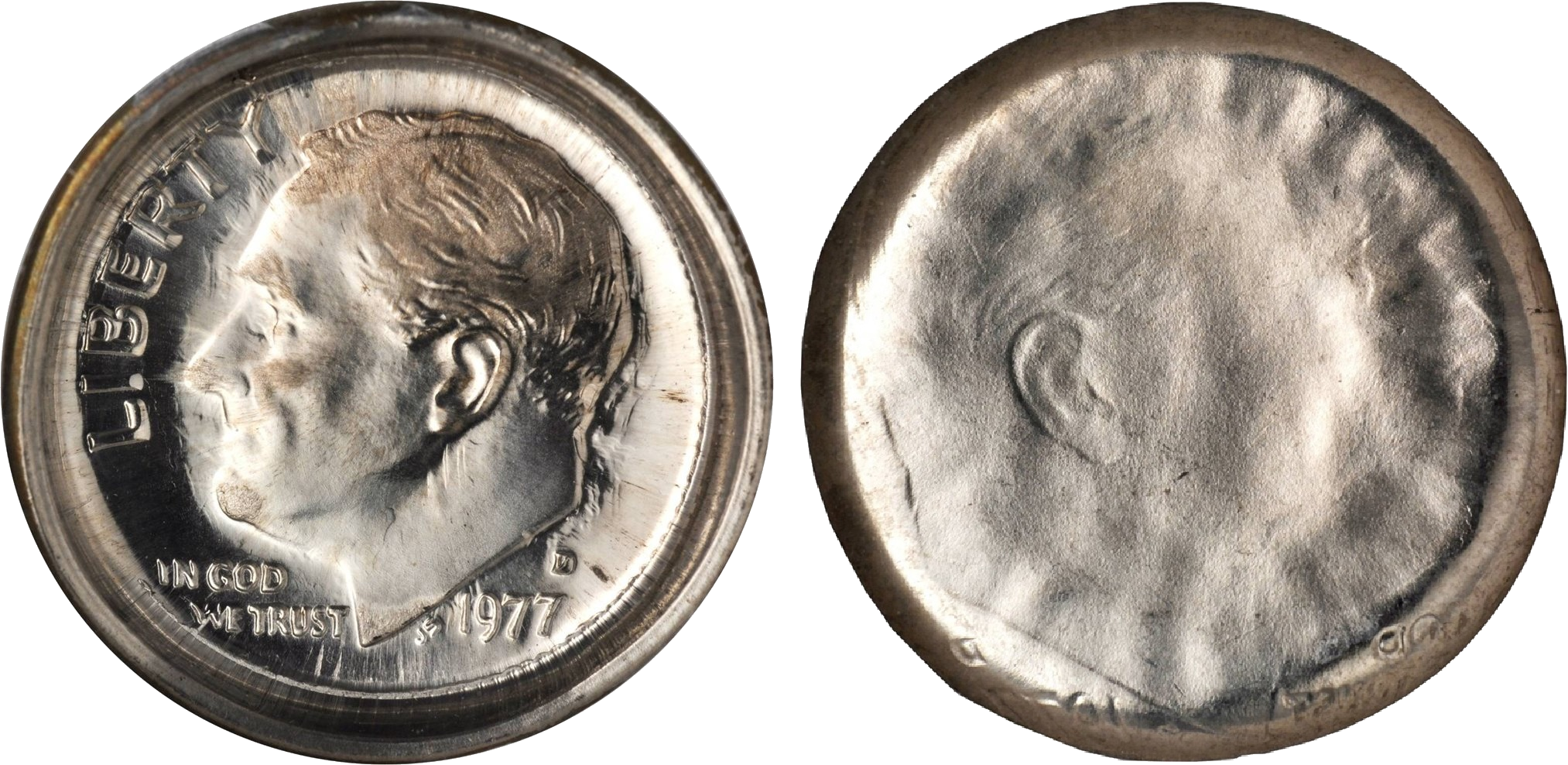
1977 (D) Roosevelt Dime — early-stage cap. The obverse shows a normal strike from the anvil die with a distinctly raised rim forming around the edge where the cap is beginning to wrap. The reverse shows a faint, incuse ghost portrait of Roosevelt — the impression left by the stuck coin acting as a substitute die. The raised lip around the perimeter is the hallmark of the capping process just beginning.
An early-stage cap has been on the die for only a few strikes. The stuck coin hasn’t deformed much yet. Coins struck against an early cap show:
- One normal side (from the anvil die)
- One side with a clear incuse (sunken) mirror-image of the stuck coin’s design
- A raised rim or lip around the edge — the beginning of the cap shape
- A diameter that’s close to normal, or only slightly enlarged
Early-stage caps are highly collectible because the incuse design is still legible. You can see the ghost of the original coin’s portrait, lettering, or date impressed into the surface — sunken rather than raised, and reversed left-to-right.
Mid-Stage Cap
After several more strikes, the cap has deepened noticeably. The stuck coin’s edges have been pushed further outward and downward, creating a more pronounced bowl shape. Coins struck against a mid-stage cap show:
- A deeper bowl on the capped side
- Partially legible incuse design — the portrait or lettering is still visible but distorted and softened
- A noticeably enlarged diameter
- The rim is now a pronounced raised wall around the edge
Late-Stage / Deep Cap
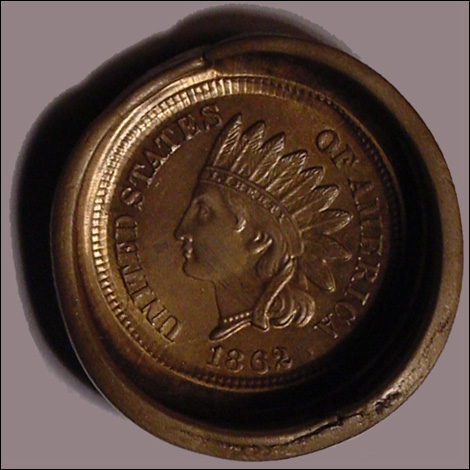
1862 Indian Head Cent — deep cap, obverse. The coin has been struck so many times while adhered to the die that it has deformed into a deep bowl. The original Indian Head design is still faintly visible at the bottom of the bowl, but the cap’s walls rise dramatically around the edges. This is the coin that stayed on the die — the cap itself, not a coin struck against the cap.
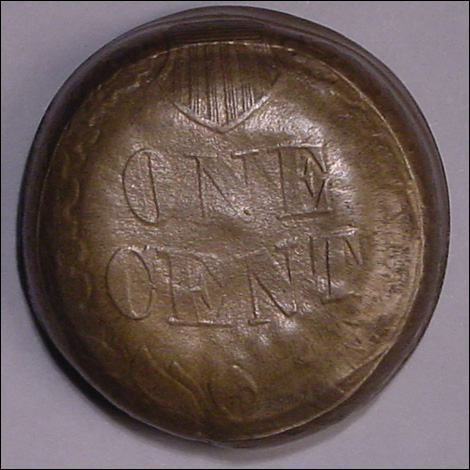
1862 Indian Head Cent — deep cap, reverse. The incuse “ONE CENT” is visible at the bottom of the bowl, struck inward rather than outward. The depth of the bowl and the height of the rim walls indicate this cap was on the die for a significant number of strikes before being dislodged.
A late-stage or deep cap has been on the die for many strikes. The stuck coin has deformed dramatically — its edges have been hammered outward and downward until the entire coin resembles a deep bowl or cup. The deep cap shown above is the cap itself: the 1862 Indian Head Cent that stayed stuck to the die. Deep caps show:
- A deep bowl shape — the coin looks more like a cup than a coin
- Little or no legible design on the capped side of coins struck against it
- A significantly enlarged diameter — the cap has spread well beyond the coin’s original size
- Smooth, featureless interior on the most extreme examples (sometimes called a “unicap”)
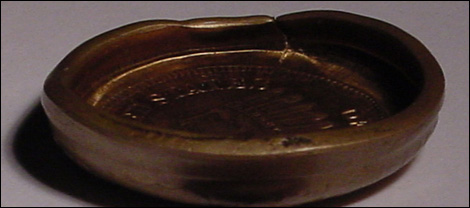
Side profile of the 1862 deep cap. The bowl depth is immediately apparent from this angle — the coin’s rim walls extend far above the original plane of the coin. This depth was created by dozens or possibly hundreds of successive strikes, each one pushing the edges further outward. The interior shows the remnants of the original die impression, now deeply recessed inside the cup.
The Connection to Broadstrikes
Capped die errors and broadstrike errors are closely related. In fact, a capped die error often begins as a broadstrike.
Here’s why: a coin that sticks to the die is, by definition, no longer inside the collar. When the next blank is struck, it may also be outside the collar (because the cap is now wider than the collar opening). The result is that coins struck against a cap are frequently broadstruck as well — they have the full design from the anvil die side, but they’re oversized because the collar couldn’t constrain them.
This is the sequence that connects last week’s broadstrike topic to this week’s capped die topic: collar failure → broadstrike → coin sticks to die → capped die → subsequent coins struck against cap are also broadstruck. One mechanical failure cascades into a chain of related errors.
What About Brockages?
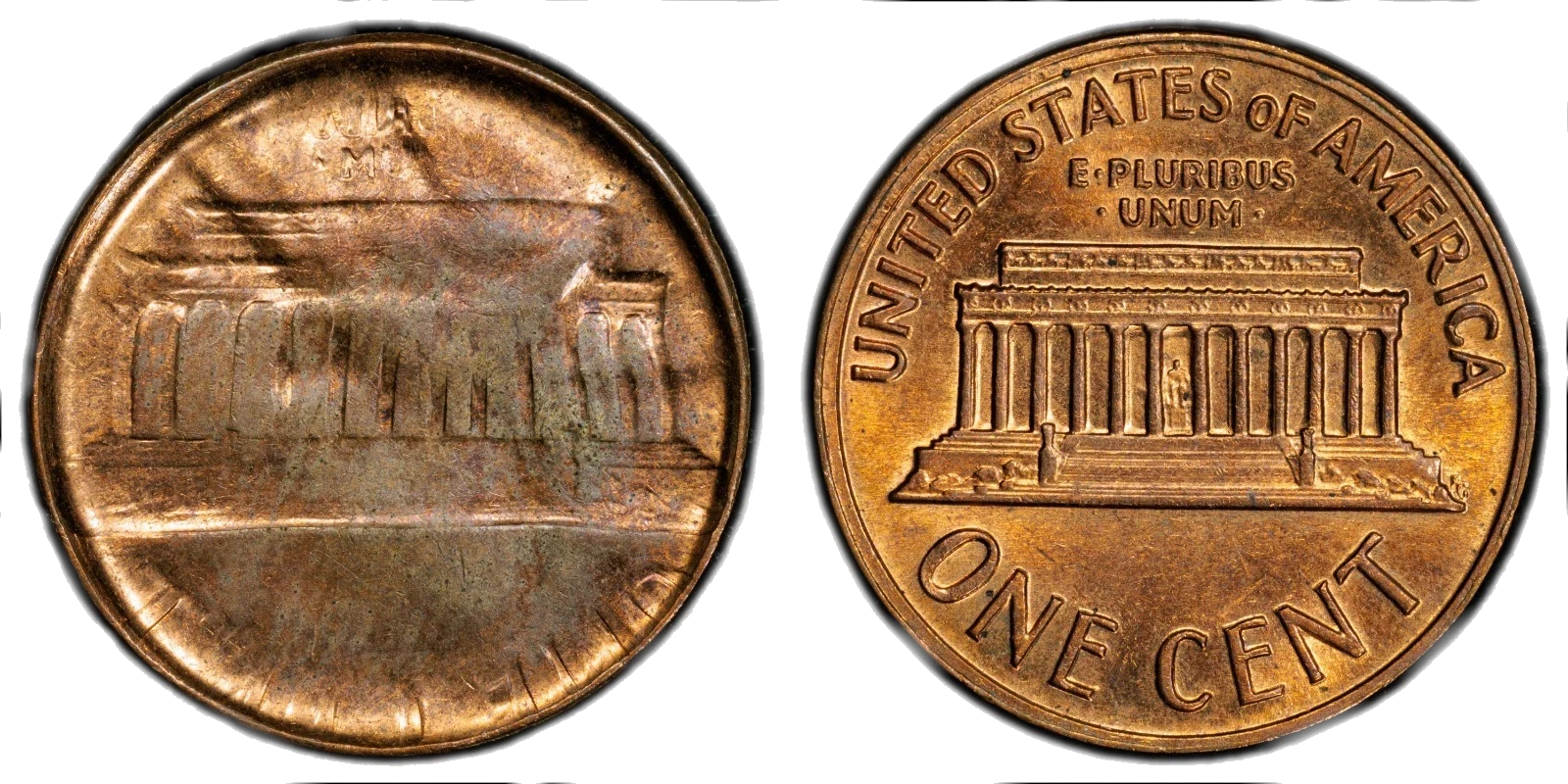
Early-stage brockage on a Lincoln Memorial Cent. The obverse (left) shows an incuse, mirror-image impression of the Lincoln Memorial — sunken rather than raised, and reversed left-to-right. This happened because a previously struck coin was sitting on top of this blank when the dies closed: the stuck coin’s reverse pressed into this coin’s obverse. The reverse (right) is a normal strike from the die. Unlike a capped die error where the stuck coin adheres to the upper die and deepens over multiple strikes, a brockage is typically a one-time event where a loose coin interferes with a single strike.
A brockage is closely related to a capped die error, but the mechanism is slightly different:
- Capped die: A coin sticks to the upper (hammer) die and stays there through multiple strikes. The cap deepens over time. Each subsequent coin struck against it shows the incuse impression on the same side (the side that faced the capped die).
- Brockage: A previously struck coin doesn’t fully eject and sits on top of the lower (anvil) die — or on top of the next blank. When the dies close, the stuck coin’s design is pressed into the new blank, creating an incuse mirror-image on that side. Brockages are typically single-event errors — the interfering coin gets pushed out after one or two strikes, rather than staying adhered through dozens.
The visual result is similar (one normal side, one incuse side), but brockages tend to show a sharper, more complete incuse impression because the interfering coin hasn’t been deformed by repeated strikes. On a capped die error, especially mid-to-late stage, the incuse design is softer and more distorted because the cap itself has been progressively flattened and spread by each successive strike.
How to Identify a Capped Die Error
Key diagnostic features that separate capped die errors from other mint errors and from post-mint damage:
- One normal side, one incuse side. The anvil die (usually the obverse on modern coins) produces a normal strike. The capped die side shows an incuse, mirror-image design — or, on late-stage caps, a smooth bowl.
- Raised rim / bottle-cap edge. The edge of the coin typically has a raised lip or wall where the cap’s rim pressed into the blank. This is especially pronounced on early-to-mid stage strikes.
- Oversized diameter. Like broadstrikes, capped die strikes are often wider than normal because the cap prevented proper collar engagement.
- Design is incuse and reversed. The incuse impression is a mirror image of the original design. Text reads backward. The portrait faces the opposite direction. This reversal is proof that the design was transferred from a coin (which is already a mirror of the die) rather than struck directly by a die.
- Weight is approximately normal. The coin was struck on a standard planchet. The weight should be close to the correct specification for the denomination.
What Is NOT a Capped Die Error
- Struck-through grease. When grease or debris fills part of a die, the affected area of the struck coin appears flat or mushy. But a grease-filled die doesn’t produce an incuse mirror-image — it produces an area with weak or missing design. No reversed details, no bottle-cap rim.
- Worn dies. Heavily worn dies produce coins with soft, shallow design elements. But the design is still raised (not incuse) and not reversed. Worn dies produce weak coins, not capped coins.
- Post-mint damage. Coins that have been squeezed, bent, or hammered after leaving the Mint can have distorted surfaces. But post-mint damage doesn’t produce a clean incuse mirror-image on one side while leaving the other side perfectly normal. The combination of one pristine side and one incuse side is the diagnostic hallmark of a genuine capped die error.
- Machine doubling. A shelf-like doubling of design elements caused by die chatter or bounce. Machine doubling is flat and shelf-like, not incuse. It doesn’t produce a mirror-image of the opposite side’s design.
Value and Collectibility
Capped die errors are among the most valuable and sought-after mint errors. Several factors influence value:
- Stage of cap: Both early-stage caps (with clear incuse design) and late-stage deep caps (dramatic bowl shape) command strong premiums. Mid-stage caps with partially legible design are less dramatic but still valuable.
- Denomination: Capped die errors on larger denominations (quarters, halves, dollars) are scarcer and more valuable than on cents. The larger dies and higher striking pressures make cap formation less likely.
- Date visibility: If the date is legible on the normal side, the coin can be attributed to a specific year, which adds to its value and historical interest.
- The cap itself: The actual cap — the coin that stayed on the die — is rarer than the coins struck against it. A deep cap with clear provenance showing how the cap formed is among the most prized error coins in numismatics.
- Era: Pre-1965 capped die errors on silver coins are genuinely rare. Modern clad examples are more available but still command strong premiums due to the dramatic visual impact.
The 1862 Indian Head Cent deep cap shown above is a Civil War–era coin that spent an extended period adhered to a die in the Philadelphia Mint. During this period, the Mint was under enormous production pressure — the war effort required vast quantities of coinage — and quality control was stretched thin. Errors that might have been caught and removed during peacetime production had a better chance of surviving the manufacturing process.
From Broadstrike to Cap to Bowl
Capped die errors demonstrate a fundamental truth about coin production: the press doesn’t care what’s between the dies. It will strike whatever is there. When a collar fails, you get a broadstrike. When a coin sticks, you get a cap. When the cap stays, you get a bowl. The press keeps running, and the errors compound.
That mechanical indifference is what makes capped die errors so fascinating. They’re not subtle die varieties or minor planchet flaws. They’re the visible evidence of a press that kept striking, coin after coin, with a piece of metal stuck to the die — producing increasingly bizarre results until someone finally noticed and stopped the machine.
Browse capped die listings in the NumisDex catalog.
0 Replies
Related Threads
- Broadstrike Errors: When the Collar Fails0 replies · 1mo ago
- Strike Through Errors: When the Mint’s Factory Floor Leaves Its Mark0 replies · 1mo ago
- Off-Center Strikes — When Coins Miss Their Mark0 replies · 2mo ago
- Broadstrike vs. Off-Center Strike: What Is the Difference?0 replies · 3mo ago
- Broadstrikes: Full Design, No Collar0 replies · 4mo ago