
Broadstrike Errors: When the Collar Fails
BRDThe Third Die You Never Think About
Every coin struck at the U.S. Mint is formed by three components, not two. The obverse die presses the front. The reverse die presses the back. And the collar — a metal ring surrounding the planchet — constrains the edge, shapes the rim, and holds the coin at its correct diameter.
The collar is sometimes called the “third die” because it’s just as essential to a properly struck coin as the other two. On reeded-edge coins (dimes, quarters, halves, dollars), the collar is what creates the vertical grooves along the edge. On plain-edge coins (cents, nickels), the collar still constrains the planchet and forms the raised rim.
A broadstrike error occurs when the collar fails to engage during striking. The planchet sits outside the collar — either on top of it or displaced to the side — and the dies close with full striking force on an unconstrained planchet. Without the collar to contain the metal, the planchet spreads freely outward under pressure. The result is an oversized coin with a distorted or missing rim, but with the full design present.
How Broadstrikes Happen
The collar is a precision-machined ring that rises into position for each strike and retracts to allow the finished coin to be ejected. In a press cycling hundreds of times per minute, the collar must move in perfect synchronization with the dies. When that synchronization breaks down, broadstrikes occur.
Common causes:
- Collar fails to rise: The collar mechanism doesn’t engage, leaving the planchet sitting on the lower die with no lateral containment. The dies still close and strike the coin, but the metal flows outward unchecked.
- Planchet sits on top of the collar: The planchet lands on the collar ring rather than inside it. When the dies close, the planchet is struck above the collar — still centered between the dies but completely unconstrained at the edges.
- Collar retraction timing error: The collar retracts too early — before the dies have fully separated — allowing the coin to spread slightly during the final moments of striking. This typically produces a less dramatic broadstrike.
In all cases, the key characteristic is the same: the design is fully struck and generally centered, but the coin’s diameter is larger than normal and the rim is weak, uneven, or absent.
Full Broadstrike vs. Partial Broadstrike
Not all broadstrikes are equal. The degree of collar failure determines the severity:
Full Broadstrike
The collar completely fails to engage. The planchet spreads freely in all directions, producing a coin that’s noticeably larger than normal with no defined rim anywhere around the circumference. The design is complete but the entire edge profile is distorted. These are the most dramatic and collectible broadstrikes.
Partial Broadstrike
The collar partially engages — it constrains one side of the planchet but not the other. The coin has a normal rim and diameter on one side, but the opposite side spreads outward past the normal edge. The result is an asymmetric coin: half normal, half broadstruck. Partial broadstrikes clearly demonstrate what the collar does, because you can see the difference between the constrained and unconstrained sides on the same coin.
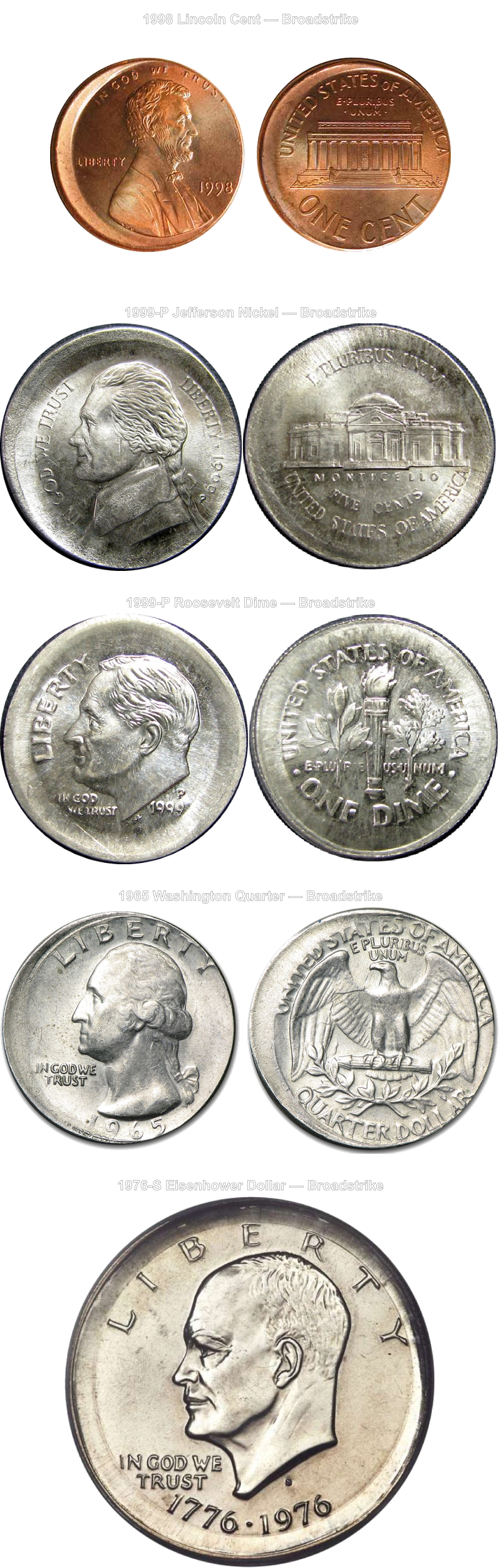
Broadstrike examples across five denominations. Notice how each coin’s design is fully struck but the metal has spread beyond its normal diameter. The 1998 Lincoln cent (top) shows a classic partial broadstrike — the metal protrudes to the left while the right rim remains partially intact. The 1976-S Eisenhower dollar (bottom) shows the spreading on a much larger coin.
How to Identify a Broadstrike
Broadstrikes have several distinctive characteristics that separate them from other errors and from post-mint damage:
- Diameter is larger than normal: This is the most immediate indicator. A broadstruck coin is wider than a normal coin of the same denomination. You can verify this with calipers or by placing the coin next to a normal example — the size difference is usually visible to the naked eye.
- Full design is present: Unlike an off-center strike (where part of the design is missing because the planchet was misaligned), a broadstrike shows the complete design. The coin was centered between the dies — it just wasn’t constrained at the edges.
- Rim is weak, uneven, or absent: The collar creates the rim. Without the collar, there’s no rim — or only a partial, irregular one. On a normal coin, the rim is uniform and raised around the entire circumference. On a broadstrike, the edge may be flat, wavy, or completely undefined.
- The coin feels different: A broadstruck coin is wider and slightly thinner than normal. The metal that would normally be pushed upward to form the rim has instead spread outward. You can often feel the difference by touch alone.
- Edge is smooth or irregular: On coins that should have a reeded edge (dimes, quarters, halves, dollars), a broadstrike will have a smooth or rough edge instead. The collar creates the reeding, and the collar wasn’t there.
- Weight is normal: Unlike wrong planchet errors, broadstrikes are struck on the correct planchet. The weight should match the standard for the denomination. This is a useful diagnostic — if the coin is the wrong weight, it’s not a simple broadstrike.
What Is NOT a Broadstrike
Several types of damage and wear can produce coins that superficially resemble broadstrikes. Here’s what to watch for:
- “Dryer coins”: Coins tumbled in a clothes dryer become thinner and wider as they’re repeatedly struck against the dryer drum. They can look like broadstrikes, but the surfaces show extensive post-mint damage — scratches, loss of luster, and uniform distortion that doesn’t match the characteristics of a single-strike collar failure. Dryer coins are damaged, not error coins.
- Railroad coins / vise jobs: Coins placed on railroad tracks or compressed in a vise become wider and thinner. But the design distortion is extreme and irregular — the metal flows unpredictably rather than expanding uniformly from a centered strike.
- Worn coins with weak rims: Heavy circulation wear can reduce a coin’s rim to near nothing. But the diameter doesn’t change — the coin is still the same size. A worn coin with no rim is just a worn coin, not a broadstrike.
- Environmental damage: Corrosion and chemical damage can erode rims and alter a coin’s surface character. But again, the diameter doesn’t change, and the damage patterns are visually distinct from the clean spreading of a broadstrike.
The single most reliable diagnostic: measure the diameter. A genuine broadstrike is measurably larger than a normal coin. Post-mint damage that merely weakens the rim doesn’t increase the coin’s diameter (or increases it in an irregular, non-uniform way that doesn’t match a broadstrike).
Broadstrike vs. Off-Center Strike
These two errors are often confused because both involve striking problems, but they’re fundamentally different:
- Broadstrike: The coin is centered between the dies but unconstrained by the collar. Full design, wrong diameter.
- Off-center strike: The coin is misaligned relative to the dies. Part of the design is missing because part of the planchet extended beyond the die face. The collar may or may not have been engaged.
The key distinction: on a broadstrike, you can see the entire design. On an off-center strike, part of the design is missing. If you can see all of the lettering, the date, the portrait, and the reverse design, it’s a broadstrike, not an off-center.
Value Factors
What makes one broadstrike more valuable than another?
- Degree of spread: The more dramatically the coin exceeds its normal diameter, the more visually impressive and valuable the broadstrike. A coin that’s barely larger than normal generates less collector interest than one that’s obviously oversized.
- Denomination: Broadstrikes on larger denominations (half dollars, dollars) are scarcer than on cents. The larger dies and higher striking pressures make collar failures less common on large coins. Broadstruck dollars are genuinely rare.
- Full broadstrike vs. partial: Full broadstrikes (complete collar failure, uniform spreading all around) are generally worth more than partial broadstrikes, because the visual impact is greater and they’re less common.
- Date and series: Broadstrikes on classic series (Morgan dollars, Walking Liberty halves) command strong premiums because collectors of those series actively seek error examples. Modern clad broadstrikes are more common and affordable.
- Grade: Uncirculated broadstrikes are worth significantly more than circulated examples. The original luster and sharp design details make the error characteristics more visible and the coin more visually appealing.
- Missing reeding: On denominations that normally have reeded edges (dimes, quarters, halves, dollars), the absence of reeding on a broadstrike provides an additional visual indicator of the error — and an additional authentication point.
Broadstrike cents in circulated condition are among the most affordable major mint errors — making them an excellent entry point for error collectors. Broadstruck silver coins and dollars are at the other end of the spectrum, commanding strong premiums due to their rarity.
The Collar’s Role in Coin Production
Understanding broadstrikes helps you appreciate how much work the collar does on every normal coin. The next time you look at a coin’s rim — that perfectly uniform raised border — remember that it was formed by a precision-machined ring operating in synchronization with two dies at hundreds of strikes per minute. When everything works, you get a perfectly round coin with a sharp rim. When the collar fails, you get a broadstrike: a coin that shows you exactly what happens when that third die isn’t there.
Browse broadstrike listings in the NumisDex catalog.
0 Replies
Related Threads
- Broadstrike vs. Off-Center Strike: What Is the Difference?0 replies · 3mo ago
- Capped Die Errors: When a Coin Refuses to Leave the Press0 replies · 1mo ago
- Strike Through Errors: When the Mint’s Factory Floor Leaves Its Mark0 replies · 1mo ago
- Off-Center Strikes — When Coins Miss Their Mark0 replies · 2mo ago
- Broadstrikes: Full Design, No Collar0 replies · 4mo ago