
Split Planchets: When a Coin Breaks in Half (And Why the Other Half Might Be Out There)
Split PlanchetEvery coin is a sandwich. Metal layers bonded together, rolled thin, punched into blanks, and struck under enormous pressure. Most of the time, the metal holds. But sometimes there's a flaw hiding inside -- a gas bubble from the casting process, a slag inclusion, contamination from the rolling mill -- and the planchet splits in two.
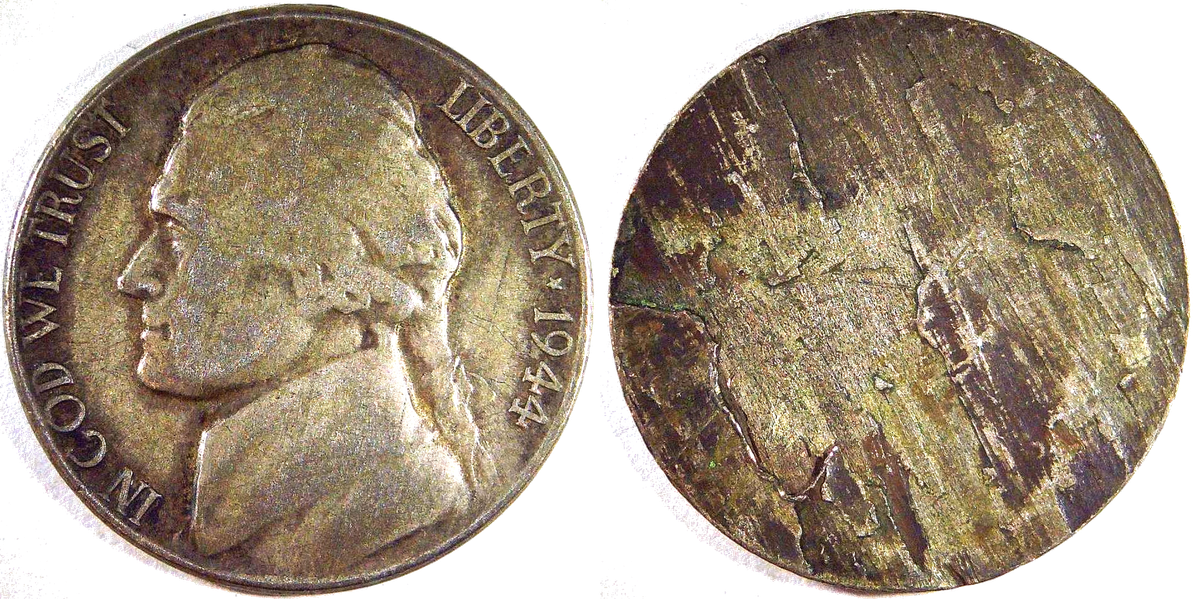
A split planchet — the coin delaminated along its internal structure, producing this remarkably thin half with exposed interior metal
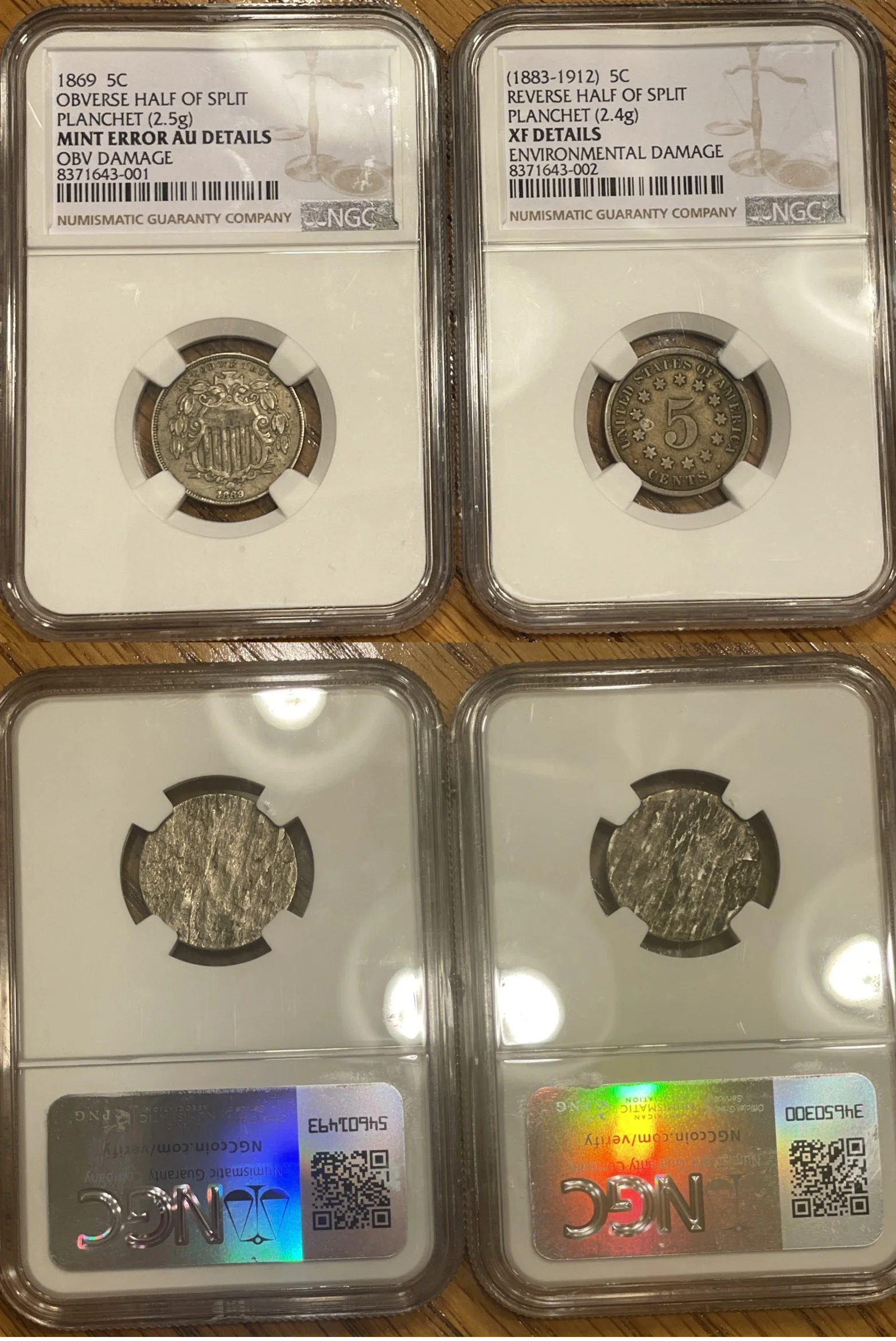
Both halves of a split planchet reunited — finding both halves from the same coin is exceptionally rare
A split planchet is exactly what it sounds like: a coin's metal blank cleaves into two separate halves. One half carries the obverse design, the other carries the reverse. It's the most dramatic form of internal metal failure in numismatics, and it produces some of the most visually striking error coins you'll find.
Before Strike vs. After Strike
Split planchets are classified by when the separation happens, and the distinction changes everything about what the coin looks like.
Before-strike splits: The planchet has already separated before entering the press. The die strikes only one thin half. The result is a coin with a weak or incomplete design on the struck face and raw striated metal on the split face. Weight is well below normal.
After-strike splits: The planchet was intact when struck -- both sides received a full-depth design impression. Then the planchet split along the internal flaw, producing two halves that each show their respective side's design at full strength. The split face on each half shows rough, striated internal metal with no design detail.
Feature | Before Strike | After Strike |
|---|---|---|
Design on struck face | Often weak or incomplete | Full strength |
Both halves show design? | No -- only the struck side | Yes -- obverse on one, reverse on the other |
Weight | Well below half of normal | Each half approximately half of normal |
After-strike splits are more collectible because they show a fully struck coin that failed after the fact. You can see that this was a real, functional coin before it broke.
Matched pairs: The Holy Grail
When a coin splits after striking, both halves exist somewhere. One has the obverse, the other has the reverse. If both halves are found and matched -- by weight, die characteristics, and the topography of the split faces -- that's a matched pair. It's one of the rarest and most satisfying finds in error collecting.
Notable matched pairs have sold at auction for significant premiums, including a Greece 1966 5 Drachmas pair and a 1917 Buffalo Nickel pair.
What Causes Splits?
The root causes are the same metallurgical flaws that produce laminations, but more severe:
- Trapped gas from the casting process creates voids that become fault lines when the ingot is rolled into strip
- Slag inclusions (non-metallic impurities) create unbonded planes where the metal above and below the inclusion isn't connected
- Rolling mill contamination introduces foreign material between metal layers
- Non-standard alloy compositions -- wartime coins (1942-1945 silver war nickels, 1943 steel cents) show higher rates of splits due to unfamiliar alloys processed under production pressure
How to Identify a Split Planchet
- Weight: Always below normal. This is the most reliable first check. A split half weighs roughly half of the denomination's standard.
- Striations: The split face shows a characteristic pattern of fine to coarse striations -- the exposed crystalline structure of the metal's interior. This texture is nothing like the smooth struck surface.
- One normal face, one raw face: Normal struck design on one side, raw internal metal on the other. This contrast is the visual hallmark.
- Thinner than normal: Noticeably thinner than a regular coin.
Split Planchet vs. Lamination
Both errors come from internal metal flaws, but the scale is different:
- Lamination: A surface layer peels or flakes away. The coin remains mostly intact.
- Split planchet: The coin cleaves completely into two separate pieces.
Think of lamination as a skin peeling off, and a split planchet as a log splitting in half.
Learn more about split planchets: /learn/planchet-errors/split-planchet
---
Explore in the NumisDex Catalog
Related varieties and errors from the NumisDex database:
0 Replies
Related Threads
- Lamination Error vs. Environmental Damage: How to Tell3 replies · 3w ago
- Wrong Planchet Errors: When a Coin Gets Struck on the Wrong Metal0 replies · 1mo ago
- Wrong Planchet Errors: How to Tell If Your Coin Is Struck on the Wrong Blank0 replies · 3mo ago
- Wrong Planchet Errors: When a Coin Gets the Wrong Body0 replies · 4mo ago