
RCD-10c-1903O-01R Retained Cud
Error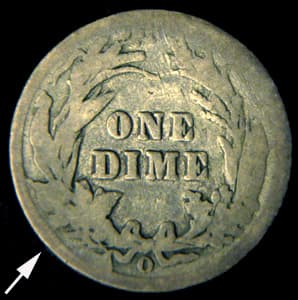
Description
First retained cud variety documented for the 1903 New Orleans Barber dime by Cuds on Coins, RCD-10c-1903O-01R captures a die rim failure on Charles Barber's Liberty Head design that served the dime denomination from 1892 through 1916. The "R" suffix in the catalog number indicates this is a reverse retained cud, meaning the die fracture occurred on the reverse die rather than the obverse. New Orleans struck approximately 8.18 million Barber dimes in 1903, a respectable mintage that ensured significant die usage across the production run. Retained cuds on Barber dimes carry particular interest because Barber's designs — featuring Liberty wearing a Phrygian cap with laurel wreath on the obverse and a heraldic wreath surrounding the denomination on the reverse — present clean rim areas where die fractures are visually prominent against the relatively simple peripheral design elements. The retained cud condition means the fractured die segment cracked but remained partially attached to the die body, producing a raised area on struck coins that shows both the displacement of the die break and residual traces of the original design detail — a transitional state between a die crack and a full cud where the broken piece has completely separated. No cross-references from other attribution services have been documented for this variety. The New Orleans Mint, which operated intermittently from 1838 until its final closure in 1909, produced Barber dimes with the distinctive O mintmark on the reverse within the wreath. Collectors examining 1903-O Barber dimes should inspect the reverse rim under 5-10x magnification for the characteristic retained cud signature: a raised area that appears elevated relative to the normal rim but retains partial design impression rather than presenting the completely blank plateau of a full cud.
Attribution History
- Discovered by Fred Weinberg
- Expert attribution by Cuds on Coins
External References
Community & Reference
More Retained Cud Errors
Collector Essentials
Tools for examining and preserving error coins and die varieties.
10x-20x Jeweler's Loupe
Essential for examining die varieties, doubled dies, and RPMs
Cherry Picker's Guide
The definitive reference for U.S. error coins and die varieties
2x2 Coin Flips & Holders
Protect and organize your finds with archival-quality holders
USB Digital Microscope
Capture detailed images for documentation and community submissions
As an Amazon Associate, NumisDex earns from qualifying purchases.