
RCD-10c-1891-03R Retained Cud
Error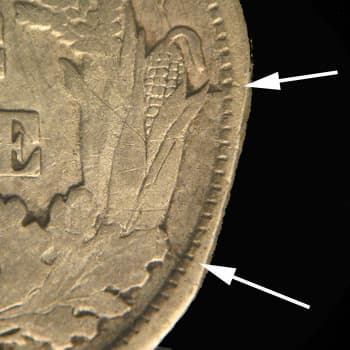
Description
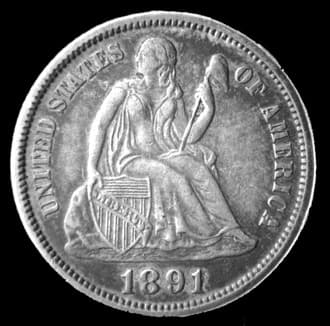
Appearing on the final year of the Seated Liberty Dime series, RCD-10c-1891-03R documents the third reverse retained cud for the 1891 issue. The Seated Liberty design served on dimes from 1837 through 1891 — a remarkable 54-year span that makes it the longest-running dime design in American coinage history. A retained cud forms when a die crack extends to the rim and a wedge-shaped fragment fractures partially free but remains mechanically captured, continuing to stamp a raised irregular mass onto each subsequent planchet. The result is a coin bearing a blob-like protrusion at the rim, partially obscuring the underlying design where the trapped fragment sits. Cataloged by Cuds on Coins, this business strike was produced at Philadelphia in 90% silver, the standard composition for dimes throughout the 19th century. Three reverse retained cuds for 1891 reflects the accumulated die stress of high-volume production during the series' terminal year. For collectors of Seated Liberty Dimes, die failure varieties from the last date carry a natural appeal, as they represent the final documented instances of die attrition before Charles Barber's new design replaced the seated figure in 1892.
External References
Community & Reference
Related Errors
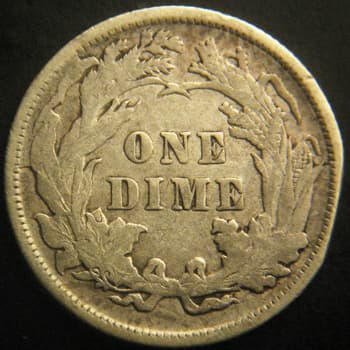
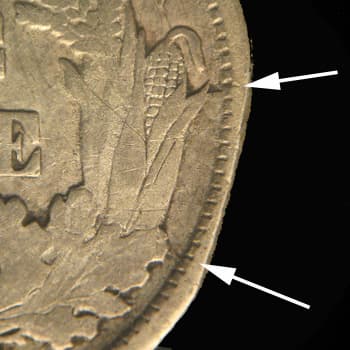
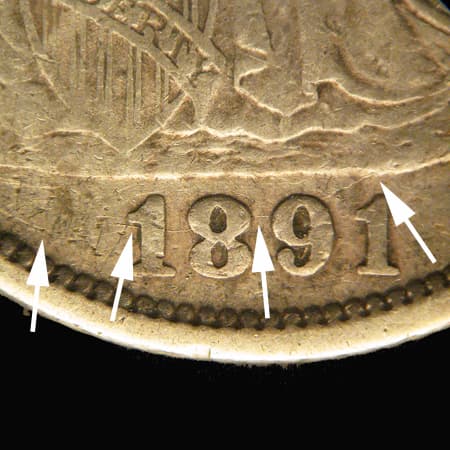
More Retained Cud Errors

Collector Essentials
Tools for examining and preserving error coins and die varieties.
10x-20x Jeweler's Loupe
Essential for examining die varieties, doubled dies, and RPMs
Cherry Picker's Guide
The definitive reference for U.S. error coins and die varieties
2x2 Coin Flips & Holders
Protect and organize your finds with archival-quality holders
USB Digital Microscope
Capture detailed images for documentation and community submissions
As an Amazon Associate, NumisDex earns from qualifying purchases.