
1845 Braided Hair Large Cent Newcomb-9 Reverse Rim Cud
Error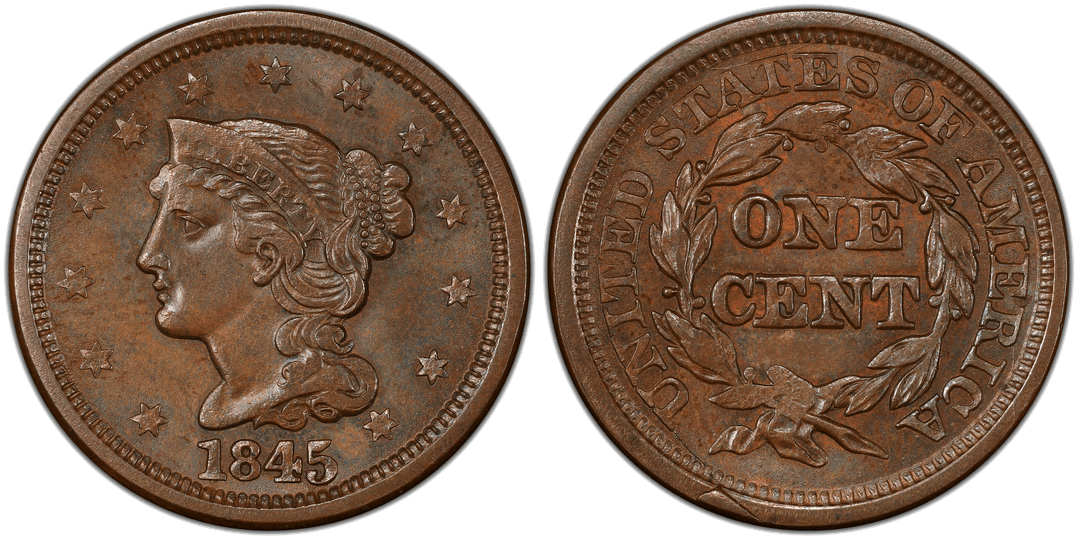
Community Voting
This listing needs 10.0 weighted votes to advance to community review.
Description
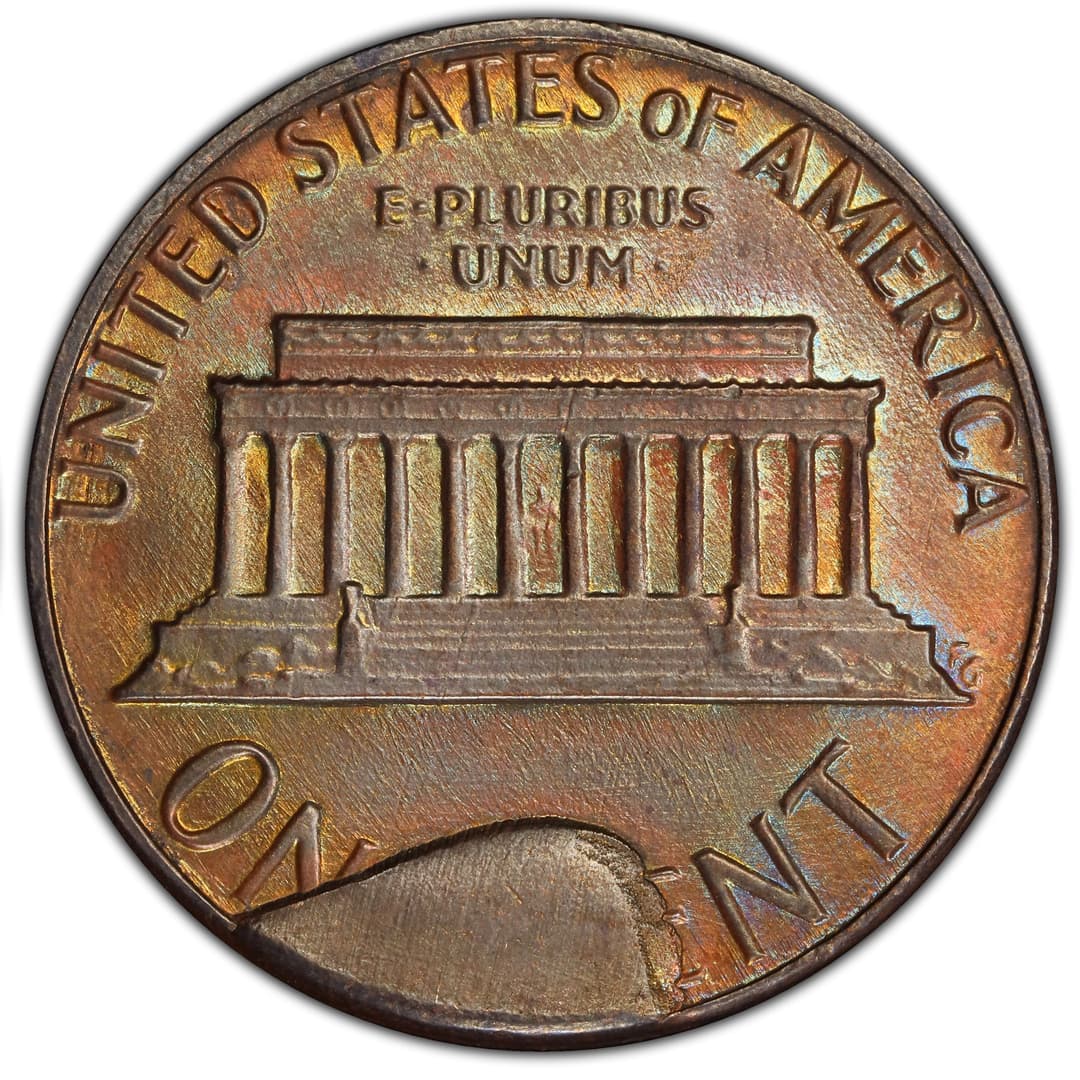
This 1845 Braided Hair large cent, attributed as Newcomb-9 (N-9) in the Newcomb die variety reference, displays a reverse rim cud between the 6 o'clock and 7 o'clock positions where a section of the reverse die broke away along the rim, leaving a raised featureless area on the struck coin. Christian Gobrecht designed the Braided Hair large cent type, produced from 1839 through 1857, featuring Liberty with her hair in an elaborate braid and bound by a headband inscribed LIBERTY on the obverse, with a wreath encircling ONE CENT on the reverse. Philadelphia struck approximately 3.89 million large cents in 1845, a moderate mintage during the period when the large cent was steadily losing public favor due to its cumbersome size — nearly the diameter of a modern quarter but substantially thicker and heavier. Rim cuds form when a section of the die along its perimeter fractures and separates, leaving a void in the die that produces a raised, unstruck blob on every subsequent coin — the metal that would normally be shaped by the die's design instead flows into the void, creating the characteristic featureless raised mass. The 6 to 7 o'clock location on the reverse places this cud in the lower-left area when viewing the coin in standard orientation, potentially affecting portions of the wreath or the lower inscription. The Newcomb reference system, developed by Howard R. Newcomb in the early 20th century, provides die-pair identification numbers for large cents that remain the standard attribution framework. Collectors examining 1845 large cents should look for the raised featureless area on the reverse rim in the lower-left quadrant — the cud's clean boundary against the normally struck surrounding design confirms it as a die break rather than post-strike damage or planchet irregularity.
Attribution History
- Discovered by NumisDexDealer
- Newcomb N-9
Community & Reference
Learn About Cud
How this error occurs, identification tips, and collecting guide
Discuss in Forum
Join the community conversation about Cent
Catalog Status
More Cud Errors
Collector Essentials
Tools for examining and preserving error coins and die varieties.
10x-20x Jeweler's Loupe
Essential for examining die varieties, doubled dies, and RPMs
Cherry Picker's Guide
The definitive reference for U.S. error coins and die varieties
2x2 Coin Flips & Holders
Protect and organize your finds with archival-quality holders
USB Digital Microscope
Capture detailed images for documentation and community submissions
As an Amazon Associate, NumisDex earns from qualifying purchases.