
1837 Token WB-102, Feuchtwanger Eagle
Strike Type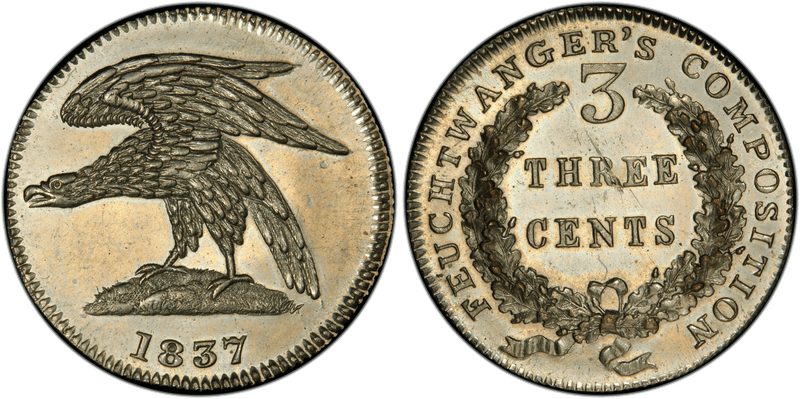
Coin Details
Description
The 1837 Feuchtwanger Eagle WB-102 is the rarest of the Feuchtwanger three-cent varieties, a special strike or presentation piece that was never intended for circulation. Cataloged as Low-119 and cross-listed as HT-265A, this variety is immediately distinguishable from the standard eagle three-cent (HT-263/Low-118) by its dramatically different obverse die featuring a larger, more imposing eagle. Numismatists describe this as the "defiant eagle" — a hulking bird with spread wings and an almost comical expression, standing on a flat-based rock rather than the rounded rock of HT-263. The date numerals are also noticeably larger than on the standard eagle type. The reverse is equally distinctive, using an oak wreath rather than a laurel wreath and expressing the denomination THREE CENTS twice within the design — a feature unique among Feuchtwanger reverses. All known examples display prooflike or specimen surfaces, confirming they were carefully struck as presentation pieces intended for members of Congress, influential figures, or Feuchtwanger's personal associates. The WB (Witham-Bowers) catalog designation specifically identifies this within the specialized Hard Times token die study framework. PCGS grades these under the Specimen (SP) designation rather than the standard Mint State scale. This reverse die has special historical significance: it was later reused to strike the 1864 Feuchtwanger Three Cent (HT-267), creating a direct die linkage between the Hard Times era and the Civil War token era. The existence of a reverse die surviving and being pressed into service twenty-seven years after its original use demonstrates that Feuchtwanger carefully preserved his dies and viewed the Civil War coinage shortage as an opportunity to renew his proposal. Only six specimens of the 1837 Low-119 have been traced, including the Ford:215, Ford:216, Oechsner:540, Litman:86, and Steinberg pedigrees, making this the most elusive piece in the five-coin Feuchtwanger set.
Rarity Notes
Rarity High R-7 (extremely rare). Six specimens traced across all grades, all displaying prooflike or specimen surfaces. Documented pedigrees include Ford:215, Ford:216, Oechsner:540, Litman:86, and Steinberg. An SP-65 PCGS CAC example sold at Heritage Auctions in January 2012 (Lot 4630) — one of the finest known. An SP-50 PCGS example sold at Stack's Bowers. Any example in any grade is a significant numismatic rarity.
Cross References
Low-119; HT-265A (specimen strikes) / HT-265 (if commercial surfaces exist); Rulau W-NY-480; Witham-Bowers WB-102. Reverse die linked to HT-267 (1864 reissue). Part of the PCGS Feuchtwanger Tokens (1837-1864) five-piece registry set. Distinguished from HT-263 (Low-118) by larger date, defiant eagle, flat rock base, oak wreath, and denomination expressed twice.
External References
Error Varieties
No listings found
This category doesn't have any child listings yet.
Other Strike Types in This Series
Collector Essentials
Tools and references for building and protecting your coin collection.
10x-20x Jeweler's Loupe
A must-have for examining coin details, mint marks, and surface quality
Red Book — Guide to U.S. Coins
The essential annual reference for U.S. coin values, history, and mintages
Coin Albums & Storage
Archival-quality albums and holders to protect and display your collection
USB Digital Microscope
Capture detailed images for documentation and community submissions
As an Amazon Associate, NumisDex earns from qualifying purchases.