
1837 HT-268, Feuchtwanger's Cent
Strike Type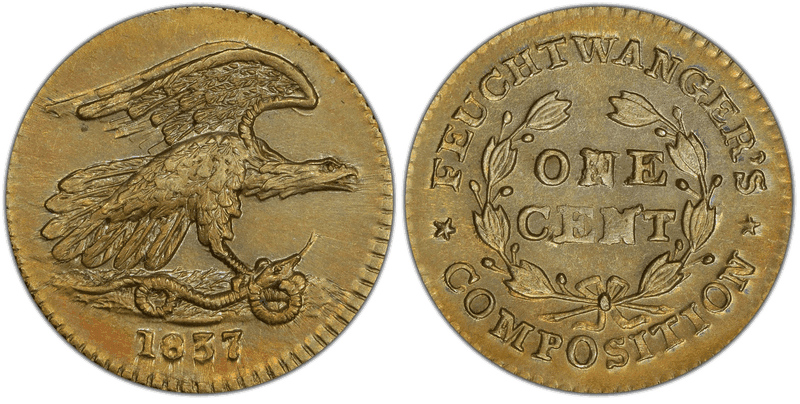
Coin Details
Auction Record
$14,400 MS61 08-20-2019 Stack's Bowers
Description
The 1837 Feuchtwanger Cent is the most widely collected token produced by Dr. Lewis Feuchtwanger, a German-born chemist and metallurgist who operated a pharmacy in New York City. Feuchtwanger petitioned Congress in 1837 to adopt his proprietary alloy — approximately 53% copper, 29% zinc, and 18% nickel with trace tin and antimony — as the official metal for United States small-denomination coinage. He struck and distributed over one million of these one-cent tokens from his pharmacy as physical demonstrations of the alloy's suitability, arguing it was cheaper, more durable, and more resistant to corrosion than the large copper cents then in circulation. The obverse depicts an eagle in flight grappling a serpent in its talons, with the date 1837 below. The reverse features a berried laurel wreath surrounding the denomination ONE CENT, with the legend FEUCHTWANGER'S COMPOSITION around the periphery. Six obverse dies and nine reverse dies are known, producing fourteen die marriages that range from R-1 (very common) to R-8 (unique or nearly so, for dies 3-C, with three examples traced). The tokens were manufactured by Scovill Manufacturing Company of Waterbury, Connecticut, one of the era's most prolific token producers. At 18.5mm, the Feuchtwanger Cent is significantly smaller than the contemporary large copper cent (27.5mm), presaging the small-cent format that the U.S. Mint would adopt two decades later with the 1857 Flying Eagle Cent. Although Congress rejected Feuchtwanger's petition, his concept proved prescient. The Flying Eagle cent of 1856-1858 used an 88% copper / 12% nickel alloy, and copper-nickel compositions have remained standard for U.S. base-metal coinage ever since. The Feuchtwanger Cent is ranked number four in Bowers and Jaeger's "100 Greatest American Medals and Tokens" and forms part of the five-piece PCGS Feuchtwanger Registry Set. These tokens circulated freely during the Hard Times era (1832-1844), a period of severe small-change shortage triggered by President Jackson's destruction of the Second Bank of the United States and the Specie Circular of 1836.
Rarity Notes
Overall type is common as HT-268. Die combination 6-G and 5-H are R-1 (very common); combination 3-B is R-5 (scarce); 3-D is R-7 (very rare); 3-C is R-8 (unique or nearly so, with three examples traced including the Bowers plate coin). Over one million pieces estimated struck between 1837 and approximately 1844. Circulated examples widely available; Mint State pieces above MS-63 become scarce, with MS-65 and MS-66 examples genuinely rare. A 6-G MS-66 PCGS CAC realized $5,040 at Stack's Bowers August 2018 ANA auction.
Cross References
Low-120; Rulau W-NY-480; PCGS #20001; Bowers-Jaeger "100 Greatest" #4. Manufactured by Scovill Manufacturing Company, Waterbury, CT. Part of the PCGS Feuchtwanger Tokens (1837-1864) five-piece registry set.
External References
Error Varieties
No listings found
This category doesn't have any child listings yet.
Other Strike Types in This Series
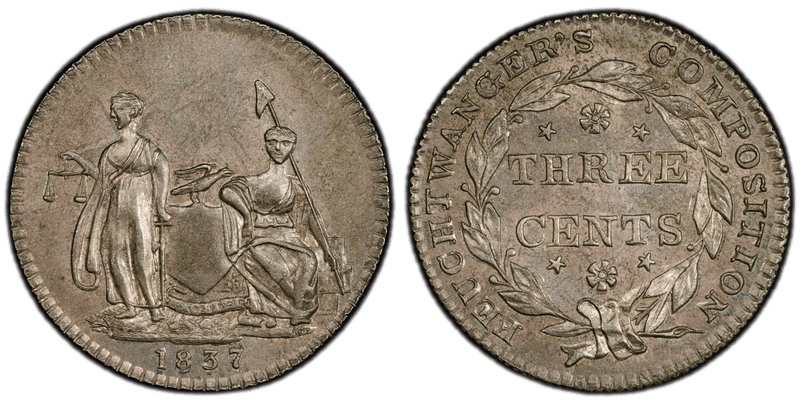
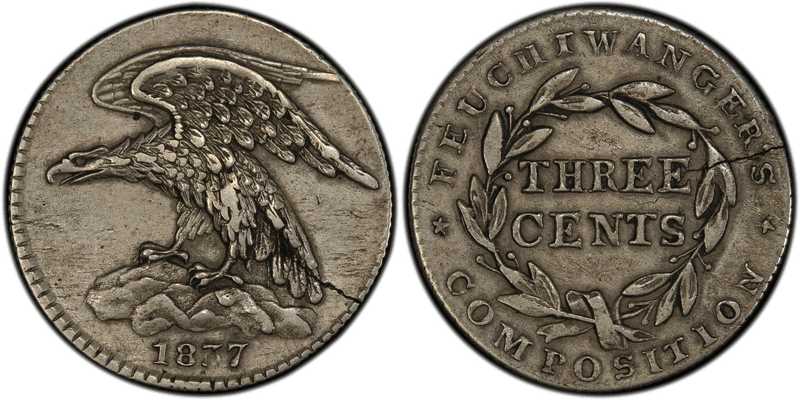
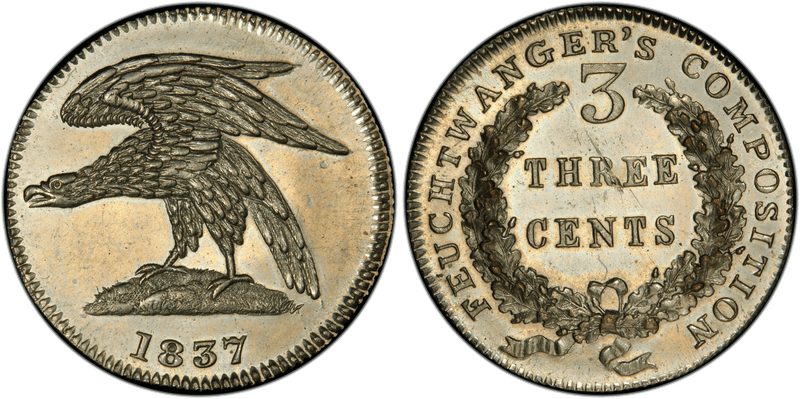
Collector Essentials
Tools and references for building and protecting your coin collection.
10x-20x Jeweler's Loupe
A must-have for examining coin details, mint marks, and surface quality
Red Book — Guide to U.S. Coins
The essential annual reference for U.S. coin values, history, and mintages
Coin Albums & Storage
Archival-quality albums and holders to protect and display your collection
USB Digital Microscope
Capture detailed images for documentation and community submissions
As an Amazon Associate, NumisDex earns from qualifying purchases.