
By Brandon Norris
Reference: Partial Collar (PAC) in Learn
Collar Errors: The Overlooked Third Die
Partial CollarEveryone Forgets About the Collar
Most collectors think of coin production as two dies — obverse and reverse. But there's a third die that's just as important: the collar. This steel ring surrounds the planchet during striking, constrains the expanding metal, forms the coin's precise diameter, and impresses the reeding on reeded-edge coins.
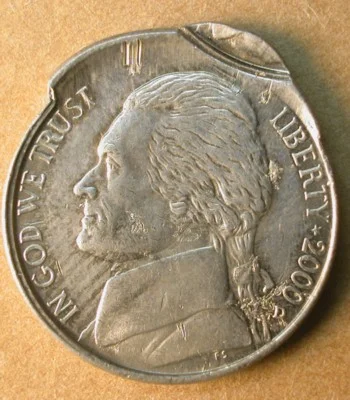
A 2000 Jefferson nickel with a complete collar break — across the arc at the top the edge had no collar to contain it, so the metal spread outward. Note where the break starts and stops: abruptly, at a step.
The collar can fail in three different ways, and they are not equally common. It can fail to rise, it can break, or it can be absent altogether. Knowing which one you are holding is most of the attribution.
Partial Collar — the One You Will Actually Find
The collar is supposed to rise and surround the planchet before the hammer die comes down. When it only gets part of the way up, the planchet is struck with part of its edge inside the collar and part above it. The confined part gets a normal edge with normal reeding; the free part spreads outward and stays smooth. The result is two different edges stacked one above the other with a visible step between them — the error collectors have called a railroad rim for generations.
It happens when a tight or off-centre planchet pushes the collar back down, when a badly centred coin blocks its rise, or when debris jams it. Everything else about the strike is normal: both faces are fully struck and the weight is correct. Only the edge records it, which is why it is missed by anyone who looks only at the faces.
This is the most frequently found error in the collar family, and one of the few a patient person can still pull from circulation. How to identify a partial collar →
Tilted Collar — the One Collectors Chase
A tilted collar is the same failure with the collar's seating out of true, so the boundary between the struck edge and the free edge is slanted rather than level. In a severe example one side of the coin is fully reeded and the opposite side completely smooth. It is the most dramatic thing the collar does, and the form most often collected and discussed by name. Tilted collar →
Collar Break — Eight Failures, Not One
Here the collar itself gives way rather than failing to arrive. "Collar break" is a family name: Error-Ref catalogues the group as collar cuds and lists eight distinct failures, from mildest to most complete:
- Chipped collar — small pieces break off the working face, leaving small raised defects on the edge. On reeded coins these run vertically, often rim to rim
- Vertical collar crack — the collar cracks lengthwise, frequently at two opposite points, and is often the first stage of the next one
- Bilateral split collar — two opposing cracks spread apart, giving the coin a raised nib at each pole and a slightly oval diameter
- Irregular collar break — a chunk breaks from the upper edge of the working face, transferring as an irregular bite of missing metal along the rim
- Complete collar break — an entire section breaks away, leaving an arc of edge with no collar support, bounded by a step at each end (the coin above)
- Retained collar cud — the broken section stays in place and moves, so one end of the break steps up and the other steps down
- Rotating collar cud — a damaged collar turns gradually, so a chip appears at a different clock position on each coin from the same die pair
- Catastrophic collar failure — the collar breaks apart during a strike, and the coin in the chamber records it
The step is the diagnostic that ties them together and separates them from damage: a complete break steps up at both ends of the missing arc, a retained cud steps up at one end and down at the other. Nothing done to a coin after it left the Mint reproduces that. The full breakdown →
One useful habit: collar dies outlast obverse and reverse dies, so a single damaged collar can mark coins from several different die pairs, and the damage worsens as it goes. Two coins with the same defect in the same place settle any question of post-mint damage.
No Collar at All — the Broadstrike
When the collar never deploys, nothing contains the metal and the whole coin spreads outward. A broadstrike is wider than normal, has no raised rim and no reeding anywhere, and shows no step — because there was no boundary between confined and unconfined. It is the most commonly confused with a partial collar, and the distinction is simple: if any part of the edge carries normal collar contact, it is a partial collar. Broadstrike →
Collar Clash
The collar and a die make contact with each other, transferring marks. Unlike the failures above, the evidence is on the coin's face rather than its edge. Collar clash →
Detection Tip
Always examine the edge. Every error in this family except the collar clash is invisible if you only look at the obverse and reverse. Rotate every coin and look at the edge profile, especially when searching rolls. Where metal was free to spread or pushed into a void, the surface shows pressure flow lines; filing, grinding or a vice leaves tool marks, scratches and displaced metal instead. And a genuine collar error reads the same from both faces at the same clock position — a defect visible from one side only is damage.
Discussion
- Have you found a partial collar in change or in a roll? Which denomination?
- Do you check edges routinely, or only when something on the face catches your eye?
- What is the most dramatic tilt you have seen — how much of the edge was still reeded?
- Has anyone tracked a damaged collar across more than one die pair?