
2027 American Innovation Dollars: CCAC Selects Designs for Oregon, Kansas, West Virginia, and Nevada
Innovation Dollars Continue Through 2027: Four New State Honorees
At its April 21, 2026 meeting, the CCAC reviewed and recommended reverse designs for the four 2027 American Innovation $1 Coins. The program, authorized by the American Innovation $1 Coin Act of 2018, honors a specific innovation or innovator from each U.S. state and territory, issuing one coin per state per year from 2018 through 2032. The 2027 coins honor innovations from Oregon, Kansas, West Virginia, and Nevada.
All Innovation Dollars share a common obverse: the Statue of Liberty, paired with the inscription "In God We Trust" and a privy mark. The reverse of each coin is unique to the state or territory being honored.
Oregon: Beverly Cleary
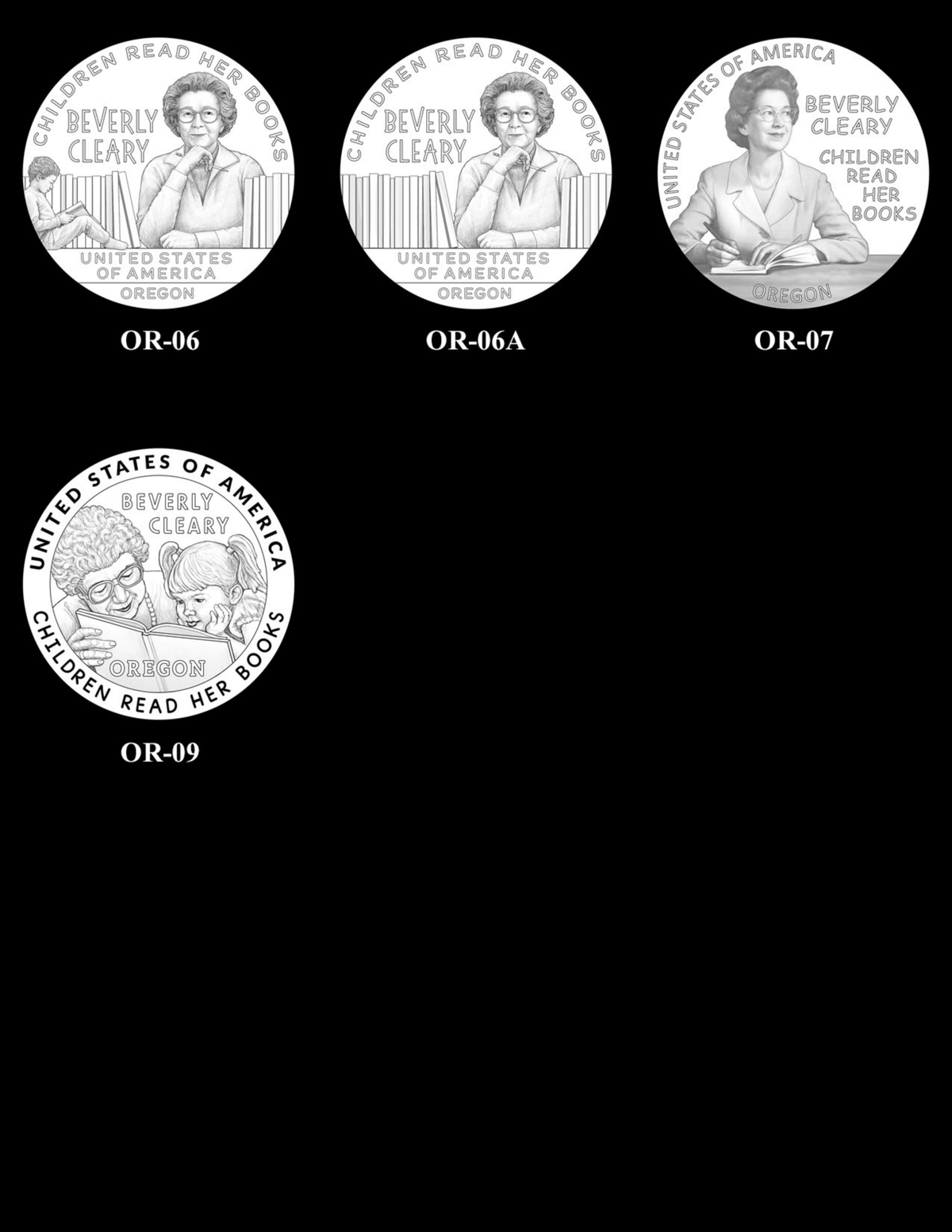
OR-06A: The winning Oregon design, scoring 20 out of 27 points (reflecting the number of voting members present at this session). Beverly Cleary (1916–2021) was one of the most beloved children's authors in American literary history, creating the characters of Ramona Quimby and Henry Huggins in a Portland, Oregon neighborhood setting that generations of young readers recognized as their own. Both the State of Oregon and the Cleary family expressed a preference for this design derivation, making OR-06A the natural selection.
Beverly Cleary's innovation is not mechanical or scientific — it is the innovation of making ordinary childhood life the subject of literature worth reading. Her books sold over 91 million copies, have been translated into 29 languages, and remain in print more than 70 years after their first publication. The Newbery Medal, the National Book Award for Lifetime Achievement, and the Library of Congress's Living Legend designation all recognized what readers already knew: that Cleary changed how American children saw themselves in fiction.
Kansas: Jack Kilby and the Integrated Circuit
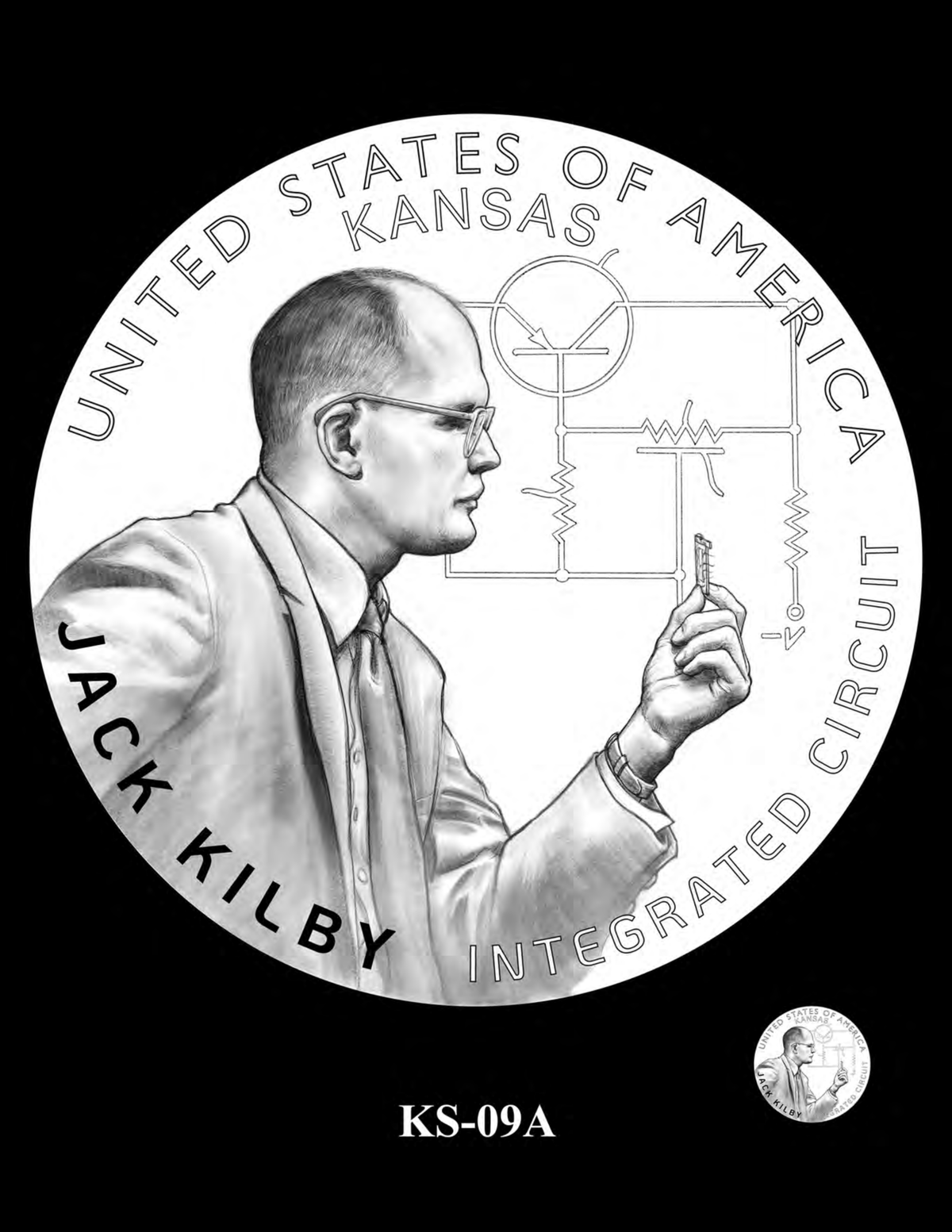
KS-09A: The winning Kansas design, scoring 23 out of 27 points — the second-highest score of the session. Jack Kilby (1923–2005) invented the integrated circuit on July 12, 1958, at Texas Instruments — one of the most consequential technological achievements of the twentieth century. The design shows Kilby's profile alongside integrated circuit imagery. The Kilby family endorsed this design.
Kilby was born in Jefferson City, Missouri, but grew up in Salina, Kansas and returned to the state throughout his career — his Kansas roots are the basis for his representation in this program. The integrated circuit he invented at Texas Instruments forms the foundational architecture of every semiconductor device made since 1958: every smartphone, every computer, every medical device. Kilby received the Nobel Prize in Physics in 2000 — more than four decades after the invention — for work whose importance only became clearer with time. He shared the Nobel with Herbert Kroemer; Robert Noyce, who independently developed a practical version of the integrated circuit, had died before the Nobel could be awarded to him jointly.
West Virginia: The Robert C. Byrd Green Bank Telescope
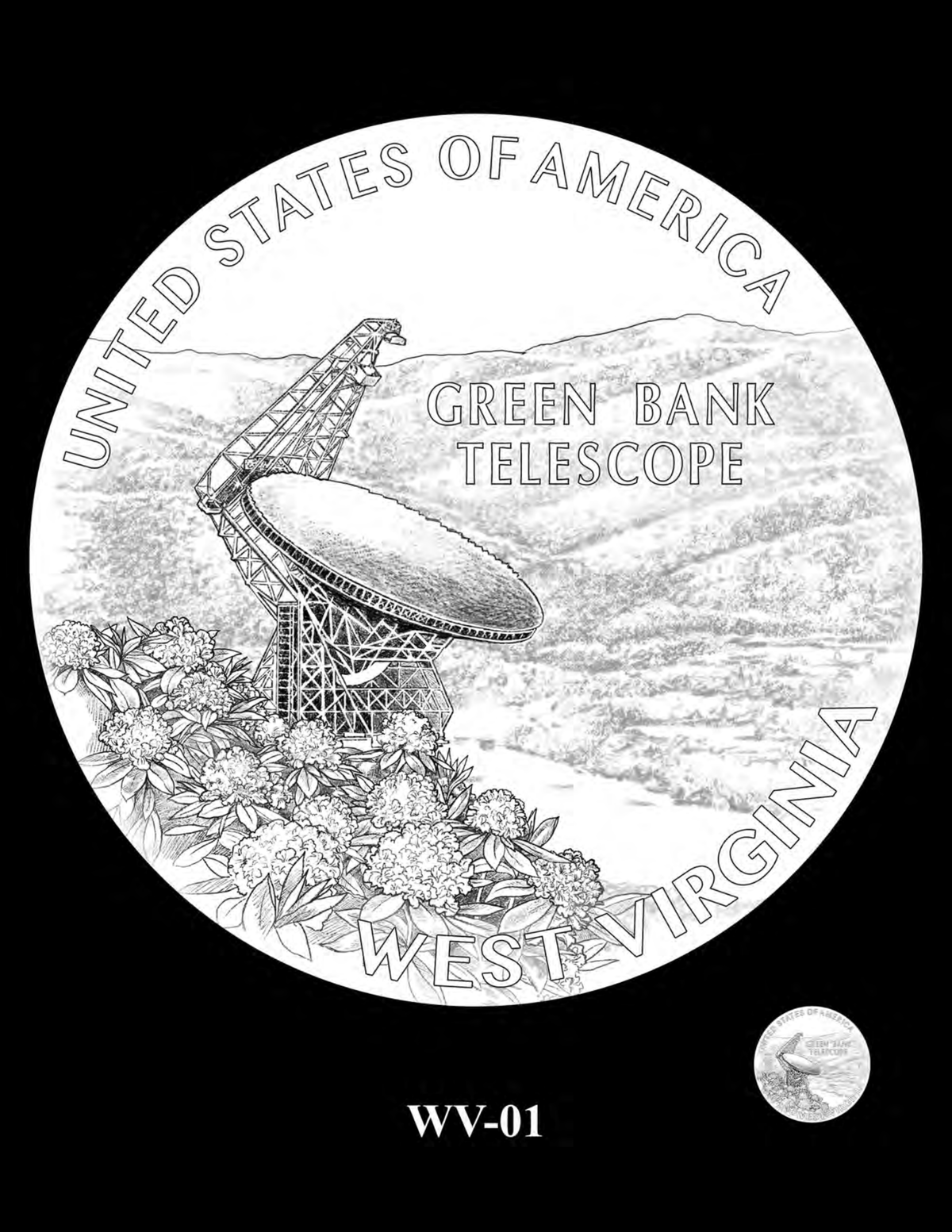
WV-01: The winning West Virginia design and the highest-scoring design of the entire April 21 session, scoring 25 out of 27 points. The Robert C. Byrd Green Bank Telescope (GBT) in Green Bank, West Virginia, is the world's largest fully steerable radio telescope. A motion to enlarge the telescope's depiction in the design was considered during the meeting but rejected after Chief Engraver Joseph Menna explained the artistic and technical constraints involved in rendering fine structural detail at dollar coin scale.
The Green Bank Telescope is a remarkable instrument: its dish is 100 meters by 110 meters (the equivalent of roughly two football fields), it weighs 17 million pounds, and it can be pointed at any position in the sky — unlike fixed or partially movable telescopes of similar size. The GBT operates in the National Radio Quiet Zone, a federally protected area where most radio transmissions are restricted to prevent interference with sensitive astronomical measurements. West Virginia's contribution to radio astronomy is genuine and enduring, and the GBT represents American scientific infrastructure of world significance.
Nevada: Copper-Riveted Clothing
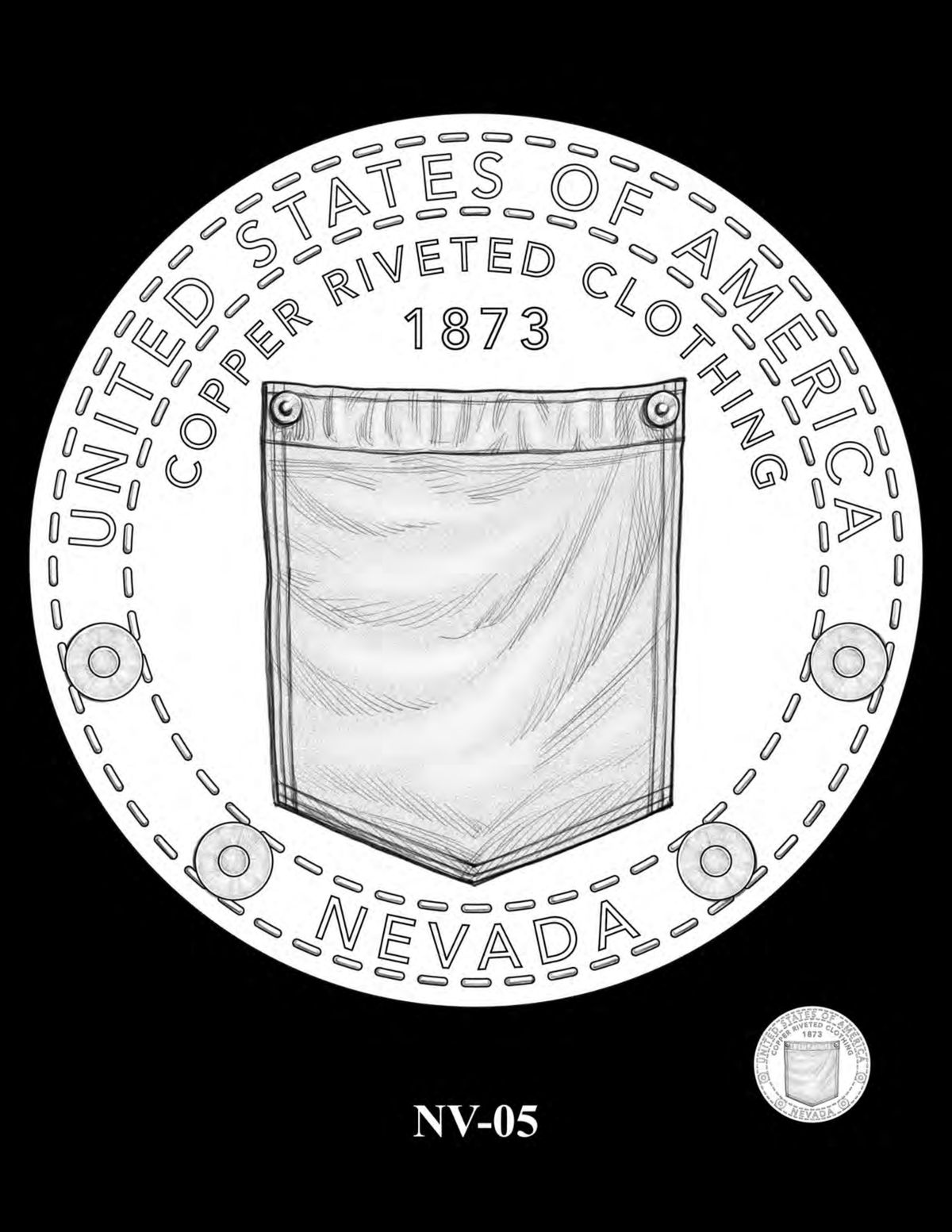
NV-05: The winning Nevada design, scoring 12 out of 24 points — the most contested selection of the session, with 6 abstentions. The design honors the 1873 patent for copper-riveted clothing issued to Jacob Davis and Levi Strauss in Reno, Nevada — the founding document of blue jeans. The CCAC acknowledged openly that this was a challenging concept to render on a coin. The 6 abstentions reflected the difficulty of the visual translation, not opposition to the Nevada innovation itself.
The innovation being honored is specific and historically significant: on May 20, 1873, the U.S. Patent Office issued Patent No. 139,121 to Jacob W. Davis and Levi Strauss for "Improvement in Fastening Pocket-Openings" — the copper rivet reinforcement of pants pockets that became the defining feature of denim work pants. Davis was a tailor in Reno, Nevada; Strauss was his San Francisco fabric supplier. The patent was Davis's idea, but he lacked the money to file for it and proposed a partnership with Strauss. The result was the blue jean, which went on to become arguably the most universally worn garment in human history. Reno's connection to this story — through Davis's Nevada tailoring shop — is the basis for Nevada's representation in the Innovation Dollar program.
The Program's Broader Context
The American Innovation Dollar program runs from 2018 through 2032, ultimately honoring innovations from all 50 states, the District of Columbia, and five U.S. territories. The 2027 coins represent the program's middle years, with the series well established and collectors familiar with its patterns.
The four 2027 innovations span an unusually wide range of human endeavor:
- Literature: Beverly Cleary's contribution to children's reading (Oregon)
- Electronics: Jack Kilby's invention of the integrated circuit (Kansas)
- Astronomy: The Green Bank Telescope's role in radio astronomy (West Virginia)
- Manufacturing and fashion: The riveted denim patent that created blue jeans (Nevada)
This breadth is characteristic of the program at its best — honoring the full spectrum of American creative and scientific achievement, from the practical to the transcendent, from the individual genius to the institutional infrastructure. The common Statue of Liberty obverse unifies these diverse subjects under a single American symbol.
For collectors of the Innovation Dollar series, explore the American Innovation Dollars in the NumisDex catalog.
0 Replies
Related Threads
- Trade Dollars: The Only US Coin the Government Disowned0 replies · 1w ago
- The Dollar Coin: Eleven Designs, 232 Years, and a Country That Still Won’t Use Them0 replies · 1mo ago
- 2026 American Innovation Dollars: Iowa, Wisconsin, California, and Minnesota0 replies · 3mo ago
- The $10 Million Dollar: When Did Your Dollar Series Begin?0 replies · 4mo ago
- Morgan Dollars: Why America's Most Collected Coin Still Captivates0 replies · 4mo ago