
Commemorative Coins: 134 Years of One-Off Designs, Congressional Horse-Trading, and the Coins That Almost Killed the Program
134 Years of Special Issues
The United States has been striking commemorative coins since 1892 — special issues authorized by Congress to mark historical events, honor notable Americans, and (less nobly) funnel surcharges to politically connected organizations. What started as a dignified tribute to the Columbian Exposition became, by the 1930s, a vehicle for coin dealers and special interest groups to lobby Congress for low-mintage collectibles. The program was shut down in 1954 out of sheer embarrassment, revived in 1982, and has been running ever since — with guardrails.
The Classic Era (1892–1954)
The First: 1892 Columbian Exposition Half Dollar
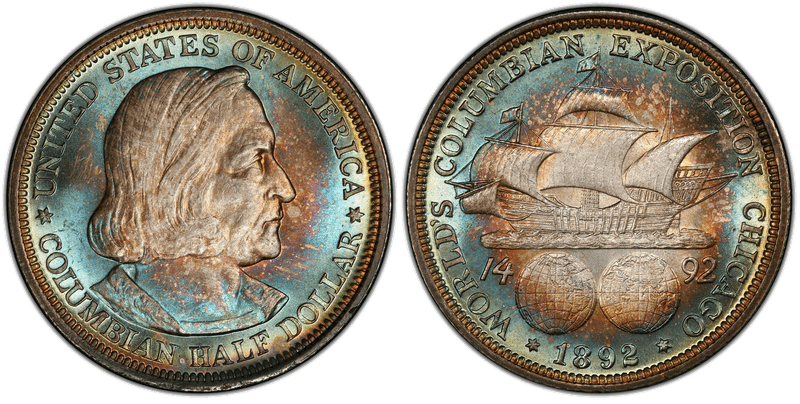
The first US commemorative coin, struck for the World's Columbian Exposition in Chicago. Designed by Charles E. Barber (obverse, Columbus portrait) and George T. Morgan (reverse, Columbus's ship the Santa Maria above two hemispheres). The Exposition sold them at $1 each — double face value. Over 2.5 million struck for 1892-dated pieces, making it one of the most common classic commemoratives. This coin established the template: a special design, a limited authorization, and a surcharge benefiting the sponsoring organization.
The Isabella Quarter — First and Only Commemorative Quarter
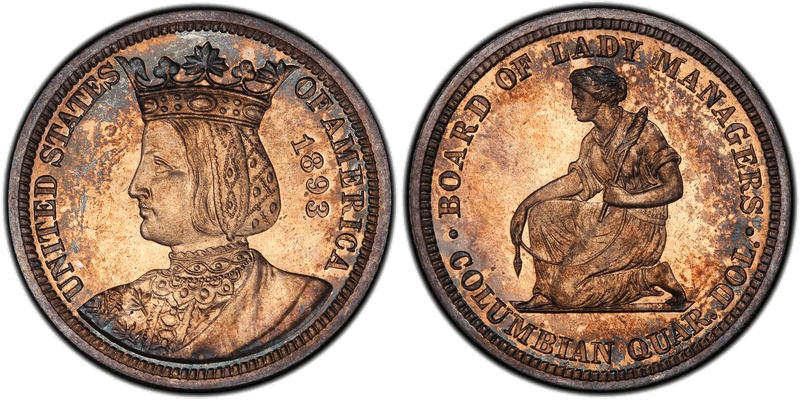
The 1893 Isabella Quarter is the first and only commemorative quarter dollar struck before the modern era. Produced for the Board of Lady Managers of the Columbian Exposition, with just 24,214 pieces. Queen Isabella of Spain appears on the obverse — the first foreign monarch depicted on a US coin. No other commemorative quarter was authorized for over 80 years.
The Classic Gold Commemoratives
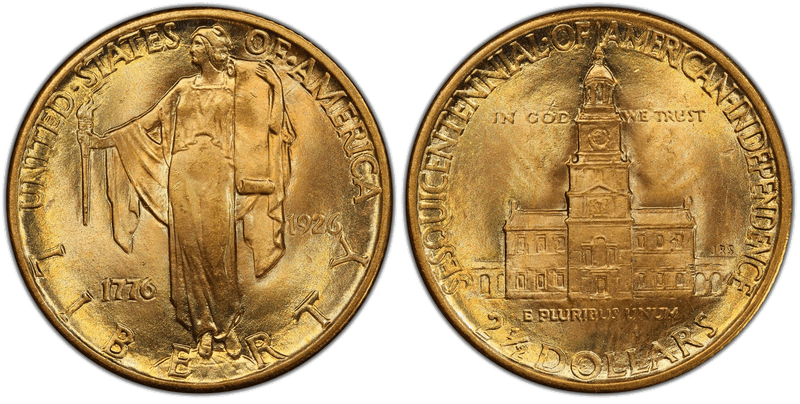
Congress also authorized gold commemoratives during the classic era. The 1903 Louisiana Purchase gold dollars (Jefferson and McKinley portrait types), the 1915-S Panama-Pacific issues (including the legendary $50 octagonal and round pieces — the most valuable classic commemoratives), and the 1926 Sesquicentennial quarter eagle ($2.50) shown above. Classic gold commemoratives are among the scarcest and most valuable coins in the entire series.
The Panama-Pacific $50 — The Crown Jewel
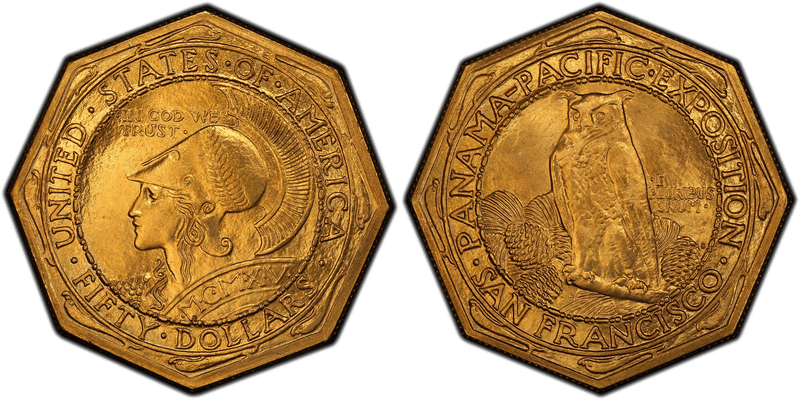
The 1915-S Panama-Pacific $50 pieces are the crown jewels of classic commemoratives. Struck in both round and octagonal formats for the Panama-Pacific International Exposition in San Francisco, these massive gold coins had a mintage of just 1,510 octagonal and 1,509 round pieces. They remain among the most valuable US coins ever struck — survivors regularly trade for six figures. The octagonal shape was inspired by California's pioneer gold coins of the Gold Rush era.
The Abuse and the Shutdown (1920s–1954)
Congressional Horse-Trading
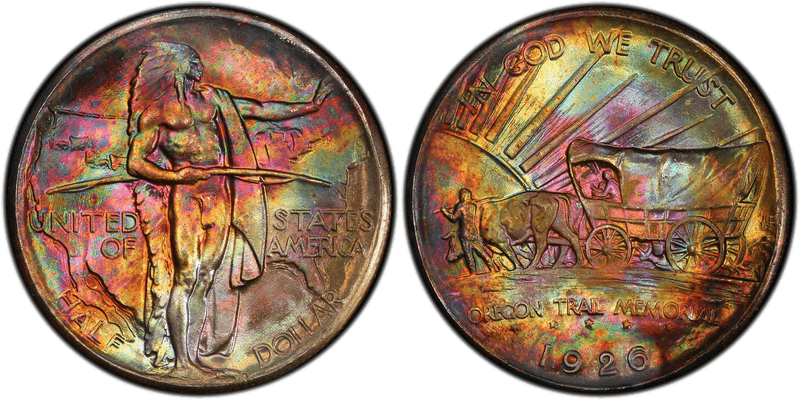
By the late 1920s, the commemorative program had become a vehicle for congressional pet projects and coin dealer speculation. Dozens of half dollars were authorized for increasingly obscure causes — the Elgin, Illinois centennial, the Norfolk, Virginia bicentennial, the Cincinnati Musical Center (which had no actual anniversary to commemorate). Coin dealers lobbied for multiple mint-mark variants of each issue to multiply the collectible set.
The Oregon Trail half dollar (shown above) was reissued almost annually from 1926 to 1939, with different mint marks and dates each year, creating an ever-growing and expensive collector set. The Texas Centennial half dollar did the same from 1934 to 1938. The 1936 program alone produced 25 different commemorative half dollars — more than in any other year before or since.
The Treasury Department began publicly criticizing the program. President Roosevelt recommended limiting future commemoratives. By the late 1940s, new authorizations had slowed to a trickle.
The Shutdown (1954)
The last classic commemorative — the 1954 Carver-Washington half dollar — marked the end of an era. Congress effectively froze the program. No new commemorative coins would be authorized for 28 years.
The Modern Era (1982–Present)
The Revival
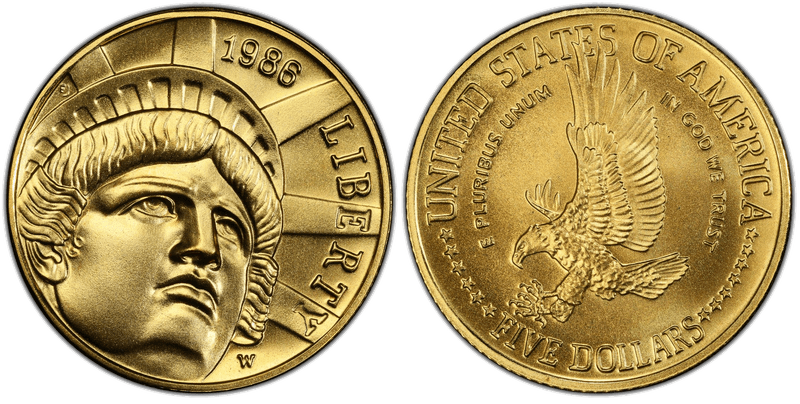
Congress revived the commemorative program in 1982 with a half dollar honoring George Washington's 250th birthday. The modern program established new rules: surcharges go to designated organizations, total mintage is limited, and designs require Treasury Department approval. The 1986 Statue of Liberty program (shown above: the $5 gold coin) was the first modern gold commemorative, paired with a silver dollar and clad half dollar. Combined mintage across all three coins exceeded 15 million pieces — a commercial success that ensured the program's continuation.
The Innovation: Bimetallic and Curved Coins
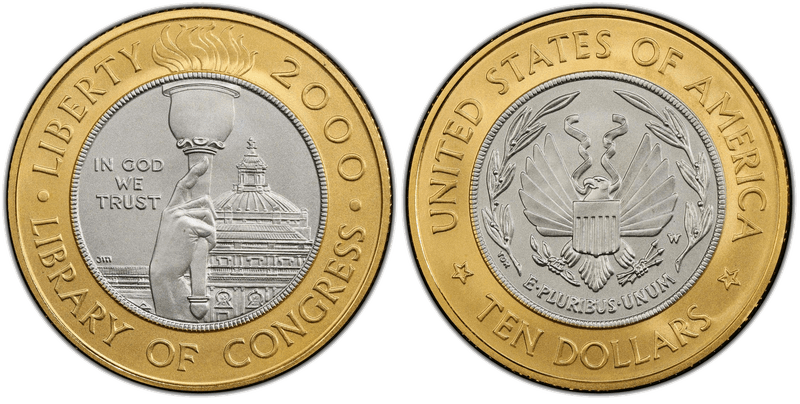
The 2000 Library of Congress $10 is the first bimetallic coin issued by the United States Mint — gold and platinum fused together. A technical achievement in coin production that has not been repeated on any subsequent US issue. The design by John Mercanti features the torch of learning on the obverse and an eagle clutching a laurel wreath on the reverse.
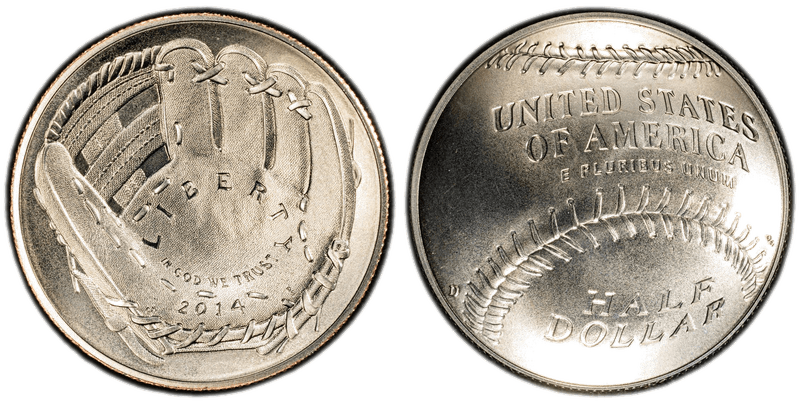
The 2014 Baseball Hall of Fame coins introduced another first: a curved (concave/convex) shape. The obverse is concave — shaped like a baseball glove — while the reverse is convex, shaped like a baseball. The technical challenge of striking a curved planchet required new production methods at the Mint. The design became immediately iconic, and the curved format has since been used for other commemorative programs including the 2019 Apollo 11 50th Anniversary coins.
Why Commemoratives Matter
Commemorative coins are where the Mint takes design risks. Regular-issue coinage changes rarely — the Lincoln cent has had Brenner's portrait since 1909, the quarter had Washington from 1932 to 2022. But commemoratives get new designs every time. They are the experimental wing of US coinage: the place where the Mint tests new shapes, new metals, and new artistic approaches that would never be approved for circulation strikes.
They are also a window into what America chose to commemorate — and who had enough political pull to get a coin authorized. The 1936 commemoratives tell you as much about Depression-era political horse-trading as they do about American history. The modern program tells a different story: controlled authorization, genuine historical significance, and designs that push the boundaries of what a coin can be.
The Denominations
Classic commemoratives were struck primarily as half dollars (over 50 different issues from 1892 to 1954), with a handful of gold dollars and quarter eagles. The modern program expanded the range:
- Clad and Silver Half Dollars — the most affordable modern commemoratives, continuing the classic half-dollar tradition
- Silver Dollars — the most common modern format, struck in 90% silver
- $5 Gold Coins — struck since 1984, typically the premium piece in a multi-coin program
- $10 Gold Coins — rare, including the 2000 Library of Congress bimetallic and the 2003 First Flight Centennial
- $25 and $50 Gold Coins — the newest denominations, authorized for recent programs
Browse the full commemorative catalog on NumisDex: Classic and Modern Commemoratives.
Related Reading
- Gold Coins: Six Denominations, One Executive Order, and the Most Beautiful Coin Ever Made — the regular-issue gold coins that classic commemorative gold pieces were struck alongside
- The Half Dollar: From America's Workhorse Coin to Its Rarest Pocket Change — the denomination that carried the vast majority of classic commemoratives
- The Dollar Coin: Eleven Designs, 232 Years, and a Country That Still Won't Use Them — the most common denomination in the modern commemorative program
- The Quarter: America's Most Collected Coin — home of the Isabella Quarter, the first and only classic commemorative quarter