
When a Die Dies: How Cuds Form and Why Every Stage of Failure Is Collectible
CudEvery coin you've ever held was made by two dies -- an obverse die and a reverse die -- slamming together under 35 to 150 tons of force. A single die might strike 200,000 to 500,000 coins before it's retired. But some dies don't make it that far. They break.
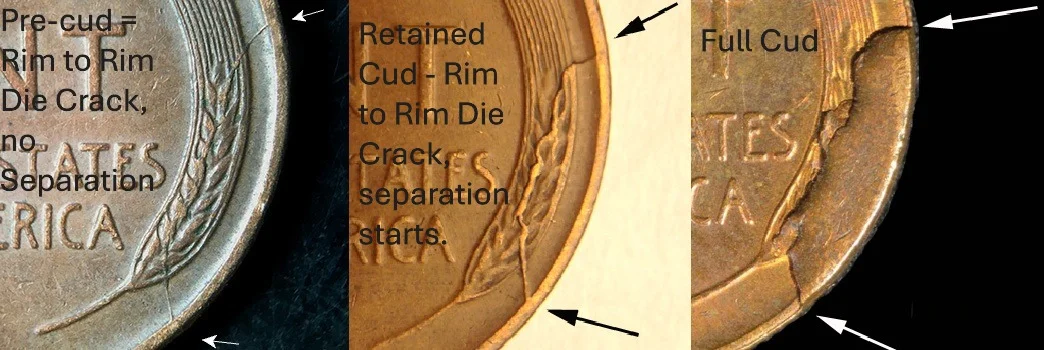
The lifecycle of a cud — from pre-cud (die crack reaching the rim) to retained cud (partially detached metal) to full cud (missing die chunk leaving a blank area)
When a piece of the die breaks away at the rim, it leaves a raised, featureless blob on every coin struck after the break. That blob is called a cud.
Cuds are one of the most visually dramatic die errors in numismatics. They're also one of the most collectible -- because they tell the story of a die's death, and every stage of that death is documented and sought after by collectors.
The Life and Death of a Die
A die doesn't go from perfect to broken overnight. The failure follows a predictable sequence, and collectors actively seek examples from each stage:
Stage 1: Die Cracks
Hairline fractures develop in the die face from repeated striking. On coins, these appear as fine raised lines running across the surface. Die cracks are common and usually modest in value, but they signal that the die is starting to fail.
Stage 2: Pre-Cud (Advanced Die Cracks)
The cracks extend to the rim and begin to deepen. The die fragment is starting to separate but hasn't detached yet. On coins, the crack area may appear wider or slightly raised. Pre-cuds are scarcer than simple die cracks because the die is usually caught and replaced before reaching this stage. Collectors who track die states prize them.
Stage 3: Full Cud
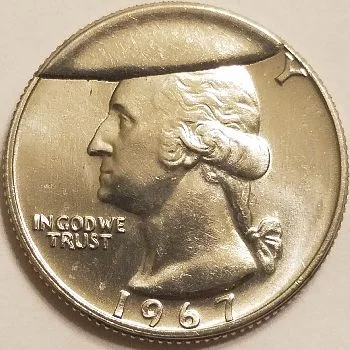
A dramatic full cud — the die chunk broke away completely, leaving a featureless raised area on the coin's rim
The die fragment breaks away completely. With that section of die missing, struck coins show a raised, blank area where the design should be. The cud is level with or slightly above the rim. The larger the missing piece, the more dramatic the cud -- and the more valuable the coin.
Stage 4: Retained Cud
Sometimes the broken fragment doesn't fall away. Instead, it stays loosely in place, shifted slightly from its original position. Coins struck in this state show a raised area with partial or displaced design elements -- a cud with ghost design inside it. Retained cuds are scarcer than full cuds and highly sought after.
Stage 5: Shattered Die
If the Mint doesn't catch the die in time, multiple cracks can propagate until the entire die face is a web of fractures. Coins struck by a shattered die show a spider web pattern of raised lines across the entire surface. Full shattered dies are rare because the Mint's quality control usually catches the die before this stage.
How to Identify a Cud
| Feature | What to Look For |
|---|---|
| Location | Always at the rim. If it's in the interior, it's an interior die break, not a cud. |
| Texture | Smooth or slightly rough. No design detail in the cud area. |
| Elevation | Raised above the field, sometimes above the rim itself. |
| Boundary | Clear demarcation line where the cud meets the normal design. |
| Opposite side | The side struck by the intact die may show weakness or distortion in the area opposite the cud. |
What Affects a Cud's Value?
- Size: A cud covering 10-20% of the coin is a "major cud" and commands a serious premium. Small rim blebs are common and modestly valued.
- What it covers: A cud that obliterates the date, mint mark, or a recognizable portrait feature is worth more than one in a blank area.
- Die state: A full die state progression set (same die pair: die crack → pre-cud → full cud) is the holy grail for cud collectors.
- Denomination and date: Common-date Lincoln cents and Jefferson nickels with cuds are affordable. Early copper (large cents, half cents) with cuds command substantial premiums.
Where to Find Cuds
Cuds are one of the most accessible die errors for new collectors. You can find them:
- Coin roll hunting: Lincoln cents, Jefferson nickels, and Roosevelt dimes are the most productive denominations for modern cud searching.
- Mint sets: Uncirculated mint sets occasionally contain cud varieties, often in better condition than circulation finds.
- Dealer inventory: Common cuds on modern coins can be purchased for modest prices. Major cuds on popular dates command more, but the entry-level prices are friendly.
The website cuds-on-coins.com maintains one of the most extensive cud registries, and many of these documented varieties are cataloged on NumisDex.
Why Cuds Matter
Cuds are more than blobs on coins. They're forensic evidence of the minting process -- physical proof that these coins weren't made by machines that run perfectly every time. Every cud tells you something specific: where the die fractured, how far the failure progressed, and how many coins were struck after the break before someone noticed.
For new collectors, cuds are an ideal entry point into error collecting. They're visually obvious (you don't need a loupe to spot a major cud), they're somewhat affordable, and they're findable in rolls. For advanced collectors, the die state progression from crack to cud offers a research-driven collecting challenge that goes beyond simply owning a coin.
Learn more about cuds and related die errors on NumisDex:
- [Cud (CUD)](/learn/die-damage-family/cud)
- [Die Break (DBK)](/learn/die-damage-family/die-break)
- [Pre-Cud (PCD)](/learn/die-damage-family/pre-cud)
- [Retained Cud (RCD)](/learn/die-damage-family/retained-cud)
Explore in the NumisDex Catalog
Related varieties and errors from the NumisDex database:
0 Replies
Related Threads
- Spiked Heads: When the Portrait Grows a Horn0 replies · yesterday
- 50c-2026-D-DBK or DIC0 replies · 1w ago
- Split Dies: When the Die Comes Apart0 replies · 2w ago
- What Is a BIE Error on a Lincoln Cent, and Is It Worth Anything?0 replies · 3mo ago
- Die Crack vs. Die Chip vs. Cud: How to Tell Them Apart0 replies · 3mo ago