
When Melt Value Exceeds Numismatic Premium: What Happens to Common-Date Silver Coins
The Vanishing Premium
For most of numismatic history, a common-date Morgan dollar was worth significantly more than its silver content. Collectors paid for the design, the history, and the collecting experience — the "numismatic premium" above melt. But with silver averaging $67-68 per ounce in mid-2026 (and having spiked to $121 in January), something has shifted: for many common-date silver coins, melt value now accounts for 80-95% of the coin's total market price.
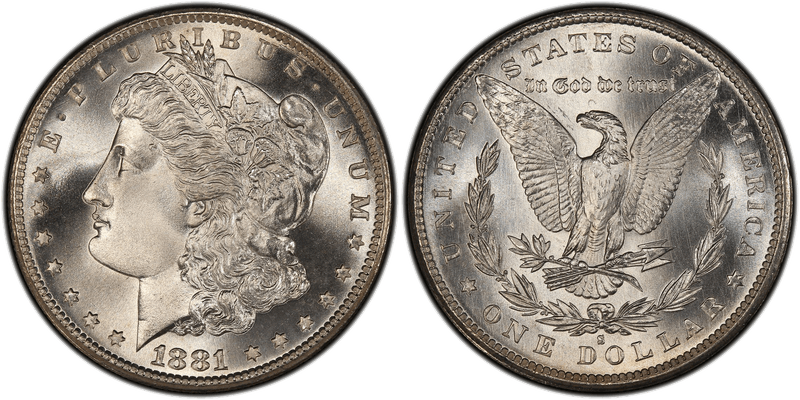
The 1881-S Morgan Dollar — one of the most common dates in the series. View in the NumisDex catalog.
The Math
A pre-1965 U.S. silver coin contains 90% silver. Here's what that means at various price levels:
| Coin | Silver (troy oz) | Melt @ $30/oz | Melt @ $67/oz | Melt @ $121/oz |
|---|---|---|---|---|
| Morgan/Peace Dollar | 0.7734 | $23.20 | $51.82 | $93.58 |
| Walking Liberty Half | 0.3617 | $10.85 | $24.23 | $43.77 |
| Washington Quarter (pre-1965) | 0.1808 | $5.42 | $12.12 | $21.88 |
| Mercury/Roosevelt Dime | 0.0723 | $2.17 | $4.84 | $8.75 |
At $30 silver, a common Morgan dollar might sell for $35-40 — with roughly $12-17 of numismatic premium above melt. At $67 silver, that same coin sells for $55-65, but now only $3-13 of that is numismatic premium. The premium hasn't disappeared entirely, but it's been compressed dramatically.
What This Means for Collectors
For buyers:
- Common-date silver coins are currently poor values as collectibles. You're paying mostly for metal, not numismatic content.
- If silver corrects, the coin's value drops proportionally — unlike a key date, which has a floor based on rarity.
- The silver premium on "junk silver" bags ($1,000 face value bags of circulated pre-1965 coins) has thinned to near zero in many markets. Dealers are selling at or just above melt.
For sellers:
- If you have common-date silver coins you don't value as collectibles, the current market offers historically excellent exit prices.
- Dealers are actively buying common silver at or near spot — something that wasn't always true when silver was $20.
For variety and error collectors:
- This is actually a favorable environment. Error and variety premiums are independent of metal prices. A doubled die or RPM on a common-date silver coin may be relatively cheaper compared to the base coin than during low-silver periods.
Historical Perspective
This isn't the first time melt has dominated. During the 1979-80 silver spike (when the Hunt Brothers drove silver to $49.95), massive quantities of circulated silver coins were melted — permanently reducing the surviving population. If today's elevated prices persist, the same attrition will occur, eventually making survivors of common-date silver coins less common than they are today.
Browse Morgan Dollars and Walking Liberty Half Dollars in the NumisDex catalog.
0 Replies
Related Threads
- Rosa Parks Commemorative Coins: HR 916 Would Honor a Civil Rights Icon0 replies · 2mo ago
- Olympic Coins for LA 2028 and Salt Lake City 2034: S. 2265 Explained0 replies · 2mo ago
- The End of the Penny: What HR 4459 (MINT Act) Means for Collectors0 replies · 2mo ago
- The $2.50 Coin Is Coming Back: What Collectors Need to Know About HR 56160 replies · 2mo ago
- U.S. Mint Releasing 250,000 Special "July 4th" Privy Mark Declaration of Independence Quarters0 replies · 2mo ago